Archives for April 2014

Gathering of Nations PowWow 2014

Gathering of Nations PowWow

April 24-26, 2014

University of New Mexico Arena “The Pit”
Avenida Cesar Chavez Blvd. SE
(Hwy. 25, exit #223)
Albuquerque, New Mexico, USA
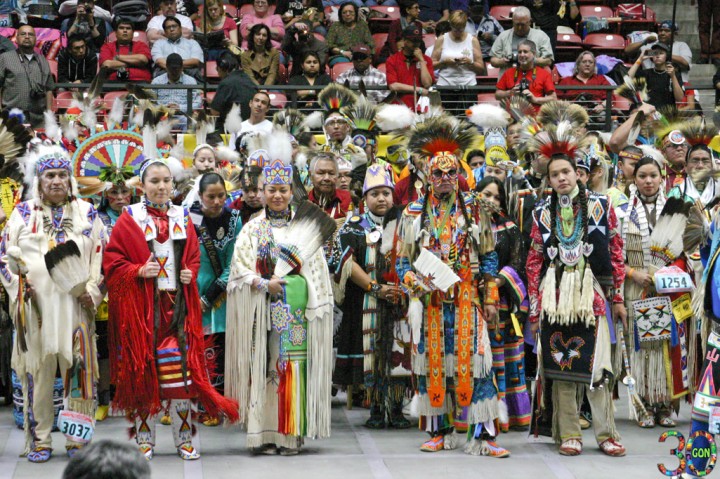
Gathering of Nations Grand Entry

SCHEDULE OF EVENTS

April 26th, 2014 – Saturday

Registration for Dancers & Singers Open. 9:00 am

Will Call for Advance Tickets Purchases Open.
Bullet Doors Open to the Public. 10:00 am

Pre-Powwow Performances on Arena Floor & Stage 49.
Bullet Drum Roll Call 11:45 am

Grand Entry of Dancers – Invocation
Bullet Hand Drum Contest (Saturday Afternoon ONLY) NOON –  3:00pm
Competition Dancing for Golden Age, Juniors & Teens Categories, Tiny Tots Contest (Saturday Only!)
Bullet Drum Contest.

Red Thunder Rolling Motorcycle Riders Arrive 2:00 pm
Bullet Specials Contests, Giveaways & Honoring the 2014

Gathering of Nations Head Dancers. 3:00pm

Final Gourd Dance. 5:00pm

Bullet Final Grand Entry of Dancers – Invocation 6:00pm
Final moments for Out-Going 2013-2014 Miss Indian World Kansas K. Begaye 7:00pm
Bullet Crowning of the New Miss Indian World 2014-2015.

Announcement 2014 GON Elders, Tiny Tots, Golden Age &  Junior Winners. 8:00pm – ?
Bullet Competition Dancing & Singing continued for Adult Categories and Drum Contest Continues.
Announce 2014 GON Teens, Adults & Drums Winners.

Live Stream

The Americans and the Navajo

1848 – 1868  Americans and the Navajo

Mexico and the United States of America signed the Treaty of Guadalupe Hidalgo on February 2, 1848 ending the Mexican War. Mexico, having lost the war, was forced to give up half of its homeland that included Texas, New Mexico, Arizona, Colorado, Utah, Nevada, and California.

Navajo Chief Manuelito with his brother Chief Cayetanito

Navajo Chief Manuelito with his brother Chief Cayetanito 1865

The Navajo homeland was part of this vast trade of land. Navajos now come under the hands of the U.S. government instead of a distance Mexican authority

The Diné people, had previously been under a distant Mexican authority. Now they were forced to negotiate with the American authorities for their own land and water, as the U.S. Army’s horses and mules were using the Navajos’ best water sources and grazing lands.

After the treaty of Guadalupe Hidalgo was signed, the U.S. government took over lands in New Mexico and faced the problem of making peace with the Navajos. Raiding had become a way of life for the Navajos. The raiding which the Navajos carried out against the Pueblo and Mexican villages was done for dependent food needs, material goods and captives to sell, or use as slaves. The killing of Pueblos or Mexicans except in some instances of revenge, was entirely incidental acquiring goods and animals.

The U.S. government sent General William Kearney to Indian country to try to settle the disputes and raidings. He found the various ‘Pueblos from Taos to’ Zuni as well as the Mexican people.anxious to all themselves with the White Americans for a vigorous war against the Navajos. The General did not want war.

He thought the Navajos were a united tribe and went out to have the Navajo leaders sign a peace treaty.  Treaties were signed but not carried out for the few leaders, such as Zarcilla Largo, and Narbona who did sign, did not have power over. the whole Navajo nation.

Earlier treaties had been signed with the Ute Indians to the north of Navajo country and these were kept, allying the Utes with the White Americans. Raids by various Navajo clans continued in much the same way as before the treaty. During the next three years, five military expeditions were launched into Navajo country to control Navajo raiding. These expeditions were often guided by “enemy” Navajos, Utes, Zunis and other Pueblos. These expeditions were not successful and the raiding In 1849, at the mouth of Canyon De Chelly, Colonel Washington I, found three Navajo leaders who’ were again willing to talk peace.

And at Chinle another treaty was signed. Although· this treaty was ratified by the United States Congress it too, was not honored. and raids continued as before. The war department and the Territory of New Mexico together decided that the Navajo raids could not be settled with treaties and that direct forcible control of the Navajos would have to be undertaken.

A military post of four companies of cavalry, one of artillery, and two of infantry was established. The site ,in the heart of Navajo country but west or the area of the heaviest concentration of Navajos, and later came to be called’ Fort Defiance.

The Navajos’ regarded this as an invasion of their country but at first they offered to direct resistance to the companies of soldiers permanently stationed at the Fort Indian agents were sent into Navajos country by the Department of the Interior. The first worked out of Jemez, but,in 1853, the second one established himself at Sheep Springs northwest of Fort Defiance, and went to work to persuade Navajo leaders to be peaceful.

He had great success with Zarcilla Largo who continued to, be a power among many Navajos. Another Indian agent, Henry Linn Dodge, brought a Blacksmith to his agency and began teaching the navajo how to work with metal.

Dodges personal, efforts with’ Navajo Leaders resulted in a period of peace. In 1850′ Dodge was killed by Apaches on a trip to the South and trouble developed between ,men of the Army post and Navajos in the area.

In 1858, the Post commander regulated a large area of grazing land solely for the use of any horses. Navajo sheep and horses were’ now excluded from what had long been an important pasture. To enforce the regulation, which the Navajos regarded as a ruthless appropriation of land, Navajo horses and sheep found on the pasture were shot. This cause more hostile feelings among the, Navajo.s and a Negro slave belonging to the post commander was, killed in retaliation.

Zarcilla Largo, who was regarded by the soldiers as a “head chief” of the Navajos, was ordered to give up the murderer. He tried to settle the ‘matter in accordance with Navajo custom, by paying blood money but this was refused, and the post commander set out to punish the Navajos for not complying with-his order.

During the negotiations Sarcillos Largos, a “young chief, of great sagacity and boldness, stood up and replied to the American Commander (Doniphan) said: ‘Americans! You have a strange cause of war against the Navajos. We have waged war against the New Mexicans for several years. We have plundered their villages and killed many of their people, and made many prisoners. We had just cause for all this. You have lately commenced a war against the same people. You are powerful. You have great guns and many brave soldiers. You have therefore conquered them, the very thing we have been attempting to do for so many years. You now turn upon us for attempting to do what you have done yourselves. We cannot see why you have cause of quarrel with us for fighting the New Mexicans on the west while you do the same thing on the east. Look how matters stand. This is our war. We have more right to complain of you for interfering in our war, than you have to quarrel with us for continuing a war we had begun long before you got here. If you will act justly, you will allow us to settle our own differences’.”

Three successive expeditions marched against the Navajos with no results except the killing of a few peaceful Indians. Finally, another treaty was signed by a group headed by a man called Herrero. The White Americans appointed him head leader in place of Largo. This treaty as the others, had no effect, and throughout the year 1859, the soldiers continued their campaign to stop Navajo raids:

The expeditions covered the whole territory lived in by Navajos, from Zuni northward to the San Juan River and from Mount Taylor westward to Marsh Pass. Navajos were impressed with the fact that the White Americans had enlisted the aid of all neighboring Indians, enemy Navajos, Utes, ,Zunis, Hopis and other Pueblos, to act as scouts for them but no surrenders were made by Navajos and raids continued. Despite the show of White American ” strength, the reaction of the majority of the Navajos was not to sue for peace,but rather to drive the Americans out of their country.

Invasion of the Navajo territory at Fort Defiance was resented, and trouble with the troops there festered hatred. Navajos leaders, like Herrero and others who had once tried for peace, now joined forces for an attack on Fort ,Defiance. In April 1860, attack was made by the Navajo war leaders “and carried out with a force of more’ than two thousand warriors armed more with bows and arrows. The artillery of the soldiers proved to be too much for the Navajos and after a two hour battle many were badly injured or killed.

The attempt made by the Navajos to drive the White Americans out  of their territory ‘failed, and the raiding continued. After the attack on Fort Defiance, the raiding spread as far east as Santa Fe and as far south as Zuni, the renewed vigor of the raids led New Mexicans to organize for retaliation. In, a short time they took one hundred Navajo prisoners, mostly women and children as slaves. It was reported about this time that there were as many as five to six thousand Navajo slaves living with families in the New Mexico villages.

Although they were defeated at Fort Defiance, it began to appear to the Navajos that the White Americans were weakening. In 1861, the  Fort was abandoned and troops were withdrawn except for a small force at Fort Fauntleroy (later to: be known as Fort Wingate).

The U.S. Civil War was drawing the attention of the government elsewhere and for two years it appeared to ‘the Navajo War leaders that they were succeeding in their attempts to get rid of the White Americans.

However, as Union troops gained control of the New Mexico territory,ra determined effort was launched to keep open the lines of communication with the far west. This resulted in an order to destroy at all costs’ the Navajo threat to white settlers.

More History of the Navajo

Ancient Navajo and Native Americans Migrations
First Contact with the Navajo – 1540
The Americans and the Navajo
The Mexicans and the Navajo
The Spanish and the Navajo
Navajo Long Walk to Bosque Redondo
Antonio el Pinto Chief of the Navajos

The Mexicans and the Navajo

Mexicans and  Navajo History 1821 – 1848

THE MEXICANS
Mexico declared independence from Spain.
Treaty of Cordova between Spain and Mexico dated August 24, 1821, and in the Mexican Declaration of Independence, proclaimed September 28, 1821. The capital was kept in of Santa Fe, New Mexico.

 Santa Fe New Mexico 1848

Painting of the Mexican capital in  Santa Fe New Mexico 1846


The Mexicans became the bitterest enemies of the Navajo. The former were the mixed-blood descendants of the Spanish and the Indians. Spanish and American accounts report with horror the slaughter by Mexicans of Navajo who came peacefully to trade, or the slaughter of innocent Mexican traders by the Navajo. No matter what the case, a war of reprisal was necessary–either to steal what had been left behind, or to avenge murder.

The Mexicans were forced to abandon several cities because of the Navajo attacks; and generally it was conceded that the Navajo were better warriors than the Mexicans. Eaton (1854), an American officer, sorely maintained that the Navajo were not good warriors, but that they seemed so because the Mexicans were cowards. The Mexicans called the Navajo their slaves, and scornfully declared that they furnished them (the Mexicans) with good weavers, whom they could sell to the Spanish at a high price. The Navajo stole the Mexicans’ sheep, but refrained from completely annihilating the enemy because, so they said, they wished to leave a few as shepherds to raise more flocks for the Dene.

SLAVERY
The Navajo stole hundreds of slaves from the Mexicans and the native tribes. In turn they also lost some of their tribesmen to Mexican raiders. Intelligent and industrious Navajo women who knew how to weave were highly prized. A beautiful and healthy girl of eight was sold for as high as $400 worth of horses and goods. Poor people frequently sold orphans or their own children for a horse or an ox. It was once estimated that there were from 2000 to 3000 Navajo working as slaves in Spanish or American families (Commissioner of Indian Affairs, Report of 1867:325 ff.). Children born to the Navajo women who were Spanish slaves had the rights of citizens and free men.

The Navajo treated their slaves well, although there was no hesitation in killing them when ritual duties required the sacrifice. Two slaves were given the duty of preparing and burying a corpse, after which they were killed on the grave. Slaves were sometimes adopted into a family; they married Navajo, and their descendants might form a new clan. That “slave” clans existed, the Navajo admit, but no one will acknowledge that his clan was founded by captives. (Reichard, 1928:15; Ethnologic Dictionary, 1910:424).

1846 June 21 – The “Army of the West” consisting of 1648 men and commanded by Colonel Stephen Watts Kearny, was mobilized of regulars and volunteers at Fort Leavenworth, Kansas, and departed that place on this date for Santa Fe where, in a bloodless coup, New Mexico, then in possession of Mexico, came under the dominion of the United States. Included in the army were Colonel Alexander William Doniphan and Major Edward Vose Sumner, figures later prominent in the destiny of the Navajos.
Aug 15 – At Las Vegas, Kearny addressed the populace from one of the housetops, saying, in part: “ … I have come amongst you by orders of my government, to take possession of your country, … Henceforth I absolve you from all allegiance to the Mexican government, and from all obedience to General Armijo. He is no longer your Governor; … I am your Governor …

Aug 18 – Kearny and his Army of the West entered Santa Fe at 6 p.m., occupying the capital of New Mexico without “ … firing a gun or shedding a drop of blood”

The Treaty of Guadalupe Hidalgo
The peace treaty signed in 1848 in Guadalupe Hidalgo between the U.S. and Mexico that ended the Mexican–American War .
It gave the United States the Rio Grande boundary for Texas, and gave the U.S. ownership of California, and a large area comprising New Mexico, Arizona, Nevada, Utah, and parts of Wyoming and Colorado.

The Spanish and the Navajo

History of the Spanish and the Navajo

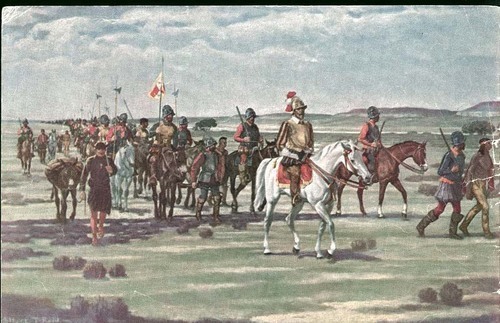
The first account in history of the Spaniards arrival in the Southwest dates back to 1540 when Coronado and his expedition came in search of gold and riches. Unsuccessful, they returned to Spain empty handed.

coronado_expedition

The Spaniards succeeding visit to the Southwest had other intentions. They wanted to resettle, indoctrinate and civilize the Indians by converting them to Catholicism. Through their efforts they wanted to teach the Indians a better way of life.

The Spaniards did, indeed, meet one objective. They took the best farm lands and resettled in Indian territory. Their second objective failed. Although Missions were established and Indians did attend services, they were not converted to Catholicism. The third objective was met to an extent. The Indians absorbed the Spanish culture and. used it to their,advantage, but they did not let the Spaniards influence their beliefs and philosophy of life.

Spanish and the Navajo

When the Spaniards arrived in the Southwest, they brought with them domestic animals such as cows, horses, and sheep. They also brought with them guns and tools, which were all new to the Indians.

The presence and depredations of the Spaniards were to totally change the world of the Navajos. Within ten years after the arrival of the Spanish colonists in 1598 the Navajos had obtained sheep, cattle and horses from pueblo Indians who escaped from the Spaniards, taking the cattle, horses and sheep they were tending with them, and sought refuge among the Navajos.

The first impression the Indian had of the Spaniards was ‘that they were Gods.
Later, their impression changed dramatically when the Spaniards settled on their best farm lands and left their families homeless, and used Indians as slaves and servants. Those who served as slaves learned many of the Spani~h ways.
They learned how to build’ adobe homes using molds . They learned to grind wheat to make bread, as well as how to ride horses and care for domestic animals. At the same time the Spaniards learned from the Indians. They were introduced to foods made from corn and corn meal.

This went on for many years and the Indians grew weary. They resented the Spanish invaders. They wanted them out of their territory. They no longer wanted any part of them. So in 1680, all the Indian tribes acted together to drive the Spaniards out; and this they did.

After 1700 the Spanish found the Navajo to be an ever growing scourge because of their raids and alliances. The tribe always managed to be at peace with some tribes, while it fought and raided others. They feared only the Utes, who had learned war in the Plains area. Once the Plains tribes acquired the horse, they developed Indian warfare into an art. The annual efforts of the Spanish to break up alliances and outwit the Navajo are reported in the letters of the Spanish governor de Anza, 1777-87. (Thomas, 1932). These efforts were fruitlessly continued until, in 1846, the United States relieved the Spanish of the Southwest and their Navajo problem.

By the end of the 1700’s the Navajos had drifted farther west into the Canyon de Chelly area. New settlements were established. By 1776, the region lying between the Rio Grande Pueblos and the Hopi village was known to the Spaniards as “Providence of the Navajos” and a new way of life for the Navajos began.

By this time, the Navajos had acquired thousands of sheep and horses they were more mobile and they could farm to a greater extent and their tribe was growing in number.

In 1800, Antonio Pinto died. He was a Navajo leader who was Instrumental to some extent in keeping the peace between the Spaniards and Navajo. After his death the Navajos relied heavily on raiding the villages of New Mexico for sheep and horses. The Spaniards raided for the purpose of acquiring captives as laborers and household, servants, and by this time hundreds of Navajo women and children were living in Spanish homes as servants.

Hostilities grew deeper and deeper and the Navajos rebelled by not only raiding the Spanish settlements, but other Indian tribe settlements as well. The other Indian tribes appealed to the Spaniards for help and in 1818 a treaty was signed by one band of Navajos·whom the Spaniards had defeated once before.

The Treaty failed because once again there was no one leader for all the Navajo clans. Raiding continued for several more years. The Navajo way of life was greatly influenced by the Spaniards during this period.

Navajos remained free from all military, political, and ecclesiastical control. They continued to acquire items of Spanish material culture through their systematic harassment of the settled Spanish and Pueblo villages but their social and political organization remained unchanged.

More about Navajo History:


20th Annual Heritage Language Conference

Heritage Language Conference

Theme: “Father Sky, Mother Earth”

San Juan School District
Friday, April 11, 2014

20th Annual Heritage Language Conference

Conference Agenda

7:30 AM REGISTRATION AND CONTINENTAL BREAKFAST
8:00 AM GENERAL ASSEMBLY
8:30 AM KEYNOTE SPEAKER #1 Rex Lee Jim, Vice President, NN
9:45 AM KEYNOTE SPEAKER #2 Steve Darden
11:00 AM BREAK-OUT SESSION #1
12:00 PM LUNCH (provided)
1:00 PM BREAK-OUT SESSION #3
2:00 PM BREAK-OUT SESSION #4
3:15 PM EVALUATIONS / CERTIFICATES

Teachers are encouraged to attend any hands-on workshops that will be going on throughout the day with the STEAM Maker Expo that the USU Blanding Campus is hosting in conjunction with our conference.

PDF File of Conference Agenda

Registration Form 2014

In addition to the programs and activities listed in the attachments, please join us for a Thursday evening, pre-conference taco dinner, traditional dancing, and star gazing party! Thursday evening activities will take place at USU Blanding Campus Arts and Events Center outdoor plaza.
Navajo tacos and dancing from 5:00 pm until 7 pm (Taco Dinner hosted by IEC; dancers from San Juan School District and Desert Mountain Navajo Dancers)
Star gazing and program with Moab’s Red Rock Astronomer, Alex Ludwig, from 7:30 – 9:30 pm

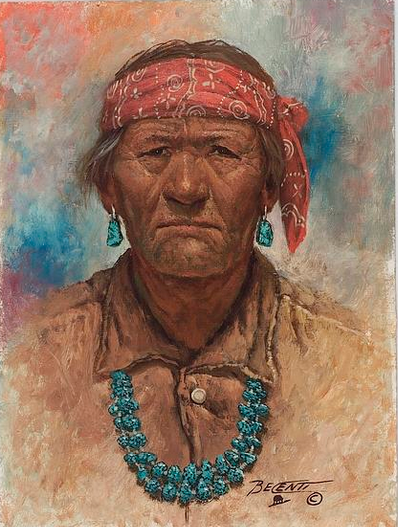
Antonio el Pinto Chief of the Navajos

Chief of the Navajos from 1783 – 1793

Antonio el Pinto Hashke’ likízhí (Speckled Warrior)

By  Robert Becenti 1978  Diné (Navajo)

By Robert Becenti 1978 Diné (Navajo) 
Courtesy of National Museum of the American Indian

On August 24, 1777, the Viceroy of New Spain appointed Anza as the Governor of the Province of Nuevo México, the present day U.S. state of New Mexico.

Governor de Anza led a punitive expedition against the groups of Native Americans, who had been repeatedly raiding Taos.

Governor de Anza in a new ploy to help control the Navajos , selected a chief whom the Spanish had named Antonio el Pinto (apparently because of his “speckled complexion), gave him the title of “general,” and paid him to keep other Navajos from raiding the Spanish settlements. The new “general” was given silver medals, several saddles, roles of cloth and sacks of food, which he no doubt enjoyed to the fullest. But he had no influence whatsoever over the other Navajo war chiefs and their bands of professional raiders, so the raids continued.

1785 June 25 – It was reported that after June 25, 1785, the Navajos made two more campaigns (against the Gila Apaches) and sent 14 leaders to Santa Fe, … One, the very famous Antonio (el Pinto), had been the mainspring of the Navajos reluctance to declare war upon the Gilas. But he now sought the Governor’s pardon and promised future devotion, and on the next expedition against the Gilas, to be made in August, to assist with as many Navajos as possible.

To recompense Antonio el Pinto and his volunteers, de Anza agreed to furnish each one of the auxiliaries who presented himself an almud (about 6 bushels) of pinole, mounts to carry them, and two head of cattle for the total of them, because Antonio had indicated to him (de Anza) that without this aid they could not subsist the length of time required on our expeditions.  De Anza requested of the Comandante General Jose Antonio Rengel that four canes with silver points be sent him with an equal number of medals as insignia … ” for Antonio el Pinto and the other three chiefs who had accompanied him to Santa Fe.

July 15 & 17 – Fourteen Navajos, including four captains, came to see Governor de Anza and offered to continue making war on the Gila Apaches. On July 27, a captain and six Navajo warriors from the rancheria of Guadalupe north of Mt. Taylor made the same offer.
It was reported to de Anza that ” … although these Indians (Navajos) know well the advantage of having us (Spaniards) as friends and the ruin which would come to them by obliging us to declare war upon them, this does not yet save from them fear of the Gilas and the repugnance they feel in sacrificing to our friendship the ancient ties of kinship and alliance which they have maintained with them.

In this opinion, Captain Antonio (el Pinto) fortifies and assures them because he is the one who has been most opposed to the Spaniards and has made himself respected among the others because of his great riches, and large number of relatives and partisans.

De Anza was instructed to continue his efforts to dissolve the Navajo-Gila Apache alliance, and to aid him the Comandante General stated that he was sending a number of horses and mules and 200 firearms with corresponding munitions for the equipment of the militia, settlers and Navajos who attend the campaigns. He further advised de Anza to insure the friendship of the Utes ” … so that by no means may they permit the said enemies (Navajos) to approach or take refuge in their territories … ”

1786
June 8 – Navajo “General” Don Carlos and his Lt. Don Jose Antonio, the interpreter, and seven others arrived in Santa Fe. Don Carlos reported that ” … he had visited all the rancherias of his dependency, where he was received and recognized with universal applause; … ”

The interpreter who had been placed among the Navajos by de Anza reported that the tribe consisted of 700 families of four or five persons each and that there were five divisions, San Mateo, Cebolleta, Canon, Chuska, and de Chelly; that there were 1000 warriors possessed of 500 horses, and Navajo possessions also consisted of 600 mares with young, 700 black ewes, and forty cows with bulls and calves.

Don Carlos lamented a recent epidemic which he attributed to lack of trade with New Mexico which the Governor had closed to them. He also reported that Antonio el Pinto had been deposed as Chief of the Navajos ”

The Comandante General authorized a payment of 200 pesos annually to “General” Don Carlos, Navajo Chief ” … elected with the consent of all the nation … ” and approved by Governor de Anza, and of 100 pesos annually to his Navajo Lieutenant, Don Jose Antonio, to secure their fidelity to the Spaniards and their continued break of alliance with the Gila Apaches.

Ugarte also proposed that the Navajos ” … organize themselves into formal settlements or Pueblos and devote themselves to cultivating the soil in order to induce them to abandon their wandering way of life.”

Regarding the Navajo Chief, Antonio el Pinto, Ugarte wrote de Anza: “If previous facts justify this concept, your lordship will search for the most secure and prudent means of destroying this individual or exiling him from his country without which the complete pacification of this (Navajo) nation will never be secured.”

1787
September – A number of Navajos accompanied a Spanish expedition against the Gila Apaches. Other Navajos made a raid on Abiquiu.
October – A small party of Navajos raided the Rio Abajo. Also, Antonio el Pinto and some of his tribesmen went to Isleta to trade. He was seized by the Alcalde and taken to Santa Fe, where he was held pending orders from the Commanding General of the Provincias Internas. The head chief of the Navajo, as well as many others of the tribe, hastened to Santa Fe to plead with the Governor, Fernando de la Concha, for his release

In April of 1788, Antonio was freed, for Governor Concha had become convinced of his innocence and of his value as a friend and ally to the Spanish cause. The old Navajo headman had been imprisoned twice under the same charge.

1788
Jan 14 – Governor Don Fernando de la Concha, who succeeded de Anza,
April 12 – After Antonio el Pinto was released from imprisonment on April 4, 1788, Governor Concha ordered Vizente Troncoso, one of his officers, and an escort of four soldiers, to accompany the well-known Chief to his ranchería and to verify his arrival there. On his return Troncoso made a lengthy report to the Governor on his observations of the customs and behavior of the Navajos. He wrote: “… we soon arrived at the houses which, five in number, are situated on a plain that is formed in the slope of the mountain (the San Mateo Mountains west of the Rio Puerco), so that it is necessary to climb by a very steep hill. As soon as reached the top Antonio’s parents and brothers (and sisters?) came out to receive me … He (Antonio) had them bring in his stock, killed the largest sheep and offered as much as I and the soldiers might want. All the rest of the morning all the headmen and residents of the nearby

Nov 12 – Governor Concha reported to Ugarte, Señor Comandante-General de Provincias Internas, the “… excellent footing wich we find ourselves at present with the Navajos …” which promised permanent peace between the Navajos and the Spaniards. He also reported how, under the Navajo Chief Antonio el Pinto, the tribe had constructed ten rock towers or fortifications within their encampments to safeguard their women and children from the continuous invasions by the Gila Apaches. He also recommended that the Navajos be established in permanent villages. Governor Concha concluded finally that Antonio el Pinto should be given the title of “General”.

1793
Oct 26 – Antonio el Pinto, Head War Chief of the Navajos, died at his hogan near Guadalupe, New Mexico, of wounds received from a Gila Apache raiding party which he and other Navajos had pursued into the San Mateo Mountains. After killing two of the enemy, he had been shot in the right shoulder by an Apache arrow. After his death, a Navajo war party accompanied by Ute and Jemez allies, set out to avenge the old Chief’s death.