Archives for January 2015

Honeeshgish, or Fire Poker

A Navajo Legend

The Honeeshgish, or fire poker, is sacred to traditional Navajo. They believe that the Holy People blessed it and gave it to the Dinè to use in their fireplaces, their homes, and their ceremonies.

Story told by: Don Mose, Jr.
Illustrated by: Molly Trainor

Based on sketches by Don Mose, Jr.
Culture Consultant: Clayton Long & Brenda Whitehorse
Editing and layout by: Kathryn Hurst

Also see:

Ms. Coyote and Doe – A Navajo Tale

Coyote, Bobcat and the Corn

Father Sky and Mother Earth- A Navajo Legend

Owl and Woodpecker – A Navajo Tale

You can order a printed copy of the book from:

San Juan School District
Heritage Language Resource Center
28 West 200 North
Phone: 435-678-1230
FAX: 435-678-1283
Store Hours: 9:00 – 4:30
Monday through Thursday
Email: rstoneman@sjsd.org

Online order at this Website: media.sjsd.org

We accept purchase orders, credit cards, and checks.
We bill only for items shipped and actual cost of shipping.
Personal orders ship after payment is received.
Please estimate 10% of purchase total for shipping cost.

Ms. Coyote and Doe

A Navajo Tale

Story told by Don Mose, Jr.
Illustrated by Molly Trainor

Based on sketches by Don Mose, Jr.
Culture Consultant: Clayton Long & Brenda Whitehorse
Editing and layout by: Kathryn Hurst

Also see:

Coyote, Bobcat and the Corn

Father Sky and Mother Earth- A Navajo Legend

Owl and Woodpecker – A Navajo Tale

You can order a printed copy of the book from:

San Juan School District
Heritage Language Resource Center
28 West 200 North
Phone: 435-678-1230
FAX: 435-678-1283
Store Hours: 9:00 – 4:30
Monday through Thursday
Email: rstoneman@sjsd.org

Online order at this Website: media.sjsd.org

We accept purchase orders, credit cards, and checks.
We bill only for items shipped and actual cost of shipping.
Personal orders ship after payment is received.
Please estimate 10% of purchase total for shipping cost.

The Navajo Four Cardinal Directions

East – Ha’a’aah

South – Shádi’ááh

West – E’e’aah

North – Náhookos

1-4a Forth World

East – Ha’a’aah

Dawn, birth, beginning of life, a new beginning of each day.  Goal setting visualizing, conceptualizing, and  developing mental strength capabilities.
Realization,creativity, reasoning, awareness,developing ideas,and forming opinions.
Develop good memory skills and sensitivity. Intellectual development and  becoming innovative.

North – Náhookos

Darkness mysteriousness – aging process spiritual wholeness – confidence – reflection – competency –  evaluation. Questioning. Full implementation in strategic planning, goal setting, implementing, reviewing and revising an evaluation, display mental strength and emotional stability, comfortable living, understanding, lifetime learning and living well. Obtaining a sense of balance with self and surrounding surroundings. Obtaining strong mental stability.

South – Shádi’ááh

Planning identify resources, gather information, analyze-express emotional stability, understanding,  identity capabilities and possibilities.
Becoming creative, understanding, generosity, care through understanding of key. Understand I love, emotional stability. Develop awareness of good health and the importance of eating healthy foods daily exercise. Third, the importance of self-sufficient. Self-support, self-governance. Recognize your role and responsibilities in the clan, and extended family and community

West  E’e’aah

No parental role and responsibilities. No purpose of living no family values and principles, no primary and extended family, clan members-use correct term – the terminology in relationships, no appropriate behaviors and acceptable attitude. Make positive relationships and teasing. No accomplishments and implementation, production, results, construct and revise life goals and objectives, missionary person. Active in family social activities as well as general community concen..

The dawn is assigned to, and indicates, the east, the Skyblue the south, the evening twilight the west, and darkness the north.

Hence, the symbolic color of the east is white, that of the south blue, of the west yellow, of the north dark or black. In consequence sand paintings, for instance, of the sacred mountains are decorated in these colors, Sisnajini (Pelado Peak), white, Tsodzil (Mt. Taylor), blue Dookoslid (San Francisco Mountains), yellow, Debentsa (San Juan Mountains), black.

Sacrificial stones, too, are assigned according to the color of the direction: white shell (yolgai), to the west, cannel coal (bashzhini), to the north, red-white stone (tselchii), to the center.

Sources:
An Ethnologic Dictionary of the Navaho Language; 1910, The Franciscan Fathers.
Reichard (1950:187-203)
Navajo Nation Department of Diné Education


Navajo Constellations Lesson 1

Navajo Language Lesson and  Video

Navajo Language Lesson links

Clayton Long – Instructor
Clayton Long YouTube Channel
Navajo Language Lessons Page
Navajo Language Lessons YouTube Channel
Navajo People Language Page
Heritage Language Resource Center
Harold Carey Jr – Computer Teacher

Coyote, Bobcat and the Corn

A Navajo Legend

Story told by Don Mose, Jr.
Illustrated by Molly Trainor

Coyote, Bobcat and the Corn


Cultural Note
According to Navajo tradition, this is a
winter tale. Coyote stories should only be
told in the winter time.

Also see:

Father Sky and Mother Earth- A Navajo Legend

Owl and Woodpecker – A Navajo Tale

You can order a printed copy of the book from:

San Juan School District
Heritage Language Resource Center
28 West 200 North
Phone: 435-678-1230
FAX: 435-678-1283
Store Hours: 9:00 – 4:30
Monday through Thursday
Email: rstoneman@sjsd.org

Online order at this Website: media.sjsd.org

We accept purchase orders, credit cards, and checks.
We bill only for items shipped and actual cost of shipping.
Personal orders ship after payment is received.
Please estimate 10% of purchase total for shipping cost.
The View Campground & Cabins

An Outdoor and Indoor Oasis

The View Campground


By Roberta John

MONUMENT VALLEY – It’s all about the mystical view.
That is the view of Monument Valley Navajo Tribal Park here on the northern outskirts of the Navajo Nation.
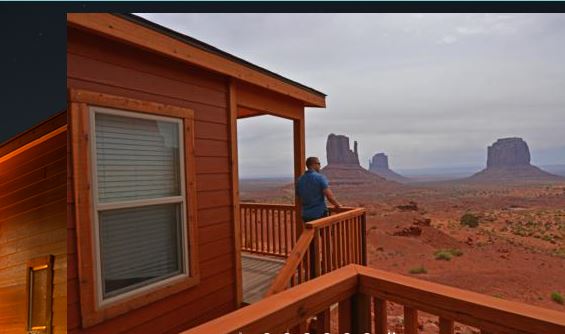
For the past several years, visitors have had an opportunity to wake up to the soothing rays of the sun overlooking towering chestnut-colored rock formations at Monument Valley Navajo Tribal Park from their room at The View Hotel – the only hotel in the world that is located in Monument Valley.
However, owners of The View Hotel Armanda and Art Ortega, soon learned there are also visitors who want to connect with Mother Earth yet still be able to embrace the warm welcome of early morning dawn from a whole new level. Visitors who revel in outdoor adventure yet want a haven where mother nature abounds and wake up to a feeling of openness.
With that concept in mind, the Ortegas planned and designed a multi-dimensional campground, which is called The View Campground while the cabins at the campground are called “The Cabins at The View.” Located just north of The View Hotel, The View Campground has 29 separate cabins that authenticate a cultural retreat and vintage peaceful pleasure.
And whether you’re talking about scenery or The View Campground, it echoes the spiritual solitude and calmness of the valley.
“The view captivates what we want visitors to see and experience,” said Armanda Ortega. “It just seemed appropriate to name our hotel and now our new RV campground using the word view.”
The word view has proven to be an effective marketing tool for Armanda who is the president of her company called Shadi’i’ Co. Shadii means older sister in Navajo.
Most visitors who visit Monument Valley are so amazed that they often come back for a second visit.
The View Campground also includes 30 RV spots and 30 wilderness campsites, which attracts outdoor enthusiasts who want to capture the essence of rustic living and a dust of authentic Navajo history.
Thanks in large part to Armanda and her father Art’s creative ingenuity, there is an abundant amount of options for lodging at Monument Valley from their perfectly located accommodation called The View Hotel and now The View Campground & Cabins at The View.

The View Cabins

Photos courtesy of The View Campground & Cabins

The cabins have a rustic look on the outside to imitate a natural age pantina, but have a warm and timeless realm of western nostalgia on the inside.
No expenses were spared….giving this ranch-like campground a sense of legacy and retreat.
Armanda explained that the RV spots are dry and the cabins are fully furnished and equipped just like a private hotel room.
In traditional Navajo culture, touching Mother Earth is a form of healing and medicine so it was important to design the rooms with a ground level ambiance and give visitors a down-to-earth experience.
The RV campground has full shower facilities with restrooms, WIFI and access to all of The View Hotel amenities including discount breakfast at The View Restaurant.
Armanda explained that since they are still in their first year of operation, many visitors did not know there was a RV campground or cabins at Monument Valley until they arrived.
“We are working to change that very quickly,” she commented.

The View Cabins
The Navajo-owned company hired up to 20 people during the peak of the tourism season in the summer. The View Campground was completed in June 2014; however, there are additional plans for improvement.
“It is a work in progress,” Armanda added. “We are working behind the scenes to help visitors enjoy the magnificent beauty and wonder of Monument Valley Navajo Tribal Park. However, we know the true beauty of this valley are the Navajo people who are the cultural treasures and an integral part of this world-renowned attraction.”

The View Cabins
Navajo Nation Parks and Recreation Department Manager Martin L. Begaye reverberated his support of The View Campground, noting, “We are very pleased that there is a multi-use RV campground and cabins here within Monument Valley Navajo Tribal Park. The new addition has helped create new jobs for the local Navajo people and provide a new avenue for visitors to experience the unique solitude that can only be found here at Monument Valley. The View Campground has also helped increase visitation to Monument Valley Navajo Tribal Park and increased revenues that will help maintain and improve the park. Lastly, The View Campground also allows visitors to stay longer.”
The View Campground…where the stay is as important as the view.
A place to bask in the quiet and hear the sound of nothingness.
The perfect retreat to hear silent whispers of Navajo culture.
For more information about The View Campground or The View Hotel, contact them at www.monumentvalleyview.com
www.theviewcampground.com
www.cabinsattheview.com

Trotting Coyote Poster

Coyote or Ma’ii is an important character in the creation stories of the Dinè (Navajo).

Trotting Coyote Poster

Coyote the trickster is both good and evil. Cunning and confusing he refers to everyone as his cousin, animals and humans alike.

Each winter we tell our children Coyote stories so they can learn lessons from his mistakes and misadventures and avoid those pitfalls in their lives.

His mistakes, foibles, curiosity, and misadventures have brought both good and evil to the Dinè. His stories teach us about ourselves and what we should leave alone.

11″ by 17″ Poster $2.00
18″ by 22″ Poster $6.00

You can order from:

San Juan School District
Heritage Language Resource Center
28 West 200 North
Phone: 435-678-1230
FAX: 435-678-1283
Store Hours: 9:00 – 4:30
Monday through Thursday
Email: rstoneman@sjsd.org

Online order at this Website: media.sjsd.org

We accept purchase orders, credit cards, and checks.
We bill only for items shipped and actual cost of shipping.
Personal orders ship after payment is received.
Please estimate 10% of purchase total for shipping cost.

My Body – Navajo Language Lesson

I’m speaking about my body

Shits’íí´s Baa Hashne’

The Holy Beings Teach the Twins

I’m am one of the  Earth Surface Holy People

Video by Clayton Long

Navajo Language Lesson links

Clayton Long – Instructor
Clayton Long YouTube Channel
Navajo Language Lessons Page
Navajo Language Lessons YouTube Channel
Navajo People Language Page
Heritage Language Resource Center
Harold Carey Jr – Computer Teacher

Owl and Woodpecker – A Navajo Tale

A Navajo Legend

Story told by Don Mose, Jr.
Illustrated by Molly Trainor

Owl and Woodpecker - A Navajo Tale

To the Navajo, the owl is a bearer of bad news. When an owl appears, it may be a warning that something terrible is about to happen. When a traditional Navajo sees an owl, he ppecker – A Navajo Talerays for intervention, protection, and guidance.

You can order a printed copy of the book from:

San Juan School District
Heritage Language Resource Center
28 West 200 North
Phone: 435-678-1230
FAX: 435-678-1283
Store Hours: 9:00 – 4:30
Monday through Thursday
Email: rstoneman@sjsd.org

Online order at this Website: media.sjsd.org

We accept purchase orders, credit cards, and checks.
We bill only for items shipped and actual cost of shipping.
Personal orders ship after payment is received.
Please estimate 10% of purchase total for shipping cost.

Also see:

Father Sky and Mother Earth- A Navajo Legend

Coyote, Bobcat and the Corn

The Navajo Four Sacred Colors

Color In Navajo Life And Beliefs

Color has many symbolic meanings in Navajo culture; in fact, a single color can mean several different things depending on the context in which it is used. Four colors in particular black, white, blue, and yellow have important connections to Navajo cultural and spiritual beliefs. These colors represent the four cardinal directions.

Color Navajo Symbolic Associations Chart copy

The Navajos define their homeland as the area between four sacred mountains in each direction, so each color represents a sacred mountain as well. Thus, among their myriad other meanings, the colors black, white, blue, and yellow link the Navajos to their ancestral homeland and the story of its creation.

The Navajos define their homeland as the area between four sacred mountains in each direction, so each color represents a sacred mountain as well.

Thus, among their myriad other meanings, the colors black, white, blue, and yellow link the Navajos to their ancestral homeland and the story of its creation.

  • Black, which associated with north, also symbolizes Dibé Ntsaa (Hesperus Peak), in what is now southwestern Colorado.
  • White, which represents east, is connected to Sisnaajini (Blanca Peak), in what is now south-central Colorado.
  • Blue, is connected with south and Tsoodzil (Mount Taylor), northeast of Grants, New Mexico.
  • Yellow,  is associated with west and Dook’o’oosliid (the San Francisco Peaks), near Flagstaff, Arizona

The Navajo Sacred Mountains Poster

COLOR

Black

While

Blue

Yellow

DIRECTION

North

East

South

West

TIME OF DAY

Night

Dawn

Day

Dusk

In the Emergence, the Navajo creation story, First Man took four stones.

  • jet, which represents black;
  • white shell, which symbolizes white;
  • turquoise, which is tied to blue; and
  • abalone, which represents yellow

—and placed them at the four directions.

He blew on the stones four times and they grew into a hogan. For the Navajos, the hogan is more than simply their traditional form of shelter; it has sacred meanings and still plays a vital role in Navajo spiritual and community life. In the story of the Emergence, First Man’s hogan became the world. First Man also created the four sacred mountains in this world.

These are just two examples of the four colors in the Navajo creation story; myriad other references to color appear throughout this and other Navajo traditions. Given their many connections to Navajo tradition, these four colors are an important part of the way culture and spirituality is passed from one generation to the next. One venue for the transmission of culture is art, and the four colors appear frequently in Navajo spiritual objects and works of art.

Navajo silversmiths, for example, can use the four precious stones and shells to connect their work to Navajo beliefs. Navajo sand paintings are both an art form and a means of a spiritual communication that makes use of the sacred colors to transmit information about culture. For example, in sand paintings depicting the Place of Whirling Logs, the white guard watches over the corn, the blue guard watches over the beans, the yellow guard watches over the squash, and the black guard watches over the tobacco.

Weaving is another important Navajo art form, and Navajo weavers choose colors based on both aesthetic appeal and cultural symbolism.

The Navajos use the four colors in ways too numerous to list, and their meanings are frequently subtle and complex. The colors’ symbolism connects the past, present, and the future of the Navajo people. It interweaves geography, spirituality, and art and encodes deep meanings into the material culture of the Navajo people. Using these colors and teaching their meanings to younger generations is one important way the Navajos are preserving their traditional culture.