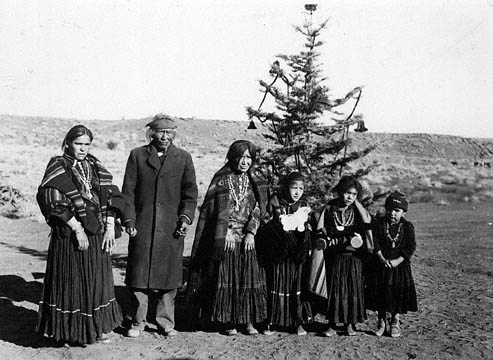
Navajo family at fair
Diné Traditional Marriage
(From the Navajo Common Law Project)
The traditional Diné wedding is based on the mating of the young maiden, White Shell Woman, and the Sun God in the White World. The following procedures of today’s wedding ceremony may vary depending on geographical location and customs are as follows:
- The wedding takes place at the bride’s residence in a traditional hooghan.
- The groom is seated on the west side in the hooghan and his relatives are seated to his left.
- The bride’s relatives enter the hooghan and are seated to the right.
- An uncle or a well-respected male individual is appointed as the wedding ceremony performer. He brings in a traditional pot of water and a gourd dipper.
- The bride immediately follows carrying a wedding basket containing com mush.
- The bride sits beside the groom with the water pot and basket placed in front of them side by side. The basket is to remain in place throughout the initial wedding ceremony.
- The person who brings in water is seated to right-hand side of the couple.
- The groom’s parents present the bride’s parents with gifts of values as agreed.
- The wedding ceremony performer proceeds with pouring the water into the gourd dipper. The bride then pours water onto the groom’s hands to rinse his hands. The groom repeats this process for the bride.
- A song or a prayer may be done before proceeding to the blessing of the com mush.
- The blessing of the com mush is performed by sprinkling com pollen from west to east and back to west then from south to north and back to south in a straight line and crossing at the center on the com mush. Then in one circular motion, a sprinkle is made beginning from the east to south, west, north and ending to the east, but the circle is not enclosed. An opening is always left to the east representing an entrance and exit for the way of life.
- The performer will place a dab of com pollen east on the com mush then the groom will take a small portion of the mush and com pollen to eat. The bride will then take a small portion of the mush and com pollen to eat. The same procedures are performed for the remaining cardinal directions and center of the com mush.
- After this blessing, the groom and bride are pronounced husband and wife.
- They are directed to continue eating more of the com mush. The com mush will also be shared with the groom’s relatives first and then with the bride’s relatives.
- When all the mush has been eaten the basket is given to the groom’s mother to keep in her family.
- A feast proceeds after the wedding ceremony. The wife’s relatives will provide all of the food for the feast.
- During the feast, traditional moral practices of motivational and fundamental speeches of advises are given to the newly wed based on the holistic values and guiding principles of parenting, family well-being, and their roles and responsibilities as husband and wife. These speakers may be parents, relatives, leaders, medicine-people, and elders.
The traditional pot and the water used in the ceremony represent the Mother Earth containing grandmother and grandfather Holy Water of Life. The gourd dipper represents the roots, growth, interweaving, and reseeding of life. The water is poured on the hands for cleansing of certain wrongs that may have been committed and symbolizes the transition from individualism to a beginning of unity and sharing of the roles. and responsibilities.
The significant of the Diné traditional basket represents the creation. It is crafted from the center and proceeds in the footprints of life in the opposite path of the sun and the shadow. It is the foundation to the proceeding of growth and journey of life, Dah’adíníisá, Hajíínáí, dóó Ha’aznáagí hane’. It also reveals, from the center and outward, the comprehension of all bad and good things that happen in the process of the journey from the Dark to White World. From outside and inward in the path of the sun and the shadow, it reveals the comprehension of all the blessings and harmonies provided by the Holy Spirit and the Holy People.
The base is the foundation of life, the Mother Earth, and the outer edge is the foundation of the Father Universe. The color prints or figures are the formations of the earth surfaces, water, and the sky of days and nights throughout the four seasons. The color prints are not completely enclosed where there is an opening that represents an entrance and exit. The opening represents access to all foundations of life that the Mother Earth and the Father Universe provide. It is also the passage for communication in all prayers and songs to the Holy Spirit and the Holy People.
The black prints also represent the Holy People’s readiness to listen, assist, protect, and to guide. Like the Holy People, they also represent the Diné medicine people and leaders. The red stripes are the rainbow and represents the children, the Diné Bíla’ Ashla’ii Dine’é with the spiritual name Diyin Nohookáá Dine’é. It also represents the mind, dreams, language, learning, teaching, planning, prayers, and songs, which are the tools to every day life and accomplishments in the future.
The Diné traditional baskets have many uses. In the wedding ceremony the basket brings in com mush where com pollen is used. The com mush is the sacrament of binding power to unity of life, and the com pollen is the blessing for a new beginning of life.
The purpose of crossing a sprinkle of the com pollen is a blessing to uphold, with integrity and dignity, a pledge of unity, and roles and responsibilities.
The sprinkle of the com pollen from the west to east and back represents the commitment and expectations that the husband will go outside to succeed and bring in the teachings and nourishment to his family’s well being. He has to maintain his energy to uphold the home and improvement of the livelihood. He has to uphold his stability, mentality, and role modeling to keep the dignity, integrity, obedience, and discipline in place for his children. He has to uphold his affection and compassion for his family.
The sprinkle of the com pollen from the south to north and back represents the expectation of the mother to uphold her roles and responsibilities like the father, but from and within the household for her family’s well-being. The circular com pollen sprinkle represents the new family’s journey on the footprints of life.
The traditional Diné kinship and clan systems (K’é dóó Dóóne’é) need to be seriously considered before a couple plans to wed. This is a Diné verbal law brought down from our ancestors to keep the bloodline healthy.
This Diné traditional wedding serves as an example of using the guiding principles of life, Iiná Bitsé Siléí dóó Báá Siléí as the Navajo Customary Law.Virtually the sole surviving function of the clan is in the limitation of marriage choices; clan exogamy at Shonto remains universal. On the positive side, however, no pattern of clan preference in marriage is discernible. The frequency of marriage between different pairs of clans is proportional throughout to the numerical strength of the clans themselves. Beyond limiting marriage choice, clan affiliation serves only to establish certain special etiquette patterns as between members, especially if they happen to be strangers. The relations and reciprocal behavior established are essentially similar to those which ensue when two Anglo-American namesakes meet by chance, and probably have no more functional significance. Economic and social responsibility for clan brothers and sisters are definitely things of the past at Shonto (cf. Kluckhohn and Leighton, 1946, p. 65). It is readily observable that interaction between households and residence groups is determined by blood relationship without reference to clan.
More than any other factor, it is probably the lack of a clearcut residence tradition (see below) which has in the long run robbed Shonto’s clans of most of their functional significance. The result of this situation is that clans cut completely across territorial lines, and cannot be correlated with any of the regular functional units of Shonto society.
Only the first six clans in the list, plus kinlichi’ini, were present in the Shonto area two generations ago. The clan inventory is extremely limited as compared with other Navaho communities (cf. Carr, Spencer , and Woolley, 1939; Kluckhohn and Leighton, 1946, p. 64). In addition to those represented in the community, only 14 additional clans are recognized by some Shonto informants. Many of the clans given separate designation by Reichard ( 1928, pp. 11-13) are believed to be not merely linked but identical. In particular, all of the clans.
Navajo People Website Links:
Navajo Culture – Navajo History – Navajo Art – Navajo Clothing Navajo Pictures – Navajo Rugs – Navajo Language – Navajo Jewelry – Navajo Code Talker – Navajo Pottery – Navajo Legends – Hogan’s – Sand Painting – Navajo Food – Navajo News – Navajo Nation