
Native American (Navajo) men take part in a bareback horse race at Fruitland, New Mexico.
The men wear no shoes.
The horses have leather bridles. Spectators stand nearby. Between 1908 and 1910.
Information about the Diné (Navajo People), Language, History, and Culture
The men wear no shoes.
The horses have leather bridles. Spectators stand nearby. Between 1908 and 1910.

OPEN INDIAN RODEO
DEAN C JACKSON MEMORIAL ARENA
AWARD TO ALL-AROUND COWBOY AND COWGIRL
BUCKLE TO EVENT WINNERS
Short Go for all events: top 10 (except for ladies and team roping).
Open to Native Americans with recognized tribal ID proof required. One time $25 office fee.
For paid purpose you must submit a W–9 with your entry form and have a valid ID in your possession in order to receive your cash award.
ENTRY FEES WILL ONLY BE ACCEPTED IN MONEY ORDER OR CASHIERS CHECKS FORM PAYABLE TO NAVAJO NATION
ENTRY/WAIVER FORM
| EVENT | LIMIT | FEE | ADDED | ROUND | FINALS |
| BAREBACK | 20 | $200 | $5,000 | 2 go | $2,000 |
| SADDLE BRONC | 30 | $200 | $5,000 | 2 go | $2,000 |
| BULL RIDING | 80 | $200 | $5,000 | 2 go | $2,000 |
| TIE DOWN | 60 | $200 | $5,000 | 2 go | $2,000 |
| STEER WRESTLING | 70 | $200 | $5,000 | 2 go | $2,000 |
| BARREL RACING | NL | $200 | $5,000 | 2 go | $2,000 |
| LADIES BREAKAWAY | 80 | $200 | $5,000 | 2 go | $2,000 |
| LADIES TEAM ROPING 2X | 200 | $400 | $10,000 | 2 go | $2,000 |
| LADIES TEAM ROPING1X | 40 | $150 | $1,500 | 2 go | $2,000 |
Entries open July 9, 2012. First to enter last to go. Entries close with postmarked by August 10, 2012 $20 late fee after August 10.
Walk-in entries: August 24, 2012 at Navajo National Museum
EVENT SCHEDULE
Tuesday, September 4
8AM – slack
Wednesday, September 5
8AM – slack
Friday, September 7
12 PM first performance
7 PM second performance
Saturday, September 8
1 PM third performance
Sunday, September 9
12 PM final four
Admission
Tuesday – No admission
Wednesday – NO admission
Friday and Sunday – $12 adults $6 child and seniors
CONTESTANT INFORMATION
The 66th Annual Navajo Nation Fair Indian Rodeo (NNFIR) shall be open to all Native American contestants who have a blood quantum of one fourth (1/4) American Indian heritage or who are enrolled members of a federally recognized tribe. The Special Events Section (SES) of the Navajo Nation Fair reserves the right to request for proof of blood quantum or enrollment status. Failure of a contestant to show proof of blood quantum or enrollment when requested may be cause for disqualification of the contestant, and forfeiture of entry fess and any money won at the rodeo.
ENTRIES
Entries for the 66th Annual NNFIR will open on July 9, 2012. Entry forms will be available on the website – www.navajonationfair.com – and at other Indian rodeos. Mail-in entries will close on August 10, 2012. All entry forms and payment for entries must be sent to: Navajo Nation Fair Indian Rodeo, c/o Navajo Nation Museum, Post Office Box 1840, Window Rock, AZ 86515. Payment for entry fees must be by money order or cashier’s check. NO CASH WILL BE ACCEPTED. All contestants shall pay entry fees for the contest events entered in FULL at the time of entry closing of entries on August 15, 2012. Entry fees are $200.00 for all events except Ladies Teams which is $150. A one-time office charge of $25.00 must be included with your payment. Mail-in entries must be received by August 15, 2012 regardless of postmark date. Entry fees in the team roping shall be paid in full by both team members (partners) at the time of entry closing to be considered entered. If entry fees are not paid in full by entry closing the team shall be scratched from entry list.
Late entries will accepted for any position not filled during the regular entry period. Late entries will be walk-in only and will incur a $20.00 late fine. All walk-in entries must be paid with money order or cashier’s check. NO CASH WILL BE ACCEPTED. Walk-in entries will be taken from 7:00 AM to 6:00 PM on Friday, August 24, 2012 at the Rodeo Office at the Navajo Nation Museum. Positions will be posted on www.navajonationfair.com prior to opening of late entries. Walk-ins will receive their position when entering. There will be no call backs for walk-in entries.
TIME EVENTS
Ladies Team Roping (LT) will be one go round with no finals. Twenty Five (25) teams will run in a slack and twenty (15) will run during a performance (5/perf Thurs, Fri & Sat). Tie down Roping (TD), Steer Wrestling (SW), Team Roping (TR), Ladies Breakaway Roping (LR) and Ladies Barrels (LB) contestants shall compete in two complete go-rounds with the first go round being held in a slack performance. The contestants with the top forty (40) times will compete during the four (4) performances with ten (10) contestants per performance/event and the remaining contestant will compete their 2nd go competition run during the 2nd go slack performance. Those contestants making trades will be one hour after the top 40 list is posted at Rodeo Office. Only horses needed during actual competition in the event will be allowed in the box during any timed event and/or noncompetitive runs. All contestants who have completed their runs shall immediately exit the arena. The arena shall always remain clear of non-competing contestants while events are in progress. Only those personnel who are authorized to be in the arena shall remain in the arena. The timers in the time events shall blow a whistle at the end of a set time limit indicating a “no time”.
PAYOUT
Prize money payout for the 66th Annual NNFIR will be made by check and no checks will be released to anyone but the winning contestant. Payoff scale will be according to PRCA/WPRA rulebooks. Contestant must complete a W-9 form with proper identification numbers and present two forms of identification (one must be picture ID) to receive prize money check(s). At year-end all contestants earnings $600.00 or more will receive a 1099 form. The NNFIR Rodeo Secretary will do payoff checks at the end of each go-round. Rodeo office hours will be posted on the post board. Any prize money check that has to be replaced for any reason after Sunday, September 11, 2012 will incur a $25.00 replacement fee.
ALL AROUND
All Around Champions must compete in two or more events. The Contestants who wins the most money in two or more events will win the All Around title. If no contestant wins money in two or more events, the contestant entering two or more events who wins the most money will win the All Around title. Money won by ladies in the men’s TR will count for the Ladies All-Around.
1. Men’s All Around – Men’s Events – BB, SB, BR, SW, TD, and TR (1 run only counts)
2. Ladies All Around – Ladies Events – LB, LR, LT and TR (1 run only counts)
Source: Terry Teller (daybreakwarrior)
http://www.youtube.com/user/daybreakwarrior/featured
The Navajo Word of the Day is “Olympics”.
The word in Navajo for olympics is “Ahaa Honinééh.” To use this word in Navajo, you would say, “Ahaa Honinééhígíí éí London hoolyéedi baa na’aldeeh.” This means, “The Olympics are being held in London.” Breakdown:
Ahaa Honinééhígíí: The Olympics
Éí: it
London hoolyéedi: at the place called London
Baa na’aldeeh: it is being held
Since I hadn’t been updating my Navajo Words of the Day like I should, I added a new word today, “Alha’dikááh,” which means, “a lot of people racing side by side.” This is more of a term for a foot or running race, but it can also be used for other events. For example:
Dzi’izí (bike) Bee (by means of it) Alha’dikááh: Competitive Cycling
Na’alkóó?’ (swimming) Yee (by means of it) Alha’dikááh: Competitive Swimming
Here are different ways you can use these words in sentences:
Ryan Lochte éí Na’alkóó’ Yee Alha’dikááh yee atah.
Ryan Lochte is competing in the swimming event.
Taylor Phinney éí Dzi’izí Bee Alha’dikááh yee atah.
Taylor Phinney is competing in the cycling event.
Again, just a few words to share since the Summer Olympics are currently being held! Enjoy!

Date around 1943. Photo by Josef Muench
BIOGRAPHICAL HISTORY: Josef Muench was born in Bavaria February 8, 1904.
At the age of 11 he received his first camera and began a lifelong interest in capturing nature on film.
He arrived in the United States with his brother in 1926 and eventually settled in Santa Barbara, California. In the 1930s, Muench began his long association with Arizona Highways Magazine.
Josef Muench died in 1998.
Today’s Navajo Word of the Day is the word for “Indian Ruins.” The word is, “Kits’iilí,” which literally means, “shattered homes.” This video was filmed at Mesa Verde National Park. The Navajo name for this area is called “Gad Deelzhah,” which means “Jagged Junipers.” Ruins such as these are typically called “kits’iilí.”
The ruins are made by the ancient peoples currently known as the Cliff Dwellers. They were formerly known as the Anasazi. Anasazi is a Navajo word, which means “Enemy’s Ancestor.” It comes from the words “anaa’í” for enemy and “bizází” for their ancestors. Since the Pueblo and Hopi tribes of today are considered to be the descendants of the Anasazi, they thought it was inappropriate for their ancestos to be named by Navajos so Cliff Dwellers is the current PC name.
I used this video to introduce other new terms as well, such as “haaz’éí” for ladder, “tsé daashjéé’ ” for corn-grinding stones or a metate, and “jeelid” for the sticky smoke soot that formed on the rock ceiling of the ruins from historic campfires.
I hope these terms help you if you decide to visit ancient ruins in the southwest such as these. Enjoy!
Source: Terry Teller (daybreakwarrior)
http://www.youtube.com/user/daybreakwarrior/featured
Video by Terry Teller (Daybreak Warrior)
Terry says:
“I get e-mails and YouTube messages saying, “I am having a baby and want to give my child a Navajo name. Can I name them such & such?” Or, “How do you translate this into Navajo for a Navajo name?” It’s kind of hard because although you’ll have a name written all cool, you may not be pronouncing it correctly or it may not flow with the general concepts that go behind the “typical” traditional Navajo names.”
See more Daybreak Warrior Videos here:
http://www.youtube.com/user/daybreakwarrior

Creation Story Poster- Ni’hodilhil First World
Illustrations by Theresa Breznau.
© 2013 Heritage Language Resource Center. All rights reserved
To purchase see bottom of page.
On the wands, the beings passed into the Third World. Blue Bird was the first to come through. He found the world was yellow. After Blue Bird, First Man, First Woman, Coyote and one of the insects came. After that, the other beings entered the Yellow World.
The Yellow World was large. Many new things were there. A great river crossed this land from north to south. It was the Female River.
There was another river crossing it from east to west, it was the Male River. This Male River flowed through the Female River and on and the name of this place is tqoalna’osdli, the Crossing of the waters.
Animals in the Yellow world
a. Squirrel
b. Chipmunk
c. Mice
d. Turkey
e. Foxes
f. Deer
g. Spiders
h. Lizards
i. Water Monster
Others in the Yellow World
1. Water Monster
2. Turquoise Boy
3. While Shell Woman
4. Coyote
5. Rivers that Cross
6. Separation of Sexes
In this world there were six mountains. These are the mountains that are important to Navajos today.
In the East was Blanco Peak Sisnaajinii, the Standing Black Sash. Its ceremonial name is Yolgaidzil, the Dawn or White Shell Mountain.
In the South stood Mount Taylor Tsoodzil, the Great Mountain, also called Mountain Tongue. Its ceremonial name is Yodoltizhidzil, the Blue Bead or Turquoise Mountain.
In the West stood the San Francisco Peaks Dook’oslid, Its ceremonial name is Dichi’li dzil, the Abalone Shell Mountain.
In the North stood the La Plata Mountains Debe’ntsa, Many Sheep Mountain.
Its ceremonial name is Bash’zliinidzil. Obsidian Mountain.
ln the middle was Huerfano Mesa. Dzilna’odili, the Upper Mountain. It was very sacred, and its name means also the Center Place, and the people moved around it. Its ceremonial name is Ntl’isdzil. Precious Stone or Banded Rock Mountain.
Near this was a cone-shaped mountain called Gobernador Knob, called Chori’i or Dzil na’odilicholi, and it was also a sacred mountain.
Different animals lived around these mountains. Squirrel, Chipmunk, Turkey, Deer, Snake and Lizard lived there. But these animals looked different from animals we see today. They were spirit beings.
The beings were happy in the Yellow World. Then one day something happened. Coyote took Water Monster’s baby. Water Monster was very angry. He was so angry that he decided to make it rain. lt rained and rained. The water rose higher and higher.
Then the water began to flood. The beings did not know where to go to escape the flood. First Man tried to help them. He told them to come to Blanco Peak. But the water kept rising. It rose higher than the mountain.
First Man wondered what to do. He planted a cedar tree. But this did not grow higher than the water. He planted a pine tree. But the pine tree was too short. He planted a male reed. The reed was still too short. Finally, First Man planted a female reed. This reed grew to the sky.
The beings climbed onto the reed. They started to climb up. When they got to the top, they found another world. This was the Fourth, White World. This is the place where all beings live today.
Creation Story Poster Set of Four

This poster set illustrates and explains the Creation Narrative in simple, design and text.
Each poster depicts the beings and landmarks associated with that World.
Illustrations by Theresa Breznau.
17” x 22” laminated on heavy cardstock.
Sold as a set for $24.00
Also available individually for $6.00 each
To Purchase:
Heritage Language Resource Center
Navajo and Ute Language Resources
28 West 20 North
Blanding, Utah 8451
435 -678 -1230
Website: media.sjsd.org
Navajo People Website Links:
Navajo Culture – Navajo History – Navajo Art – Navajo Clothing Navajo Pictures – Navajo Rugs – Navajo Language– Navajo Jewelry – Navajo Code Talker – Navajo Pottery – Navajo Legends – Hogan’s – Sand Painting – Navajo Food – Navajo News – Navajo Nation
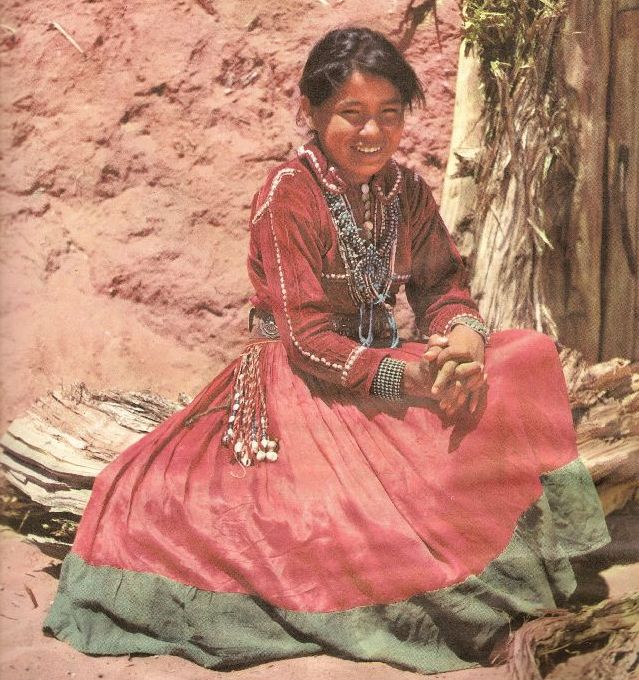
The Navajo Puberty Ceremony celebrating maturity of girls among the Navajo is held generally on the fourth night after the first evidence of the maiden’s entrance into womanhood. On the first morning following the moment of this change in life the girl bathes and dresses in her finest clothes.
Kinaalda – Maturity ceremony for Navajo Girls
Later she stretches herself face downward on a blanket just outside the hogán, with her head toward the door. A sister, aunt, or other female relation, if any happen to be close at hand, or if not, a male relative other than her father, then proceeds symbolically to remould her.
Her arms and legs are straightened, her joints smoothed, and muscles pressed to make her truly shapely. After that the most industrious and energetic of the comely women in the immediate neighborhood is called in to dress the girl’s hair in a particular form of knot and wrap it with deerskin strings, called tsklólh.
Should there be any babies or little tots about the home, the girl goes to them, and, placing a hand under each ear, successively lifts them by the neck, to make them grow faster. Then she darts off toward the east, running out for about a quarter of a mile and back. This she does each morning until after the public ceremony. By so doing she is assured of continuing strong, lithe, and active throughout womanhood.

Grinding Corn at Kinaalda, Navajo Puberty Ceremony
The four days preceding the night of the ceremony are days of abstinence; only such foods as mush and bread made from may be eaten, nor may they contain any salt. To indulge in viands of a richer nature would be to invite laziness and an ugly form at a comparatively early age. The girl must also refrain from scratching her head or body, for marks made by her nails during this period would surely become ill-looking scars.
All the women folk in the hogán begin grinding corn on the first day and continue at irregular intervals until the night of the third, when the meal is mixed into batter for a large corn-cake, which the mother bakes in a sort of bean-hole outside the hogán.

Molding at Kinaalda
Molding – Photo courtesy of Gary Witherspoon
The ceremony proper consists of little more than songs. A medicine-man is called upon to take charge, being compensated for his services with blankets, robes, grain, or other articles of value. Friends and neighbors having been notified, they assemble at the girl’s hogán fairly early in the evening.

Navajo Girl Running
Navajo Girl Running at Kinaalda – Photo courtesy of Gary Witherspoon
When dusk has settled, the medicine-man begins his songs, singing first the twelve “hogán songs” of the Bahózhonchi. After he has finished, anyone present who so desires may sing songs taken from the ritual of the same order. This motley singing and hilarity continue until well toward sunrise, when the mother brings in a bowl of yucca suds and washes the girl’s hair.
Her head and hair are dried with corn-meal, after which the girl takes her last run toward the east, this time followed by many young children, symbolically attesting that she will be a kind mother, whom her children will always follow.

Pouring Corn Batter for the ceremony cake (alkaan) – Kinaaldá, the Navajo Puberty Ceremony
The hatál, or medicine singer, during her absence sings eight songs, generally termed the Racing songs. On her return the great corn-cake is brought in, cut, and divided among the assemblage, when all disperse, and the girl may once more loosen her hair and partake of any food she pleases.
First Day
Comb
Dress
Mold
Run
Grind Corn
Put pot of wheat near outdoor cooking fire (after the molding).
Second Day
Run
Grind Corn
Spread wheat in the sun to dry (after digging the pit).
Soak cornhusks (while working on the batter).
Third Day
Run
Grind Corn
Dig pit; build fire
Make mush
Put batter in pit; bless it
Cover pit
Gather soapweed root and white clay for morning (during the singing).
Fourth Day
Dawn
Run to east while four songs are sung.
One Twelve Word song, unless the ceremony is the first Kinaalda,
when this song is omitted.
Make offering to Mother Earth.
Prepare white-clay basket (during the Racing Songs).
Lift children (after the molding).
Girl goes back into hogan (after returning goods).
Retie girl’s hair.
Navajo People Website Links:
Navajo Culture – Navajo History – Navajo Art – Navajo Clothing Navajo Pictures – Navajo Rugs – Navajo Language – Navajo Jewelry – Navajo Code Talker – Navajo Pottery – Navajo Legends – Hogan’s – Sand Painting – Navajo Food – Navajo News – Navajo Nation
Among the Navajo Indians there are many smiths, who sometimes forge iron and brass, but who work chiefly in silver. When and how the art of working metals was introduced among them I have not been able to determine; but there are many reasons for supposing that they have long possessed it; many believe that they are not indebted to the Europeans for it. Doubtless the tools obtained from American and Mexican traders have influenced their art.
 Portrait of Navajo Silversmith Bai-De-Schluch-A-Ichin (Slender Silversmith)
in Native Dress with Silver Necklaces, Concho Belts, Tools and Army Saddle Bag
1883 – Creator: Wittick, George Ben
Old white residents of the Navajo country tell me that the art has improved greatly within their recollection; that the ornaments made fifteen years ago do not compare favorably with those made at the present time; and they attribute this change largely to the recent introduction of fine files and emery-paper. At the time of the Conquest the so-called civilized tribes of Mexico had attained considerable skill in the working of metal, and it has been inferred that in the same period the sedentary tribes of New Mexico also wrought at the forge. From either of these sources the first smiths among the Navajos may have learned their trade; but those who have seen the beautiful gold ornaments made by the rude Indians of British Columbia and Alaska, many of whom are allied in language to the Navajos, may doubt that the latter derived their art from a people higher in culture than themselves.
The appliances and processes of the smith are much the same among the Navajos as among the Pueblo Indians. But the Pueblo artisan, living in a spacious house, builds a permanent forge on a frame at such a height that he can work standing, while his less fortunate Navajo confrere dwelling in a low hut or shelter, which he may abandon any day, constructs a temporary forge on the ground in the manner hereafter described. Notwithstanding the greater disadvantages under which the latter labors, the ornaments made by his hand are generally conceded to be equal or even superior to those made by the Pueblo Indian.
A large majority of these savage smiths make only such simple articles as buttons, rosettes, and bracelets; those who make the more elaborate articles, such as powder-chargers, round beads , tobacco cases, belts, and bridle ornaments are few. Tobacco cases, made in the shape of an army canteen, such as that represented in , are made by only three or four men in the tribe, and the design is of very recent origin.
Navajo People Website Links:
Navajo Culture – Navajo History – Navajo Art – Navajo Clothing Navajo Pictures – Navajo Rugs – Navajo Language – Navajo Jewelry – Navajo Code Talker – Navajo Pottery – Navajo Legends – Hogan’s – Sand Painting – Navajo Food – Navajo News – Navajo Nation
Most Navaho ceremonies are conducted, at least primarily, for the purpose of healing disease; and while designated medicine ceremonies, they are, in fact, ritualistic prayers. There are[pg 078] so many of these ceremonies that no student has yet determined their number, which reaches into scores, while the component ritual prayers of some number hundreds. The principal ceremonies are those that require nine days and nine nights in their performance. Of the many now known the names of nine are here given: KléjÄ• Hatál, Night Chant;4 TzÄlhkÃ̆chÄ Hatál, Mountain Chant; HozhónÄ Hatál, Happiness Chant; Natói Hatál, Shooting Chant; Toi Hatál, Water Chant; AtsósÄ Hatál, Feather Chant; Yoi Hatál, Bead Chant; HochónchÄ Hatál, Evil-Spirit Chant; Mai Hatál, Coyote Chant. Each is based on a mythic story, and each has four dry-paintings, or so-called altars. Besides these nine days’ ceremonies there are others whose performance requires four days, and many simpler ones requiring only a single day, each with its own dry-painting.

PÄké̆hodÄklad - Navaho
This, the first of the dry-paintings employed in the rites of the Mountain Chant—a nine days’ healing ceremony of the Navaho—as in the Night Chant, is used on the fifth night, when the purpose of the performance is to frighten the patient, and thus banish the evil within him. The name of this painting, “Frighten Him On It,” is identical with that of the one used at the corresponding moment in the Night Chant.
The whole represents the den of a hibernating bear. Inside the ceremonial hogán is thrown up a bank of earth two or three feet high, with an opening toward the doorway. Colored earths picture bear-tracks leading in; bear-tracks and sunlight—sun dogs—are represented at the four quarters, and the bear himself, streaked with sunlight, in the centre. The twigs at the entrance of the bear den represent trees, behind which bears are wont to dig their dens in the mountain side. Everything tends to make the patient think of bears. He enters midst deep silence and takes his seat upon the pictured animal. The play of his imagination has barely begun when a man, painted and garbed as a bear, rushes in, uttering hideous snarls and growls, in which all assembled join. Women patients seldom fail to faint.
