Archives for October 2009

Navajo Mountain Chant Ceremony Mountain Chant Ceremony Fourth Day

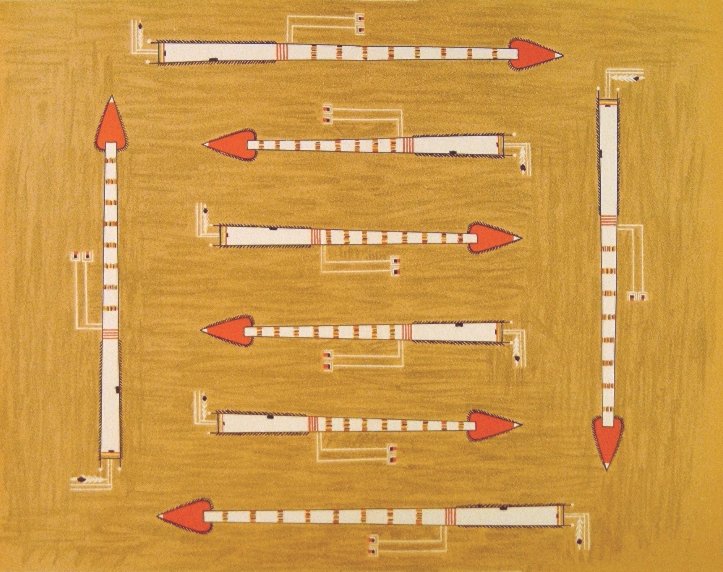
The Fourth Picture represents the kátsoyisçàn, or great plumed arrows. These arrows are the especial great mystery, the potent healing charm of this dance. The picture is supposed to be a fac simile of a representation of these weapons, shown to the prophet when he visited the abode of the Tsilkè¢igini, or young men gods, where he first saw the arrows.

There are eight arrows. Four are in the center, lying parallel to one another—two pointing east and two others, alternate, pointing west. The picture is bordered by the other four, which have the same relative positions and directions as the bounding serpents in the first picture.

The shafts are all of the same white tint, no attention being paid to the colors of the cardinal points; yet in drawing and erasing the picture the cardinal points are duly honored.

Among the central arrows, the second from the top, or north margin of the design, is that of the east; it is drawn and erased first. The next below it is the arrow of the south; the third is that of the west. The one on top belongs to the north; it is drawn and erased last.

The heads are painted red to represent the red stone points used; the fringed margins show the irregularities of their edges. The plumes at the butt are indicated, as are also the strings by which the plumes are tied on and the notches to receive the bowstring.
Navajo Sandpainting Mountain Chant Ceremony Fourth Day

Navajo Sandpainting Mountain Chant Ceremony Fourth Day

The ground of this picture is crossed with nebulous black streaks. These were originally present in all the pictures. I have omitted them in all but this, lest they might obscure the details of the reduced copies. It has been explained to me (although in the myth it is expressly stated only in one case,) that all these pictures were drawn by the gods upon the clouds and thus were shown to the Navajo prophet.

Men cannot paint on the clouds, but according to the divine mandate they do the best they can on sand, and then sprinkle the sand with charcoal, in the manner indicated, to represent the cloudy scrolls whereon the primal designs of the celestial artists were painted.

Navajo Sandpainting Mountain Chant Ceremony Third Day

The Third Picture commemorates the visit of Dsilyi‘ Neyáni to Çaçò‘-behogan, or “Lodge of Dew”. To indicate the great height of the Bitsès-ninéz the figures are twice the length of any in the other pictures, except the rainbows, and each is clothed in four garments, one above the other, for no one garment, they say, can be made long enough to cover such giant forms. Their heads all point to the east, instead of pointing in different directions, as in the other pictures.

The Navajo relate, as already told, that this is in obedience to a divine mandate; but probably there is a more practical reason, which is this: if they had the cruciform arrangement there would not be room on, the floor of the lodge for the figures and at the same time for the shaman, assistants, and spectators. Economy of space is essential; but, although drawn nearly parallel to one another, the proper order of the cardinal points is not lost sight of.

The form immediately north of the center of the picture is done first, in white, and represents the east. That immediately next to it on the south comes second in order, is painted in blue, and represents the south. The one next below that is in yellow, and depicts the goddess who stood in the west of the House of Dew-Drops. The figure in the extreme north is drawn last of all, in black, and belongs to the north. As I have stated before, these bodies are first made naked and afterwards clothed.

Navajo Sandpainting Mountain Chant Ceremony Third Day

Navajo Sandpainting Mountain Chant Ceremony Third Day

The exposed chests, arms, and thighs display the colors of which the entire bodies were originally composed. The glòï (weasel, Putorius) is sacred to these goddesses. Two of these creatures are shown in the east, guarding the entrance to the lodge. The appendages at the sides of the heads of the goddesses represent the glòï-bitcà, or headdresses of glòï skins of different colors which these mythic personages are said to wear.

Each one bears attached to her right hand a rattle and a charm, or plume stick, such as the gods in the second picture carry; but, instead of the basket shown before, we see a conventionalized representation of a branch of choke cherry in blossom; this consists of five diverging stems in blue, five roots, and five cruciform blossoms in white.

The choke cherry is a sacred tree, a mountain plant; its wood is used in making certain sacrificial plume sticks and certain implements of the dance; it is often mentioned in the songs of this particular rite. Some other adjuncts of this picture—the red robes embroidered with sunbeams, the arms and legs clothed with clouds and lightning, the pendants from the arms, the blue and red armlets, bracelets, and garters—have already been described when speaking of the second picture. The object in the left hand is a wand of spruce.

173. The rainbow which incloses the picture on three sides is not the anthropomorphic rainbow. It has no head, neck, arms, or lower extremities. Five white eagle plumes adorn its southeastern extremity. Five tail plumes of some blue bird decorate the bend in the southwest. 451 The plumes of the red shafted flicker (Colaptes auratus var. mexicanus) are near the bend in the northwest and the tail of the magpie terminates the northeastern extremity. Throughout the myth, it will be remembered, not only is the House of Dew-Drops spoken of as adorned with hangings and festoons of rainbows, but many of the holy dwellings are thus embellished.and blue the female.

Navajo Sandpainting Mountain Chant Ceremony Second Day

The Second Picture is said to be a representation of the painting, which the prophet saw in the home of the bears in the Carrizo Mountains . In the center of this figure is the bowl of water covered with black powder, to which I referred before. The edge of the bowl is adorned with sunbeams, and external to it are the four caacbitlol, or sunbeam rafts, on which seem to stand four Gods, or Yays.

The divine forms are shaped alike but colored differently. They lie with heads extended outward, one to each of the four cardinal points of the compass, the faces looking forward, the arms half extended on either side, with the hands raised to a level with the shoulders. They wear around their loins skirts of red sunlight, adorned with sunbeams. They have ear pendants, bracelets, and armlets, blue and red (of turquoise and coral), the prehistoric and emblematic jewels of the Navajo.

Their forearms and legs are black, showing in each a zigzag mark to represent lightning on the surface of the black rain clouds. In the north god these colors are, for artistic reasons, reversed. Each bears, attached to his right hand with a string, a rattle, a charm, and a basket. The rattle is of the shape of those used by the medicine men in this particular dance, made of raw hide and painted to symbolize the rain cloud and lightning. The left hand is empty; but beside each one is a highly conventionalized picture of a plant. The left hand remains empty, as it were, to grasp this plant, to indicate that the plant at the left hand belongs to the god whose corresponding hand is unoccupied and extended towards it.

The proprietorship of each god in his own particular plant is further indicated by making the plant the same color as the god. The body of the eastern god is white; so is the stalk of corn at his left, in the southeast. The body of the southern god is blue; so is the beanstalk beside him, in the southwest. The body of the western god is yellow; so is his pumpkin vine, in the northwest. The body of the north god is black; so is the tobacco plant, which is under his special protection, in the northeast.

Each of the four sacred plants is represented as growing from five white roots in the central waters and spreading outwards to the periphery of the picture. The gods form one cross whose limbs are directed to the four cardinal points; the plants form another cross having a common center with the first named cross, but whose limbs extend to the intermediate points of the compass.

Navajo Sandpainting Mountain Chant Ceremony Second Day

Navajo Sandpainting Mountain Chant Ceremony Second Day

On the head of each yay is an eagle plume lying horizontally and pointing to the right. A similar arrangement of four plumes, all pointing in one direction (contrary to the sunâcs apparent course), may be observed on the baskets carried by the gods.

The gods are represented with beautiful embroidered pouches, each of a different pattern. In old days the most beautiful things in art the Navajo knew of were the porcupine quill embroideries of the northern races. The art of garnishing with quills, and later with beads, seems never to have been practiced to any extent by the Navajo women. They obtained embroideries of the Ute and other northern tribes, and their ancient legends abound in allusions to the great esteem in which they held them.

Surrounding the picture on about three-fourths of its circumference is the anthropomorphic rainbow or rainbow deity. It consists of two long stripes, each about two inches wide in the original picture, one of blue, one of red, bordered and separated by narrow lines of white. At the southeastern end of the bow is a representation of the body below the waist, such as the other gods have, consisting of pouch, skirt, legs, and feet. At the northeastern end we have head, neck, and arms. The head of the rainbow is rectangular, while the heads of the other forms in this picture are round. In the pictures of the Yiabichy dance we frequently observe the same difference in the heads. Some are rectangular, some are round; the former are females, the latter males; and whenever any of these gods are represented, by characters, in a dance, those who enact the females wear square stiff masks, like our dominoes, while those who enact the males wear roundish, baglike masks, of soft skin, that completely envelop the head. The rainbow god in all these pictures wears the rectangular mask. Iris, therefore, is with the Navajo as well as with the Greeks a goddess.

All the other gods bear something in their hands, while the hands of the rainbow are empty. This is not without intention. When the person for whose benefit the rites are performed is brought in to be prayed and sung over, the sacred potion is brewed in a bowl, which is placed on the outstretched hands of the rainbow while the ceremony is in progress and only taken from these hands when the draught is to be administered. Therefore the hands are disengaged, that they may hold the gourd and its contents when the time comes.

In the east, where the picture is not inclosed by the rainbow, we see the forms of two birds standing with wings outstretched, facing one another, their beaks close together. These represent certain birds of blue plumage called by the Navajo çòli (Sialia arctica). This bluebird is of the color of the south and of the upper regions. He is the herald of the morning. His call of “çòli çòli” is the first that is heard when the gray dawn approaches. Therefore is he sacred, and his feathers form a component part of nearly all the plume sticks used in the worship of this people. Two bluebirds, it is said, stand guard at the door of the house wherein these gods dwell; hence they are represented in the east of the picture.

Here is an appropriate occasion to speak of a part of Navajo symbolism in color to which reference has already several times been made. In the majority of cases the east is represented by white, the south by blue, the west by yellow, the north by black; the upper world by blue and the lower by a mixture of white and black in spots. The colors of the south and west seem to be permanent: the south is always blue and the west is always yellow, as far as I can learn; but the colors of the east and north are interchangeable. The cases are rare where white is assigned to the north and black to the east; but such cases 450 occur, and perhaps in each instance merit special s

Navajo Sandpainting Mountain Chant Ceremony First Day

THE GREAT PICTURES OF DSILYÍDJE QACÀL.

A description of the four great dry-paintings  (sandpainting) pictures drawn in these ceremonies has been deferred until all might be described together. Their relations to one another rendered this the most desirable course to pursue. The preparation of the ground and of the colors, the application of the sacred pollen, and some other matters have been already considered.

The men who do the greater part of the actual work of painting, under the guidance of the chanter, have been initiated, but need not be skilled medicine men or even aspirants to the craft of the shaman. A certain ceremony of initiation has been performed on them four times, each time during the course of a different dance, before they are admitted into the lodge during the progress of the work or allowed to assist in it. The medicine man receives a good present in horses for his work; the assistants get nothing but their food. This, however, is abundant. Three times a day the person for whose benefit the dance is performed sends in enough mush, corn cake, soup, and roasted mutton to satisfy to the utmost the appetites of all in the lodge. There are some young men who live well all winter by going around the country from dance to dance and assisting in the work of the lodge.

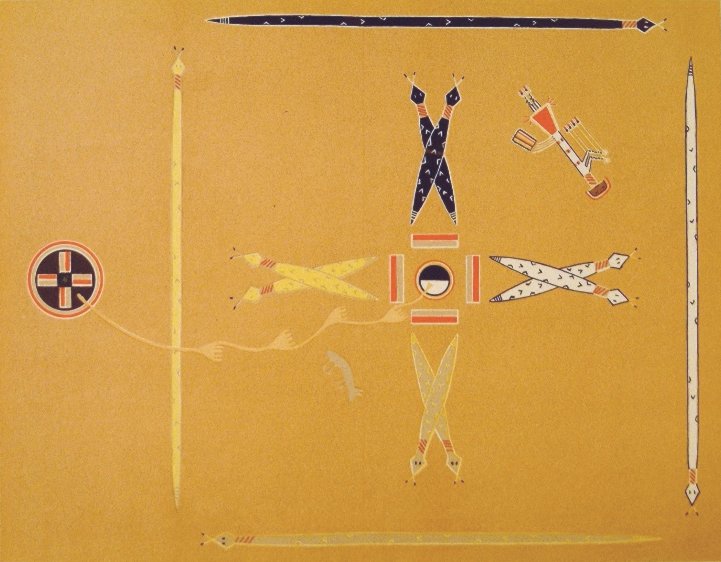
The picture of the first day  is said to represent the visit of Dsilyi‘ Neyáni to the home of the snakes at Qocestsò.

first-dry-painting

Navajo dry-painting (Sandpainting) Mountain Chant Ceremony First Day

In the center of the picture was a circular concavity, about six inches in diameter, intended to represent water, presumably the house of water mentioned in the myth. In all the other pictures where water was represented a small bowl was actually sunk in the ground and filled with water, which water was afterwards sprinkled with powdered charcoal to give the impression of a flat, dry surface. Why the bowl of water was omitted in this picture I do not know, but a medicine man of a different fraternity from that of the one who drew the picture informed me that with men of his school the bowl filled with water was used in the snake picture as well as in the others.

Closely surrounding this central depression are four parallelograms about four inches by ten inches in the original pictures. The half nearer the center is red; the outer half is blue; they are bordered with narrow lines of white. The same figures are repeated in other paintings. They appear in this drawing, and frequently in others, as something on which the gods seem to stand.

They are the ca‘bitlòl, or rafts of sunbeam, the favorite vessels on which the divine ones navigate the upper deep. In the Navajo myths, when a god has a particularly long and speedy journey to make, he takes two sunbeams and, placing them side by side, is borne off in a twinkling whither he wills. Red is the color proper to sunlight in their symbolism, but the red and blue together represent sunbeams in the morning and evening skies when they show an alternation of blue and red. It will be seen later that the sunbeam shafts, the halo, and the rainbow are represented by the same colors.

In form, however, the halo is circular, and the rainbow is distinguished by its curvature, and it is usually anthropomorphic, while the sunbeam and the halo are not. External to these sunbeam rafts, and represented as standing on them, are the figures of eight serpents, two white ones in 447 the east, two blue ones in the south, two yellow ones in the west, and two black ones in the north. These snakes cross one another (in pairs) so as to form four figures like the letter X.

In drawing these X’s the snake which appears to be beneath is made first complete in every respect, and then the other snake is drawn over it in conformity with their realistic laws of art before referred to. The neck, in all cases, is blue, crossed with four bands of red. The necks of the gods in all the pictures, it will be observed, are made thus, but the bars in the manlike figures run transversely, while those in the snake-like run diagonally.

Three rows of V-shaped figures, four in each row, are seen on the backs of the snakes; these are simply to represent mottling. Outside of these eight snakes are four more of much greater length; they form a frame or boundary to the picture, except in the west, where the mountain of Dsilyà-içín lies beyond them. There is a white snake in the east, lying from north to south and bounding the picture in the east; a blue snake, of similar size and shape, in the south; a yellow one in the west, and a black one in the north. They seem as if following one another around the picture in the direction of the sun’s apparent course, the head of the east snake approximating the tail of the south snake, and so on.

In the northeast is seen the yay, Niltci, who accompanied the Navajo prophet to the home of the snakes. In the extreme west is a black circular figure representing the mountain of Dsilyà-içín. In the original picture the mountain was in relief which I have not attempted to represents a little mound of about ten or twelve inches high. The description of the mountain given in the myth is duly symbolized in the picture, the halo added. The green spot in the center is designed to represent a twig of spruce which was stuck in the mound of sand to indicate the spruce tree door.]

From the summit of the mountain to the middle of the central waters is drawn a wide line in corn meal, with four footprints, depicted at intervals, in the same material. This represents the track of a bear. Immediately south of this track is the figure of an animal drawn in gray pigment. This is the grizzly himself, which here, I have reason to believe, is used as a symbol of the Navajo prophet. The bear, in the sacred language of the shamans, is appropriately called Dsilyàiçín, since he is truly reared within the mountains. His track, being represented by a streak of meal, has reference to the same thing as the name aka¡ninili and the practice of the couriers , who are dressed to represent the prophet, throwing corn meal in front of them when they travel.

Jobs Are Scarce on Navajo Reservation

Like thousands of Navajos on the reservation, where jobs are scarce, artist Elizabeth Whitethorne-Benally makes a living selling arts and crafts. But now her living room in the little town of Shonto in far northern Arizona is stuffed with unsold art. NPR Weblink