Archives for September 2011

2011 Miss Northern Navajo Nation Fair Pageant

The  Miss Northern Navajo Nation Fair Pageant


Click On the Photo Link below to see all photos from the Pageant.

Miss Northern Navajo 2011-2012

 Congratulations to Koltey Tso, the new Miss Northern Navajo Nation 2011-12.
Andrianna Alexia Yazzie – 1st runner up
Martha McCabe – 2nd runner up

First Prize $1.000.00 Scholarship

Second Prize $500.00 Scholarship

Third Prize $250.00 Scholarship

Will be located at:

Phil L. Thomas
Performing Arts Center
Shiprock, NM 87420-3578
(505) 368-2490
On US 64 near Shiprock High School

Pick up applications at:

Northern Navajo Nation Fair Office
100 North Uranium Boulevard
Shiprock, New Mexico 87420

ELIGIBILITY CRITERIA

Must submit completed contestant application
Must be an enrolled female member of the Navajo Nation
Must be 17 – 25 years of age, never married, no children
Must be a senior this SY (2011-2012),HS Diploma or GED equivalent
Must have some knowledgeable of the Navajo culture, history & tradition
Must submit 50 – 100 word essay on:
“Why I choose to run for Miss Northern Navajo Fair Queen”.
Must not have previously held the title of Miss Northern Navajo Nation Fair Queen

Miss Northern Navajo Tanya Lister 2009-2010

Miss Northern Navajo Tanya Lister 2009-2010

CONTESTANT APPLICATION INFORMATION

Contestant Applications can be picked up at the Shiprock Fair Office located at: Shiprock Fair grounds in the ( white trailer).

Application Deadline: All applications must be in the Shiprock Fair Office by September 30, 2011, and attend the contestants orientation on September 30, 2011, at (PTPAC) center at 4:00pm.

CONTACT INOFORMATION:

Northern Navajo Nation Fair Board
PO Box 973
Shiprock, New Mexico 87420
Phone: (505)368-5789 or Mae Sandoval, Pageant Coordinator at (505)368-5549



Navajo People
on Google+

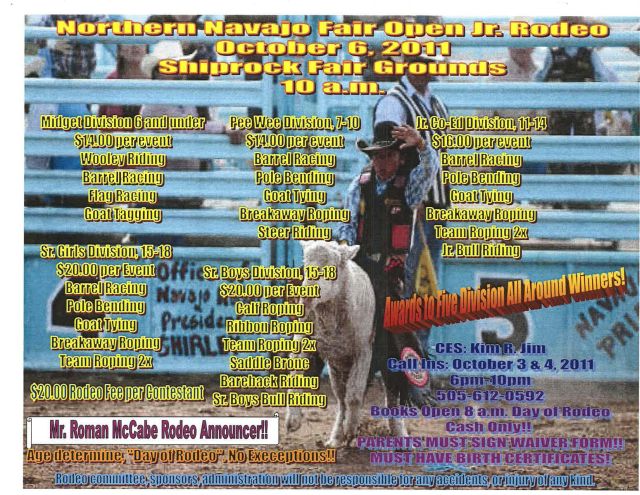
Junior Rodeo at Shiprock Navajo Fair

Northern Navajo Fair Open Junior Rodeo


October 6, 2011

Shiprock Fairgrounds

10:00 AM

Colin’s October 3 and fourth 2011

6 PM to 10 PM

Phone 505-612-0592

Books Open 8:00 AM Day of Rodeo

Cash only

Parents must sign a waiver form!

Mr. Roman McCabe rodeo announcer

Shiprock Northern Navajo Fair Open Junior Rodeo

Women’s Rodeo at Shiprock Navajo Fair

All Women’s Open Show Rodeo


October 5, 2011 @ 7:00 P.M.

Shiprock Fair Grounds

Berrel Racing $40

Breakaway roping $40

Team roping 2x $30 per Roper

flag Racing $30

Goat Tying $30

$20 rodeo fee per contestant

Must be 18 years older

CES: kim R. Jim

Call Ins: October 3, 2011

6 PM to 10 PM

Phone 505-612-0592

Books open one hour prior to rodeo

First to enter last to compete

Cash only

 Women's Rodeo at Shiprock Nation Fair
Women’s Rodeo at Shiprock Nation Fair

Bringing Lights to Navajo Homes

According to the 2000 census, 42.9 percent of residents of the Navajo Nation live below the poverty level, meaning they had an income of less than $8,350 per year.

This proportion of impoverished people is more than four times the average poverty level in the United States. In addition, 21.4 percent of Navajo families lack plumbing, and 62.6 percent lack basic telephone service.

Three quarters of all people living without electricity in the United States reside on the Navajo Indian Reservation in the Four Corners region. It is conservatively estimated that around 18,000 of the 48,000 households on the Navajo Nation lack electricity.

These families use kerosene, propane, and firewood for light and heat. Navajo families spend $20-$40 per month on candles.

Despite being located in the United States, the Navajo Nation suffers from extreme poverty.

According to the 2000 census, 42.9 percent of residents of the Navajo Nation live below the poverty level, meaning they had an income of less than $8,350 per year.

This proportion of impoverished people is more than four times the average poverty level in the United States. In addition, 21.4 percent of Navajo families lack plumbing, and 62.6 percent lack basic telephone service.

The cost of extending power lines through the rugged terrain of the Navajo Nation is extremely high. The average cost to extend a line a single mile is about $27,000 and this cost often cannot be split because a line extension may only reach a few new customers.

Many elderly Navajo have lived their entire lives without electricity, despite promises from the Tribal Government and NTUA. As a result, many people have lost hope that they will ever be provided electricity.

One woman interviewed by Eagle Energy volunteers said that the government promised that electricity would arrive by Christmas over 15 years ago and it had still not arrived. Despite a clear wish for electrification, many Navajo communities have no choice but to burn kerosene and wait.

At a cost of $25 to $35, Eagle Energy’s lights are not much more expensive than a kerosene lantern, and incur no additional monthly cost after purchase. Furthermore, solar technologies provide health benefits by reducing indoor air pollution and help to protect the environment by decreasing greenhouse gas emissions when compared with kerosene use.

Economic Benefits

Cost is also an issue for families that currently have access to grid electricity. With the high poverty levels that exist on the Navajo Nation, many who have access to grid-tied electricity cannot afford their monthly bills.

Many Navajo families interviewed by Eagle Energy volunteers expressed an interest in solar-powered lighting technologies as a way to lower their monthly electricity bills.

Eagle Energy’s solar-powered lights provide a distinct economic advantage compared to kerosene and propane-fueled lanterns because they do not require users to buy multiple replacement fuel canisters per month. Although solar-powered lights come with rechargeable batteries that must be replaced after one or two years, the $5 cost is negligible compared to replacement fuel canisters.

Health Benefits

Solar Lanterns also provide a health benefit over the kerosene lanterns commonly used by the Navajo Nation. Although the health impacts caused by using fuel lighting is an understudied field, a recent article in the International Journal of Indoor Environment and Health attempted to quantify the risk.

The authors found that vendors using simple kerosene lanterns where exposed to particulate matter concentrations significantly greater than the amount present in the ambient air. Such exposure can present long-term health risks. The article concluded that the best solution to combat this problem is the use of solar LED lighting.

Educational and Productivity Benefits

Candles and kerosene lanterns provide a low-quality light source, making it difficult for children to read and do homework, while Eagle Energy’s solar technologies provide high-quality light.

Providing children with access to sustainable energy technologies is also important, as children will be responsible for making sustainable energy choices in the future. Solar lighting technologies can also provide a benefit to people without electricity who work from home, allowing them to work after dark at a lower cost compared to kerosene lanterns.

CO2 Emission Benefits

Kerosene lanterns also produce CO2 emissions, causing harm to the environment. The average kerosene lantern, when used for four hours per night, produces over 100 kilograms of CO2 emissions per year.

If we assume that each of the 18,000 households on the Navajo Nation has just one lantern and uses it for four hours per night, the net greenhouse gas emissions reduction from kerosene lanterns on the Navajo Nation would be over 1.8 million kilograms per year.

For reference, this is equal to driving over four million miles in the average car. Replacing these lanterns with solar-powered lighting technologies would eliminate these harmful emissions.

Navajo Home

Navajo Home

Elephant Energy has expanded to the Navajo Nation in the United States with the help of a small grant from the University of Colorado and our partners Dine Care.  Eagle Energy (as Elephant Energy is known on the Navajo Nation) is working to address the energy needs of rural Navajo families,

Eagle Energy, with the help of Melton Martinez and Dine Care, is currently working with four Navajo Chapters in the Eastern Agency of the Navajo Nation, including Baca Chapter, Thoreau Chapter, Pinedale Chapter, and Mariano Lake Chapter to discuss the most effective ways to finance and distribute ASETs in these rural communities.

Please visit www.elephantenergy.org and donate to help us solve this American injustice through our unique market-based model.

http://www.elephantenergy.org/Navajo_Solar.html

Source: Eagle Energy – Navajo Solar Light Project Summary & Operational Report

100th anniversary of Shiprock Navajo Fair 2011

The Oldest and Most Traditional of the Navajo Fairs is held each fall in the Navajo Land where the Navajo people of the Four Corners come to celebrate the year’s harvest with a community celebration.

The Shiprock Fair started in 1911 and we have photos below of the 1913 fair.

Ya’at’eeh (Welcome) 

The fair will be held from Wednesday, September 28,   to Sunday, October 9, 2011

The Northern Navajo Nation Fair for 2011 Official Website

Facebook Page

Parade Begins Saturday, October 8, at 2011 7:45 am

Click here for Parade Entry Form (PDF file)

My name is Delilah Goodluck, I am the Public Information Officer for the Navajo Nation Nation Museum’s Special Events Section, otherwise known as the Navajo Nation Fair Office in Window Rock AZ.  The Special Events Section has been called in to assist the Northern Navajo Nation Fair (NNNF) staff in Shiprock, NM. Currently, an official website is not available for the NNNF. I have information on the NNNF.

Please call the NNNF Office at 505-368-5789

Or reach me at me 928-309-0207 or  email me at delilah@navajonationmuseum.org

Thank you.

The Shiprock Navajo Fair for 2011 is celebrating its 100th year anniversary.

Shiprock Northern Navajo Nation Fair for 2011 theme:
100 Years of Harvesting and Healing as we teach our children our heritage and come together with our neighbors, friends, and family.

Northern Navajo Nation Fair Schedule of Events

Click Here to download a 8 1/2 by 11 pdf file of the below  schedule

Northern Navajo Nation Fair Schedule of Events

Northern Navajo Nation Fair Schedule of Events

POW WOW Contest -Traditional Song & Dance

POW WOW Contest -Traditional Song & Dance

The Shiprock Northern Navajo Fair is the oldest and most traditional Navajo fair on the Navajo Nation.


Navajo President Ben Shelly and wife Martha at Shiprock Fair
Shiprock Fair 1913, trader's booths, Navajos and cattle

Shiprock Fair 1913, trader's booths, Navajos and cattle

It is held to coincide with the conclusion of an ancient Navajo healing ceremony. The Night Way, a nine-day chant is commonly called “Yeiibichei” ceremony.


The fair offers  events including NNRA Sanction Rodeo, POW WOW Contest, Traditional Song & Dance, Gourd Dancers and crafts, exhibits of horticulture, science, agriculture and livestock. The Miss Northern Navajo competition, a baby contest, concerts to comedians, song and dance competitions. Food concessionaires, a carnival and of course the SNF parade through the main street of Shiprock on Saturday, October 8, 2011 at 7:45 AM.

Shiprock Fair Parade

Shiprock Fair Parade


Some of the events

Thursday, October 6, 2011
4:00 pm – 11:00 pm Blues Festival Jam

Friday, October 7, 2011
7:00 pm Northern Navajo Nation PBR “Suicide Prevention Awareness Day” – Wear Purple & Turquiose
4:00 pm – 11:00 pm Rap/Hip Hop Show

Saturday, October 8, 2011
7:45 am Parade BEGINS
1:00 pm NNRA Sanction Rodeo
7:00 pm NNRA Sanction Rodeo
7:00 pm – 11:00 pm Country Concert
10:00 am – Midnight Metal Show

CONTEST POW WOW

OCTOBER 6th  THURSDAY
7:00 PM 11:00 PM Round Dance

OCTOBER 7th  FRIDAY
3:00 PM Registration Opens
5:00 PM Gourd Dance Begins
7:00 PM Grand Entry

OCTOBER 8th  SATURDAY
9:00 AM Registration Opens
11:00 AM Gourd Dance Begins
1:00 PM Grand Entry; Registration Closes
5:00 PM Supper Break; Gourd Dance Begins
7:00 PM Grand Entry


More photos of the 1913 Shiprock Fair

Shiprock Fair 1913, Ed Davies' Two Grey Hills Trading Post Booth

Shiprock Fair1913, Ed Davies' Two Grey Hills Trading Post Booth


Shiprock Fair 1913, Ed Davies' Two Grey Hills Trading Post Booth

Shiprock Fair 1913, Ed Davies' Two Grey Hills Trading Post Booth


Shiprock Fair 1913, San Juan School display of produce and Navajo blankets

Shiprock Fair 1913, San Juan School display of produce and Navajo blankets


Shiprock Fair 1913 - Navajo men, women and children with Navajo Rugs

Shiprock Fair 1913 - Navajo men, women and children with Navajo Rugs