Ancient Navajo and Native Americans Migrations

This is the story of the Diné, The People, as the Navajos call themselves and there migration to Dinétah.

Dinétah is the traditional homeland of the Navajo tribe of Native Americans. In the Navajo language, the word “Dinétah” means “among the people”.

The Navajo, are the largest Native American group in North America.

The Navajos say they came from the north and archaeologists bear them out. From Bering Strait to the shores of Hudson Bay and from the Arctic Ocean to the American line, the native inhabitants are chiefly Athabascans.

Then down the coast of the Pacific, near the coast but seldom on it, little tribes of Athabascan stock mark the trail of a great southern migration which may or may not have brought the ancestors of the Navajos.

‘The earliest inhabitants of America were hunters who migrated from the Asian mainland across the Bering Straits land bridge between 40,000 and 25,000 B.C.E. ‘ (European Voyages of Exploration: Latin America University of Calgary The Applied History Research Group)
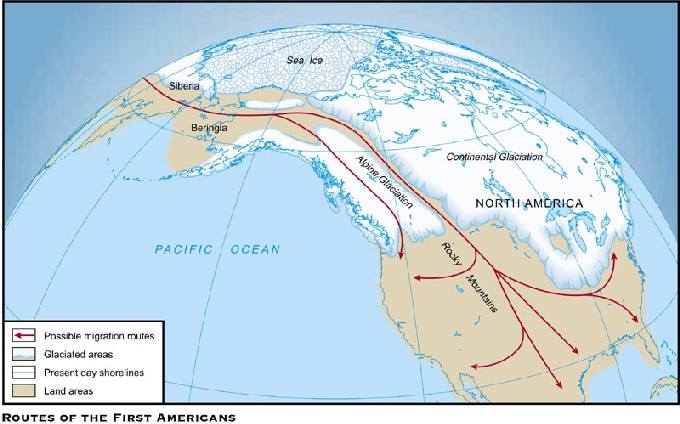
Routes if Ancient Americas Migrations

That a land bridge between Asia and North America existed during the last ice age is strongly supported by geological evidence. Ocean water locked up in glacial ice lowered sea levels to the point where a corridor up to 1600km or more wide existed between Siberia and Alaska.

“Long before Euro-Americans entered the Great Basin, substantial numbers of people lived within the present boundaries of Utah. Archaeological reconstructions suggest human habitation stretching back some 12,000 years. The earliest known inhabitants were members of what has been termed the Desert Archaic Culture–nomadic hunter-gatherers with developed basketry, flaked-stem stone tools, and implements of wood and bone. They inhabited the region between 10,000 B.C. and A.D. 400.

These peoples moved in extended family units, hunting small game and gathering the periodically abundant seeds and roots in a slightly more cool and moist Great Basin environment.

About A.D. 400, the Fremont Culture began to emerge in northern and eastern Utah out of this Desert tradition. The Fremont peoples retained many Desert hunting-gathering characteristics yet also incorporated a maize-bean-squash horticultural component by A.D. 800-900. They lived in masonry structures and made sophisticated basketry, pottery, and clay figurines for ceremonial purposes. Intrusive Numic peoples displaced or absorbed the Fremont sometime after A.D. 1000.

Beginning in A.D. 400, the Anasazi, with their Basketmaker Pueblo Culture traditions, moved into southeastern Utah from south of the Colorado River. Like the Fremont to the north the Anasazi (a Navajo word meaning “the ancient ones”) were relatively sedentary peoples who had developed a maize-bean-squash-based agriculture.

The Anasazi built rectangular masonry dwellings and large apartment complexes that were tucked into cliff faces or situated on valley floors like the structures at Grand Gulch and Hovenweep National Monument. They constructed pithouse granaries, made coiled and twined basketry, clay figurines, and a fine gray-black pottery. The Anasazi prospered until A.D. 1200-1400 when climactic changes, crop failures, and the intrusion of Numic hunter-gatherers forced a southward migration and reintegration with the Pueblo peoples of Arizona and New Mexico.”

ddd Archaeologists believe the indigenous peoples that eventually populated the Americas occurred in three separate migrations.The largest of these groups is referred to as the Amerind (Paleo-Indians). The Amerind, which includes most Native Americans south of the Canadian border, commenced around 11,500 B.C..A second migration called the Na-Dene occurred between 10,000 B.C. and 8, 000 B.C.. Even though at this point the Bering Sea separated Siberia and Alaska, it was only three miles wide in some places.

The Athapascan speaking populations of Canada and the United States belong to this group of migrants. The Apache and Navajo in the southwestern United States are from the Athapascan migrants.

The third migration around 3,000 B.C. included the Aleuts and Eskimos of Alaska, Canada, and the Aleutian Islands (Taylor).

According to modern belief The Navajos are descended from that great race which produced Genghis Khan and conquered in his lifetime half the world. While the victorious Mongols were driving relentlessly west and south, making kings and emperors their vassals, some small fragments of their clans were crossing Bering Sea, probably on the ice, and gradually overrunning North America.

Navajo men

Photography by Dane Coolidge NAVAJO TYPES Above: Hosteen Yazzi, Short Man, showing Pueblo influence (left); Hosteen Nez, Tall Man (right). Below: Kia ahni Nez, Tall Kia abni (left); Hosteen Tso, Big Man (right).

There are, many significant facts which, to the student of literature at least, prove an Asiatic origin.The Venetian traveler, Marco Polo, who visited the Court of Kublai Khan in 1275, gives some very interesting accounts of the Mongols,At a later date the French Jesuit, M. Hue, describes the wild tribes of the Grasslands. We have thus a picture of the social life of the Mongols with which to make comparisons.
Both authors agree that among the primitive Mongols the women attended to all the trading.They bought and sold and provided every necessity for their husbands and families: ‘The time of the men,’ as Marco Polo says, ‘being entirely devoted to hunting, hawking, and matters that relate to military life.’

The same is true among the Navajos to-day, as far as the women are concerned.

“Wherever they went — until the white people subdued them — the Dineh’ like the Mongols, were raiders and spoilers. The mystery of the vanished Cliff-Dwellers is a mystery no longer when we know the nature of the warriors who came among them. The Zuñis told Cushing that twenty-two different tribes had been wiped out by the Enemy People, as they called them; and the walled-up doors of proud Pueblo Bonito testify mutely to the fears of its inhabitants.” (Dane Coolidge 1930)

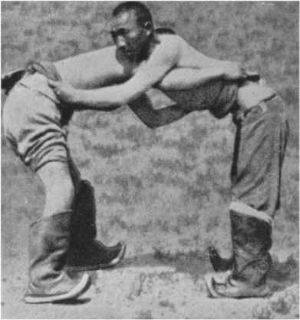
MONGOLS WRESTLING

Photograph by Dane Coolidge NAVAJOS WRESTLING, KAYENTA, 1913

MONGOLS WRESTLING

Photograph from the Central Asiatic Expeditious of the American Museum of Natural History MONGOLS WRESTLING

History of the Navajo

Ancient Navajo and Native Americans Migrations
First Contact with the Navajo – 1540
The Americans and the Navajo
The Mexicans and the Navajo
The Spanish and the Navajo
Navajo Long Walk to Bosque Redondo
Antonio el Pinto Chief of the Navajos

Navajo sheepherder with Navajo-Churro sheep about 1920

The Navajo-Churro, or Churro for short, was the very first breed of domesticated sheep in the New World and dates back to the 16th century where it was used to feed and clothe the armies of the conquistadors and Spanish settlers.

Navajo sheepherder with sheep

Navajo sheepherder with Churro sheep

Although secondary to the Merino, the Churra (later corrupted to “Churro” by American frontiersmen) was prized by the Spanish for its remarkable hardiness, adaptability and fecundity.


Domestic scene among the Navajo Indians

Native American (Navajo) women and men sit beside a summer hogan constructed of logs and brush, in Arizona or New Mexico. One woman weaves at a loom made of logs and sticks. Shows wool thread and woven rugs.

Domestic scene among the Navajo Indians

Domestic scene among the Navajo Indians

Date     1873
Notes     “Expedition of 1872, 1st Lieut. Geo. M. Wheeler. Corps of Engineers, Commanding.” printed on stereo card.; Descriptive information printed on label on verso reads: “Domestic scene among the Navajoe Indians. The women weaving blankets, and the “Lords” looking disdainfully on. The blankets seen are made from native wool, black and white.”; Formerly F6658, X-33054; Number “69” etched in original negative and reproduced in photographic print.; Stamp on verso shows eagle logo and reads: “War Department, Corps of Engineers, U.S. Army. Geographical and Geological Explorations and Surveys West of the 100th Meridian.”; Title, attribution and numbers: “No. 25” and “F. 69.” printed on label on verso.; Library owns additional iterations of this image in various formats: 1 photographic print ; 16 x 12 cm. (6 x 5 in.), 1 copy negative ; 18 x 13 cm. (7 x 5 in.); R7110073438
Physical Description     1 photographic print on stereo card : albumen, stereograph ; 10 x 18 cm. (4 x 7 in.

Navajo People Website Links:
Navajo Culture – Navajo History – Navajo Art – Navajo Clothing Navajo Pictures – Navajo Rugs – Navajo Language– Navajo Jewelry – Navajo Code Talker – Navajo Pottery – Navajo Legends – Hogan’s – Sand Painting – Navajo Food – Navajo News – Navajo Nation

)

Navajo “Baby Names” & Navajo Naming Concepts (Video)

Video by Terry Teller (Daybreak Warrior)

Terry says:
“I get e-mails and YouTube messages saying, “I am having a baby and want to give my child a Navajo name. Can I name them such & such?” Or, “How do you translate this into Navajo for a Navajo name?” It’s kind of hard because although you’ll have a name written all cool, you may not be pronouncing it correctly or it may not flow with the general concepts that go behind the “typical” traditional Navajo names.”


See more Daybreak Warrior Videos here:
http://www.youtube.com/user/daybreakwarrior


Baby and Navajo woman interior of summer hogan

Baby and Navajo woman interior of summer hogan.Baby and Navajo woman interior of summer hogan.

Rights Restrictions applying to use or reproduction of this image available from the Western History/Genealogy Dept., Denver Public Library

Native American (Navajo) woman and child sit inside a brush-covered summer hogan.

The woman holds a large piece of cloth; the child looks at a sheepskin. Sheepskins, a blanket, and other fur pelts lie on the floor.

Others hang from a wooden pole placed horizontally along the wooden pole and brush-covered walls of the hogan.

A pair of dark pants, possibly a dark shirt, and a leather ammunition belt hang from one of the horizontal poles. Date: 1908.

Navajo People Website Links:
Navajo CultureNavajo HistoryNavajo ArtNavajo Clothing Navajo PicturesNavajo RugsNavajo LanguageNavajo JewelryNavajo Code TalkerNavajo PotteryNavajo LegendsHogan’sSand PaintingNavajo Food Navajo NewsNavajo Nation

Navajo Nation running out of water

“Some 40 percent of the Navajo tribe’s 190,000 residents have no potable supply, and many receive their water out of the back of trucks.”

The Navajo Nation — which spans is the largest and, arguably, the driest American Indian reservation in the United States.

Navajo Nation, water

Delcon, Arizona: In the Navajo Nation, water is so scarce that some 40 percent of the tribe’s 190,000 residents have no potable supply, and many receive their water out of the back of trucks.

Now, with the help of veteran Arizona Senator Jon Kyl, a Republican and one of Capitol Hill’s senior experts on water law, Navajo leaders and their lawyers appear to be steadily inching closer to a long-awaited legal settlement to draw millions of gallons of water for the reservation from the Little Colorado River.

The settlement would be the 27th Indian water-rights agreement to reach completion since the federal government began negotiating water rights with tribes in the 1970s, during the Carter administration.

Like the others, the Little Colorado River agreement has followed years of intense mediation and legal negotiation by this western tribe, other water users, and the U.S. Department of the Interior.

More Information full article:
http://www.circleofblue.org/waternews/2011/world/water-law-racing-an-arizona-senators-retirement-dry-navajo-nation-draws-closer-to-securing-more-water/

2011 Miss Northern Navajo Nation Fair Pageant

The  Miss Northern Navajo Nation Fair Pageant


Click On the Photo Link below to see all photos from the Pageant.

Miss Northern Navajo 2011-2012

 Congratulations to Koltey Tso, the new Miss Northern Navajo Nation 2011-12.
Andrianna Alexia Yazzie – 1st runner up
Martha McCabe – 2nd runner up

First Prize $1.000.00 Scholarship

Second Prize $500.00 Scholarship

Third Prize $250.00 Scholarship

Will be located at:

Phil L. Thomas
Performing Arts Center
Shiprock, NM 87420-3578
(505) 368-2490
On US 64 near Shiprock High School

Pick up applications at:

Northern Navajo Nation Fair Office
100 North Uranium Boulevard
Shiprock, New Mexico 87420

ELIGIBILITY CRITERIA

Must submit completed contestant application
Must be an enrolled female member of the Navajo Nation
Must be 17 – 25 years of age, never married, no children
Must be a senior this SY (2011-2012),HS Diploma or GED equivalent
Must have some knowledgeable of the Navajo culture, history & tradition
Must submit 50 – 100 word essay on:
“Why I choose to run for Miss Northern Navajo Fair Queen”.
Must not have previously held the title of Miss Northern Navajo Nation Fair Queen

Miss Northern Navajo Tanya Lister 2009-2010

Miss Northern Navajo Tanya Lister 2009-2010

CONTESTANT APPLICATION INFORMATION

Contestant Applications can be picked up at the Shiprock Fair Office located at: Shiprock Fair grounds in the ( white trailer).

Application Deadline: All applications must be in the Shiprock Fair Office by September 30, 2011, and attend the contestants orientation on September 30, 2011, at (PTPAC) center at 4:00pm.

CONTACT INOFORMATION:

Northern Navajo Nation Fair Board
PO Box 973
Shiprock, New Mexico 87420
Phone: (505)368-5789 or Mae Sandoval, Pageant Coordinator at (505)368-5549


Navajo People
on Google+

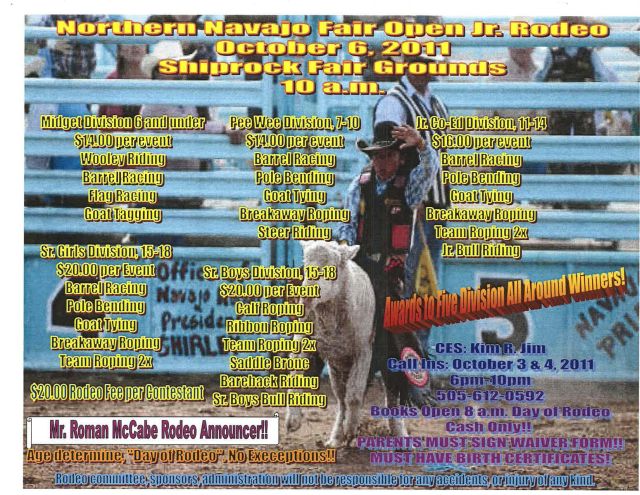
Junior Rodeo at Shiprock Navajo Fair

Northern Navajo Fair Open Junior Rodeo


October 6, 2011

Shiprock Fairgrounds

10:00 AM

Colin’s October 3 and fourth 2011

6 PM to 10 PM

Phone 505-612-0592

Books Open 8:00 AM Day of Rodeo

Cash only

Parents must sign a waiver form!

Mr. Roman McCabe rodeo announcer

Shiprock Northern Navajo Fair Open Junior Rodeo

Women’s Rodeo at Shiprock Navajo Fair

All Women’s Open Show Rodeo


October 5, 2011 @ 7:00 P.M.

Shiprock Fair Grounds

Berrel Racing $40

Breakaway roping $40

Team roping 2x $30 per Roper

flag Racing $30

Goat Tying $30

$20 rodeo fee per contestant

Must be 18 years older

CES: kim R. Jim

Call Ins: October 3, 2011

6 PM to 10 PM

Phone 505-612-0592

Books open one hour prior to rodeo

First to enter last to compete

Cash only

 Women's Rodeo at Shiprock Nation Fair
Women’s Rodeo at Shiprock Nation Fair

Bringing Lights to Navajo Homes

According to the 2000 census, 42.9 percent of residents of the Navajo Nation live below the poverty level, meaning they had an income of less than $8,350 per year.

This proportion of impoverished people is more than four times the average poverty level in the United States. In addition, 21.4 percent of Navajo families lack plumbing, and 62.6 percent lack basic telephone service.

Three quarters of all people living without electricity in the United States reside on the Navajo Indian Reservation in the Four Corners region. It is conservatively estimated that around 18,000 of the 48,000 households on the Navajo Nation lack electricity.

These families use kerosene, propane, and firewood for light and heat. Navajo families spend $20-$40 per month on candles.

Despite being located in the United States, the Navajo Nation suffers from extreme poverty.

According to the 2000 census, 42.9 percent of residents of the Navajo Nation live below the poverty level, meaning they had an income of less than $8,350 per year.

This proportion of impoverished people is more than four times the average poverty level in the United States. In addition, 21.4 percent of Navajo families lack plumbing, and 62.6 percent lack basic telephone service.

The cost of extending power lines through the rugged terrain of the Navajo Nation is extremely high. The average cost to extend a line a single mile is about $27,000 and this cost often cannot be split because a line extension may only reach a few new customers.

Many elderly Navajo have lived their entire lives without electricity, despite promises from the Tribal Government and NTUA. As a result, many people have lost hope that they will ever be provided electricity.

One woman interviewed by Eagle Energy volunteers said that the government promised that electricity would arrive by Christmas over 15 years ago and it had still not arrived. Despite a clear wish for electrification, many Navajo communities have no choice but to burn kerosene and wait.

At a cost of $25 to $35, Eagle Energy’s lights are not much more expensive than a kerosene lantern, and incur no additional monthly cost after purchase. Furthermore, solar technologies provide health benefits by reducing indoor air pollution and help to protect the environment by decreasing greenhouse gas emissions when compared with kerosene use.

Economic Benefits

Cost is also an issue for families that currently have access to grid electricity. With the high poverty levels that exist on the Navajo Nation, many who have access to grid-tied electricity cannot afford their monthly bills.

Many Navajo families interviewed by Eagle Energy volunteers expressed an interest in solar-powered lighting technologies as a way to lower their monthly electricity bills.

Eagle Energy’s solar-powered lights provide a distinct economic advantage compared to kerosene and propane-fueled lanterns because they do not require users to buy multiple replacement fuel canisters per month. Although solar-powered lights come with rechargeable batteries that must be replaced after one or two years, the $5 cost is negligible compared to replacement fuel canisters.

Health Benefits

Solar Lanterns also provide a health benefit over the kerosene lanterns commonly used by the Navajo Nation. Although the health impacts caused by using fuel lighting is an understudied field, a recent article in the International Journal of Indoor Environment and Health attempted to quantify the risk.

The authors found that vendors using simple kerosene lanterns where exposed to particulate matter concentrations significantly greater than the amount present in the ambient air. Such exposure can present long-term health risks. The article concluded that the best solution to combat this problem is the use of solar LED lighting.

Educational and Productivity Benefits

Candles and kerosene lanterns provide a low-quality light source, making it difficult for children to read and do homework, while Eagle Energy’s solar technologies provide high-quality light.

Providing children with access to sustainable energy technologies is also important, as children will be responsible for making sustainable energy choices in the future. Solar lighting technologies can also provide a benefit to people without electricity who work from home, allowing them to work after dark at a lower cost compared to kerosene lanterns.

CO2 Emission Benefits

Kerosene lanterns also produce CO2 emissions, causing harm to the environment. The average kerosene lantern, when used for four hours per night, produces over 100 kilograms of CO2 emissions per year.

If we assume that each of the 18,000 households on the Navajo Nation has just one lantern and uses it for four hours per night, the net greenhouse gas emissions reduction from kerosene lanterns on the Navajo Nation would be over 1.8 million kilograms per year.

For reference, this is equal to driving over four million miles in the average car. Replacing these lanterns with solar-powered lighting technologies would eliminate these harmful emissions.

Navajo Home

Navajo Home

Elephant Energy has expanded to the Navajo Nation in the United States with the help of a small grant from the University of Colorado and our partners Dine Care.  Eagle Energy (as Elephant Energy is known on the Navajo Nation) is working to address the energy needs of rural Navajo families,

Eagle Energy, with the help of Melton Martinez and Dine Care, is currently working with four Navajo Chapters in the Eastern Agency of the Navajo Nation, including Baca Chapter, Thoreau Chapter, Pinedale Chapter, and Mariano Lake Chapter to discuss the most effective ways to finance and distribute ASETs in these rural communities.

Please visit www.elephantenergy.org and donate to help us solve this American injustice through our unique market-based model.

http://www.elephantenergy.org/Navajo_Solar.html

Source: Eagle Energy – Navajo Solar Light Project Summary & Operational Report