
Photographer: Terry Eiler
Repository: U.S. National Archives
Subjects:
Red Rock (Navajo Nation, Arizona, United States, Ford 150 Truck, 1950s
Information about the Diné (Navajo People), Language, History, and Culture
Photographer: Terry Eiler
Repository: U.S. National Archives
Subjects:
Red Rock (Navajo Nation, Arizona, United States, Ford 150 Truck, 1950s
From Little Colorado Gorge Navajo Tribal Park you can get a fantastic view of the deep narrow gorge of the Little Colorado River.

Little Colorado River Gorge
The Little Colorado River starts at Mt. Baldy in Arizona through the Navajo Nation and then makes its way northward before reaching the Colorado River in the Grand Canyon.
The visitor center is located at the junction of Highway 89 and Highway 64 in Cameron, Arizona.

Little Colorado River Gorge
HOURS & FEES
Entrance Fee Hours are:
8:00am – 7:00pm, 7 Days a week
Entrance Fee for at VIEWPOINT 1 is:
Per Car- $2.00
Per Motorcycle – $1.00
Per Tour Bus – $10.00
Per Commercial Van – $5.00
NO Entry Fees at VIEWPOINT 2
CONTACT INFORMATION
Little Colorado River Tribal Park Office / Visitor Center
P.O. Box 459
Cameron, AZ 86020
tel : 928-679-2303
fax : 928-679-2017
The Four Corners Monument is the only place in the United States where four states (Arizona, Colorado, New Mexico, and Utah) come together at one place.
 Here you can stand in four states at the same time.
Photo by Harold Carey Jr.
The monument is maintained as a tourist attraction by the Navajo Nation Parks and Recreation Department.
The Four Corners region didn’t always have such a clear-cut divide. Part of Mexico until 1848, the area has since been home to countless squabbles over state lines.
The original marker erected in 1912 was a simple cement pad, but has since been redone in granite and brass. The Visitor Center is open year round, and features a Demonstration Center with Navajo artisans. Navajo vendors sell handmade jewelry, crafts and traditional Navajo foods nearby.
The monument was reconstruction in 2010. It consists of a granite disk embedded with a smaller bronze disk around the point, surrounded by smaller, appropriately located state seals and flags representing both the states and tribal nations of the area. Circling the point, with two words in each state, the disk reads, “Four states here meet in freedom under God.”

Picnic tables and self-contained restrooms are available. Services and accommodations are very limited to small cafes, grocery stores and self-service gasoline stations within a 30 mile radius.
We recommend that you have plenty of water, food, snacks, hand wipes and extra toiletries when visiting. The area is very remote, no running water, no electricity, no telephones.
Admission $3.00 (all ages)
Open 7 am – 8 pm (June – Sept)
Open 8 am – 5 pm (Oct – May)
Four Corners Park: 928-871-6647

There is a small visitor center, which is open year round. It features a Demonstration Center with Native American artisans. Vendors sell handmade jewelry, crafts and traditional foods nearby. Self-contained toilets are available.
Monument Valley (Navajo: Tsé Bii’ Ndzisgaii, meaning valley of the rocks) stretches across the state boundaries of northeast Arizona and southern Utah.
It is located on the border of southeastern Utah and northern Arizona, Monument Valley contains some of the most dramatic rock formations on the Colorado Plateau.

Hogans at Monument Valley Tribal Park
The valley’s earliest inhabitants include the Ice Age Paleo-Indian hunters (12,000-6,000 B.C.), Archaic hunter-gatherers (6,000 B.C.-A.D. 1), and Anasazi farmers (A.D. 1-1300).
In 1924 Harry Goulding established a post which is still in operation today, although under different management. During the 1950s Goulding encouraged the employment of Navajos in the uranium industry as well as in holding parts in the movie industry.

Monument Valley Tribal Park
Monument Valley became known throughout the world when it was featured in such western film classics as John Ford’s Stagecoach, She Wore a Yellow Ribbon, and Cheyenne Autumn.
The Navajo Nation just remodeled visitor center at one of the country’s most noted tribal parks.
Monument Valley Tribal Park, the destination of more than 250,000 visitors per year.
Monument Valley to hosts a balloon festival in February free and open to the public.
“All the staff at Monument Valley, they are all Navajo,” Hongeva said. “All the tour guides are Navajo and all the vendors who sell food or jewelry, they are Navajo, and they are all individuals who live there locally.”
Tour guides take visitors through the park’s 17 miles of scenic roads, past some of the most acclaimed formations of the American Southwest.
A $14 million lodging, called The View Hotel, was constructed on the nearly 30,000-acre park, where several Navajo families still maintain grazing rights.
Getting there:
From Flagstaff, head east on Highway 40 to Highway 89 (Page, Grand Canyon Exit). Travel north on Highway 89 to Highway 160. Travel east on Highway 160 to Highway 163 (Kayenta exit). Travel north into Utah to Goulding’s Lodge then take Indian Route 40 southeast to the entrance to Monument Valley. The closest airport is Farmington, New Mexico. It is about two and a half hours east of the park.
This is the story of the Diné, The People, as the Navajos call themselves and there migration to Dinétah.
Dinétah is the traditional homeland of the Navajo tribe of Native Americans. In the Navajo language, the word “Dinétah” means “among the people”.
The Navajo, are the largest Native American group in North America.
The Navajos say they came from the north and archaeologists bear them out. From Bering Strait to the shores of Hudson Bay and from the Arctic Ocean to the American line, the native inhabitants are chiefly Athabascans.
Then down the coast of the Pacific, near the coast but seldom on it, little tribes of Athabascan stock mark the trail of a great southern migration which may or may not have brought the ancestors of the Navajos.
‘The earliest inhabitants of America were hunters who migrated from the Asian mainland across the Bering Straits land bridge between 40,000 and 25,000 B.C.E. ‘ (European Voyages of Exploration: Latin America University of Calgary The Applied History Research Group)
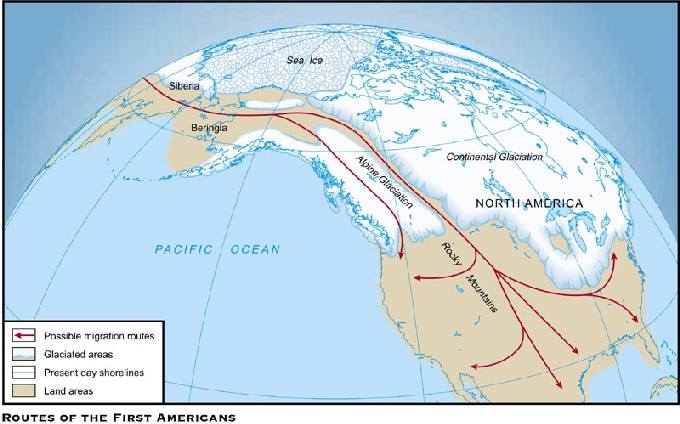
That a land bridge between Asia and North America existed during the last ice age is strongly supported by geological evidence. Ocean water locked up in glacial ice lowered sea levels to the point where a corridor up to 1600km or more wide existed between Siberia and Alaska.
“Long before Euro-Americans entered the Great Basin, substantial numbers of people lived within the present boundaries of Utah. Archaeological reconstructions suggest human habitation stretching back some 12,000 years. The earliest known inhabitants were members of what has been termed the Desert Archaic Culture–nomadic hunter-gatherers with developed basketry, flaked-stem stone tools, and implements of wood and bone. They inhabited the region between 10,000 B.C. and A.D. 400.
These peoples moved in extended family units, hunting small game and gathering the periodically abundant seeds and roots in a slightly more cool and moist Great Basin environment.
About A.D. 400, the Fremont Culture began to emerge in northern and eastern Utah out of this Desert tradition. The Fremont peoples retained many Desert hunting-gathering characteristics yet also incorporated a maize-bean-squash horticultural component by A.D. 800-900. They lived in masonry structures and made sophisticated basketry, pottery, and clay figurines for ceremonial purposes. Intrusive Numic peoples displaced or absorbed the Fremont sometime after A.D. 1000.
Beginning in A.D. 400, the Anasazi, with their Basketmaker Pueblo Culture traditions, moved into southeastern Utah from south of the Colorado River. Like the Fremont to the north the Anasazi (a Navajo word meaning “the ancient ones”) were relatively sedentary peoples who had developed a maize-bean-squash-based agriculture.
The Anasazi built rectangular masonry dwellings and large apartment complexes that were tucked into cliff faces or situated on valley floors like the structures at Grand Gulch and Hovenweep National Monument. They constructed pithouse granaries, made coiled and twined basketry, clay figurines, and a fine gray-black pottery. The Anasazi prospered until A.D. 1200-1400 when climactic changes, crop failures, and the intrusion of Numic hunter-gatherers forced a southward migration and reintegration with the Pueblo peoples of Arizona and New Mexico.”
 |
Archaeologists believe the indigenous peoples that eventually populated the Americas occurred in three separate migrations.The largest of these groups is referred to as the Amerind (Paleo-Indians). The Amerind, which includes most Native Americans south of the Canadian border, commenced around 11,500 B.C..A second migration called the Na-Dene occurred between 10,000 B.C. and 8, 000 B.C.. Even though at this point the Bering Sea separated Siberia and Alaska, it was only three miles wide in some places.
The Athapascan speaking populations of Canada and the United States belong to this group of migrants. The Apache and Navajo in the southwestern United States are from the Athapascan migrants. The third migration around 3,000 B.C. included the Aleuts and Eskimos of Alaska, Canada, and the Aleutian Islands (Taylor). |
According to modern belief The Navajos are descended from that great race which produced Genghis Khan and conquered in his lifetime half the world. While the victorious Mongols were driving relentlessly west and south, making kings and emperors their vassals, some small fragments of their clans were crossing Bering Sea, probably on the ice, and gradually overrunning North America.
 Photography by Dane Coolidge NAVAJO TYPES Above: Hosteen Yazzi, Short Man, showing Pueblo influence (left); Hosteen Nez, Tall Man (right). Below: Kia ahni Nez, Tall Kia abni (left); Hosteen Tso, Big Man (right). |
There are, many significant facts which, to the student of literature at least, prove an Asiatic origin.The Venetian traveler, Marco Polo, who visited the Court of Kublai Khan in 1275, gives some very interesting accounts of the Mongols,At a later date the French Jesuit, M. Hue, describes the wild tribes of the Grasslands. We have thus a picture of the social life of the Mongols with which to make comparisons. Both authors agree that among the primitive Mongols the women attended to all the trading.They bought and sold and provided every necessity for their husbands and families: ‘The time of the men,’ as Marco Polo says, ‘being entirely devoted to hunting, hawking, and matters that relate to military life.’ The same is true among the Navajos to-day, as far as the women are concerned. |
“Wherever they went — until the white people subdued them — the Dineh’ like the Mongols, were raiders and spoilers. The mystery of the vanished Cliff-Dwellers is a mystery no longer when we know the nature of the warriors who came among them. The Zuñis told Cushing that twenty-two different tribes had been wiped out by the Enemy People, as they called them; and the walled-up doors of proud Pueblo Bonito testify mutely to the fears of its inhabitants.” (Dane Coolidge 1930)
 Photograph by Dane Coolidge NAVAJOS WRESTLING, KAYENTA, 1913 |
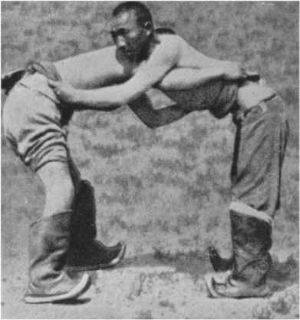 Photograph from the Central Asiatic Expeditious of the American Museum of Natural History MONGOLS WRESTLING |
History of the Navajo
Ancient Navajo and Native Americans Migrations
First Contact with the Navajo – 1540
The Americans and the Navajo
The Mexicans and the Navajo
The Spanish and the Navajo
Navajo Long Walk to Bosque Redondo
Antonio el Pinto Chief of the Navajos
