Archives for March 2011

Navajo creation story – Nihalgai – The Glittering or White World

 The Glittering or White World

The Locust,  was the first to reach the next world. He looked around, and saw that the world was covered with water that  glittered and everything looked white. This is why they call it the Glittering World or White World.
The other beings followed Locust, and everyone came into the White World. The place where they came is called Hajinei. Many people say this place is somewhere in the La Plata Mountains, in Colorado.
Note:(Locust also means grasshopper, cicada)

Navajo Creation Story Painting by Kee Lee

Navajo Creation Story Painting by Kee Lee – Nizhoni Fine Arts Competition – Navajo Nation Fair 2012

Even though they escaped the water in the Third World, the beings were not safe. The water kept rising up after them.

First Man asked the Water Buffalo why she had come and why she had sent the flood. She said nothing. Then the Coyote drew the two babies from his coat and said that it was, perhaps, because of them.

The Turquoise Boy took a basket and filled it with turquoise. On top of the turquoise he placed the blue pollen,  from the blue flowers,and the yellow pollen from the corn; and on top of these he placed the pollen from the water flags,  and again on top of these he placed the crystal, which is river pollen.

This basket he gave to the Coyote who put it between the horns of the Water Buffalo. The Coyote said that with this sacred offering he would give back the male child. He said that the male child would be known as the Black Cloud or Male Rain, and that he would bring the thunder and lightning. The female child he would keep.

She would be known as the Blue, Yellow, and White Clouds or Female Rain. She would be the gentle rain that would moisten the earth and help them to live. So he kept the female child, and he placed the male child on the sacred basket between the horns of the Water Buffalo. And the Water Buffalo disappeared, and the waters with her.

Soon, First Man and First Woman began to make things the way they were supposed to be. The Holy People helped them. Their first job was to rebuild the mountains. They had brought soil from the Yellow World. With this they made mountains in all four directions.

Then, the people made a fire. To start it, they used flint. The flint also was brought from the Yellow World. The fire was started with four kinds of wood: fir, pinyon, spruce and juniper. lt is said that these kinds of wood should be treated with respect, even today. They should not be misused.

The fire made a loud noise. The noise was so loud that some of the beings were afraid. One of them broke a branch from a tree, and stuck the branch in the fire. This made the noise go away. Because of this, a song and a prayer were made for the tree branch. This branch was the first fire poker. To this day, the poker is respected.

When they had fire, the people made a sweatbath. They built a sweathouse. They made songs and prayers for it. First Man was the first to use these things.

1-4a Forth World

Creation Story Poster- Ni’hodilhil First World
Illustrations by Theresa Breznau.
© 2013 Heritage Language Resource Center. All rights reserved
To purchase see bottom of page.

First Man and First Woman wanted a hogan. They wondered where to build it. They looked around, and saw many trails leading to other beings’ homes. But there were no other hogans at Huerfano Mesa. So first Man and First Woman built their home there. Talking God helped to build the first hogan. This was a male hogan. lt was like the forked stick hogan we have today. lt had a doorway facing east. This let in the early morning light. The male hogan was only for ceremonies.

First Man and First Woman still needed a home where they could live. With the help of other beings, they built a female hogan. This hogan was made of mud and logs. lt was shaped like a circle. This was the place where the people lived and worked.

By now First Man and First Woman had become human. They were like us. They lived at Huerfano Mesa. For food, they ate wild plants and animals. The Holy People made a song and prayer to let plants grow. Then the people planted their own food.

After this, there were four seasons. ln the spring, the plants came up from the ground. ln the winter, the plants died and were hidden under the snow. Then in the spring they came up again. The plants grew into crops like corn, beans and squash. But all was not well. There were monsters who hurt people. Horned Monster chased people and killed them with his horns. There was a monster that kicked people off the edge of a cliff. Another monster killed people by staring at them until they were under his spell. Then he ate them.

First Man and First Woman could not stop the monsters. They did not know what to do. Then one day they looked up. They saw a cloud over Gobernador Knob. First Man went to the top to see what the cloud was. ln the cloud was a baby girl.

First Man lifted the baby into his arms. He carried her down to First Woman. The Holy People helped First Man and First Woman raise the baby girl. They named her Changing Woman. ln time, Changing Woman grew to be an adult. She had twin sons. One was named Ghild Born of Water. The other was called Monster Slayer. The twins grew to be tall and strong. One day they went hunting. They looked down, and saw a hole in the ground.

Smoke was coming out of the hole. They looked closer, and heard a voice say, “Come in.” They climbed down into the hole. At the bottom, they found Spider Woman. The Twins always wondered who was their father. They asked Spider Woman about this. “The Sun is your father,” she told them. The Twins decided to meet their father. They left Spider Woman, and went toward the Sun.

It was long, hard trip. Many things tried to keep the boys from their father. Finally, they reached the Sun. They told him about the monsters that were hurting people. The Sun promised to help get rid of the monsters. Before the Twins left, their father gave them weapons and knowledge. “Use these to kill the monsters,” the Sun said.

So the Twins left. Monster Slayer used his new weapons to kill many monsters. His brother helped.

The boys stripped off his helmet and coat-of-mail and put them in his two big baskets, to carry home to their mother. Then the younger brother, Child-of-the-Water, cut off the giant’s scalp, whence his other name, the Cutter. When the twins got back to the Holy Hohrahn, they found their mother making baby-tracks of corn-pollen, as a prayer for the return of her sons. She also had a long piece of turquoise, which she held up to the Sun. When smoke arose from the upper end, it was a sign that the boys were in danger. When drops of blood appeared at the lower end, it was a sign they had killed their enemies.

The next morning the Slayer went out alone and killed the great one-horned monster which had tried to eat him up. The next day he went to Winged Rock, where the harpy which had pursued him dwelt; and so on each day he went out, until the last of the monsters was dead. But when he thought the land was freed of all evil, he spied four ugly strangers. They were Cold and Hunger, Poverty and Death, and straightway he went to destroy them.

Cold was an old woman, freezing and shivering.

‘You may kill me if you wish,’ she said. ‘But if you do, it will always be hot. There will be no snow, and no water in the summer. You will do better to let me live.’

‘You speak wisely, my grandmother,’ he answered; and so we still have the cold.
‘If you kill me,’ said Hunger, ‘the people will all lose their appetites. There will be no more pleasure in feasting and eating.’ So the Slayer let him live.

Poverty was an old man, in filthy garments.

‘Kill me,’ he said, ‘and put me out of my misery. But if you do your old clothes will never wear out, the people will never make new ones. You will all be ragged and dirty, like me.’ So the Slayer spared his life.

Death was old and bent and wrinkled and the Slayer determined to kill her.

‘If you slay me,’ she said, ‘your people will never increase. The worthless old men will not die and give up their places to the young. Let me live and your young men will marry and have children. I am your friend, though you know it not.’

‘I will let you live, my grandmother,’ he said. And so we still have Death.

Ordering Information

San Juan School District

Heritage Language Resource Center

28 West 200 North

Phone: 435-678-1230

FAX: 435-678-1283

Store Hours: 9:00 – 4:30

Monday through Thursday

Email: rstoneman@sjsd.org

Online order at this Website: media.sjsd.org

Click here for New Fall 2013  Catalog

We accept purchase orders, credit cards, and checks.

We bill only for items shipped and actual cost of shipping.

Personal orders ship after payment is received.

Please estimate 10% of purchase total for shipping cost.


More of the Navajo creation story:
Navajo creation story – The First World “Nihodilhil” (Black World)

Navajo creation story – Nihodootlizh – Second World (Blue World)

Navajo creation story – Nihaltsoh -The third World (Yellow World)

Navajo creation story – Nihalgai – The Glittering or White World

The Legend of the Navajo Hero Twins – Book

Navajo creation story – the Talking God

Navajo Creation Story – House God

Navajo People Website Links:
Navajo CultureNavajo HistoryNavajo ArtNavajo Clothing Navajo PicturesNavajo RugsNavajo LanguageNavajo JewelryNavajo Code TalkerNavajo PotteryNavajo LegendsHogan’sSand PaintingNavajo Food Navajo NewsNavajo Nation

Navajo creation story – Nihaltsoh -The third World (Yellow World)

Nihaltsoh – The Navajo Yellow World

 Navajo Third World

Creation Story Poster- Ni’hodilhil First World
Illustrations by Theresa Breznau.
© 2013 Heritage Language Resource Center. All rights reserved
To purchase see bottom of page.


On the wands, the beings passed into the Third World. Blue Bird was the first to come through. He found the world was yellow. After Blue Bird, First Man, First Woman, Coyote and one of the insects came. After that, the other beings entered the Yellow World.

The Yellow World was large. Many new things were there. A great river crossed this land from north to south. It was the Female River.
There was another river crossing it from east to west, it was the Male River. This Male River flowed through the Female River and on  and the name of this place is tqoalna’osdli, the Crossing of the waters.

Animals in the Yellow world
a. Squirrel
b. Chipmunk
c. Mice
d. Turkey
e. Foxes
f. Deer
g. Spiders
h. Lizards
i. Water Monster

Others in the Yellow World
1. Water Monster
2. Turquoise Boy
3. While Shell Woman
4. Coyote
5. Rivers that Cross
6. Separation of Sexes


In this world there were six mountains. These are the mountains that are important to Navajos today.

The Four Sacred Mountains

In the East was  Blanco Peak  Sisnaajinii, the Standing Black Sash. Its ceremonial name is Yolgaidzil, the Dawn or White Shell Mountain.
In the South stood Mount Taylor Tsoodzil, the Great Mountain, also called Mountain Tongue. Its ceremonial name is Yodoltizhidzil, the Blue Bead or Turquoise Mountain.
In the West stood the San Francisco Peaks  Dook’oslid,  Its ceremonial name is Dichi’li dzil, the Abalone Shell Mountain.
In the North stood the La Plata Mountains Debe’ntsa, Many Sheep Mountain.
Its ceremonial name is Bash’zliinidzil. Obsidian Mountain.

Other Sacred Mountains

ln the middle was Huerfano Mesa.  Dzilna’odili, the Upper Mountain. It was very sacred, and its name means also the Center Place, and the people moved around it. Its ceremonial name is Ntl’isdzil. Precious Stone or Banded Rock Mountain.

Near this was a cone-shaped mountain called Gobernador Knob,  called Chori’i or Dzil na’odilicholi, and it was also a sacred mountain.

Different animals lived around these mountains. Squirrel, Chipmunk, Turkey, Deer, Snake and Lizard lived there. But these animals looked different from animals we see today. They were spirit beings.

The beings were happy in the Yellow World. Then one day something happened. Coyote took Water Monster’s baby. Water Monster was very angry. He was so angry that he decided to make it rain. lt rained and rained. The water rose higher and higher.
Then the water began to flood. The beings did not know where to go to escape the flood. First Man tried to help them. He told them to come to Blanco Peak. But the water kept rising. It rose higher than the mountain.

First Man wondered what to do. He planted a cedar tree. But this did not grow higher than the water. He planted a pine tree. But the pine tree was too short. He planted a male reed. The reed was still too short. Finally, First Man planted a female reed. This reed grew to the sky.

The beings climbed onto the reed. They started to climb up. When they got to the top, they found another world. This was the Fourth, White World. This is the place where all beings live today.


The First World “Nihodilhil” (Black World)

Nihodootlizh – Second World (Blue World)

 Nihaltsoh -The third World (Yellow World)

 Nihalgai – The Fourth, Glittering or White World


Creation Story Poster Set of Four

4-creation posters

This poster set illustrates and explains the Creation Narrative in simple, design and text.
Each poster depicts the beings and landmarks associated with that World.
Illustrations by Theresa Breznau.
17” x 22” laminated on heavy cardstock.
Sold as a set for $24.00
Also available individually for $6.00 each

To Purchase:
Heritage Language Resource Center
Navajo and Ute Language Resources
28 West 20 North
Blanding, Utah 8451
435 -678 -1230
Website: media.sjsd.org

Navajo creation story – Ni’hodootl’izh – Second World (Blue World)

Because of the strife in the First World, First Man (Atse Hastin), First Woman  (Atse Estsan)  , and the Coyote called First Angry, followed by all the others, climbed up from the World of Darkness and Dampness to the Second or Blue World.

Nihodootlizh – Second World (Blue World)

Creation Story Poster
Illustrations by Theresa Breznau.
© 2013 Heritage Language Resource Center. All rights reserved
To purchase see bottom of page.

In the Blue World
Blue Bird
Blue Hawk
Blue Jay
Insects
Cicada
Crickets

Holy People
Zigzag Lightening
Stright Lighting
Rainbow

Animals
Wolves
Wildcat
Kit Foxes
Mountain Lion

Many beings lived in the Blue World. There was Blue Bird, Blue Hawk, Blue Jay and Blue Heron. Big insects also lived there. Wolves lived in a white house in the east. Wildcats lived in a blue house in the south. Kit foxes lived in a yellow house to the west. Mountain lions lived in a black house in the north.
The powerful swallow people lived there also, and these people made the Second World unpleasant for those who had come from the First World. There was fighting and killing.

The animals of the Blue World were at war with each other. First Man knew this, and he killed some of them. For doing this, First Man received certain songs and prayers. He said the prayers and sang the songs. When he did, the animals came to life again.
Coyote also lived in the Blue World. Coyote traveled all over. He went to all four directions. On his trips, he saw that the beings were not happy. They wanted to leave the Blue World.
When First Man heard this, he tried to help them leave. He smoked some sacred tobacco. He blew the smoke in the four directions. This made the insects feel better, but all the beings still wanted to leave. First Man tried again to help them. He tried many things, but he could not find a way for them to leave.

Finally, First Man found a black stone, called jet. He made a wand with the jet. He made three other wands. One was made of turquoise, One was made of abalone, and one was made of shell. Then First Man carved four footprints on the wands.

The beings climbed on the wands. The wands took them through an opening in the south. Before they left they made an offering. This was their way of thanking the Holy People for helping them leave. Today, people still make offerings like this.

The First Four found an opening in the World of Blue Haze  and they climbed through this and led the people up into the Third or Yellow world.

The First World “Nihodilhil” (Black World)

 Ni’hodootl’izh – Second World (Blue World)

 Nihaltsoh -The third World (Yellow World)

 Nihalgai – The Fourth, Glittering or White World


Creation Story Poster Set of Four

4-creation posters

This poster set illustrates and explains the Creation Narrative in simple, design and text.
Each poster depicts the beings and landmarks associated with that World.
Illustrations by Theresa Breznau.
17” x 22” laminated on heavy cardstock.
Sold as a set for $24.00
Also available individually for $6.00 each

To Purchase:
Heritage Language Resource Center
Navajo and Ute Language Resources
28 West 20 North
Blanding, Utah 8451
435 -678 -1230
Website: media.sjsd.org


Navajo creation story – The First World “Nihodilhil” (Black World)

Navajo origin stories begin with a First World of darkness (Nihodilhil). From this Dark World the Dine began a journey of emergence into the world of the present.

It had four corners, and over these appeared four clouds. These four clouds contained within themselves the elements of the First World. They were in color, black, white, blue, and yellow.

Navajo creation story – The First World “Nihodilhil” (Black World)

Creation Story Poster- Ni’hodilhil First World
Illustrations by Theresa Breznau.
© 2013 Heritage Language Resource Center. All rights reserved
To purchase see bottom of page.

Thing in the Black World
1. Insects – Ch’osh
a. Black Ants – Wo’ia’zhini Dine’è
b. Bee People – Tsi’s’na’ Dine’è
c. Wasp People – Na’azozii Dine’è

1., Divine Spirit
2. First Talking God
3. Second Talking God
4. Coyote
5. Primordial Dawn
6. Primordial Blue Sky
7. Primordial Twilight
8. Primordial Darkness
9. Everlasting life and happiness

The Black Cloud represented the Female Being or Substance. For as a child sleeps when being nursed, so life slept in the darkness of the Female Being. The White Cloud represented the Male Being or Substance. He was the Dawn, the Light Witch Awakens, of the First World.

In the East, at the place where the Black Cloud and the White Cloud met, First Man, was formed ; and with him was formed the white corn, perfect in shape, with kernels covering the whole ear. Dohonotini is the name of this first seed corn,  and it is also the name of the place where the Black Cloud and the White Cloud met.

The First World was small in size, a floating island in mist or water.

On it there grew one tree, a pine tree, which was later brought to the present world for firewood.

Man was not, however, in his present form. The conception was of a male and a female being who were to become man and woman.

The creatures of the First World are thought of as the Mist People they had no definite form, but were to change to men, beasts, birds, and reptiles of this world.

Now on the western side of the First World, in a place that later was to become the Land of Sunset, there appeared the Blue Cloud, and opposite it there appeared the Yellow Cloud. Where they came together First Woman was formed, and with her the yellow corn.

This ear of corn was also perfect. With First Woman there came the white shell and the turquoise and the yucca.
First Man stood on the eastern side of the First World. He represented the Dawn and was the Life Giver. First Woman stood opposite in the West. She represented Darkness and Death.

First Man burned a crystal for a fire. The crystal belonged to the male and was the symbol of the mind and of clear seeing. When First Man burned it, it was the mind’s awakening. First Woman burned her turquoise for a fire. They saw each other’s lights in the distance.

When the Black Cloud and the White Cloud rose higher in the sky First Man set out to find the turquoise light. He went twice without success, and again a third time ; then he broke a forked branch from his tree, and, looking through the fork, he marked the place where the light burned. And the fourth time he walked to it and found smoke coming from a home.

“Here is the home I could not find,” First Man said.

First Woman answered : “Oh, it is you. I saw you walking around and I wondered why you did not come. ” Again the same thing happened when the Blue Cloud and the Yellow Cloud rose higher in the sky. First Woman saw a light and she went out to find it. Three times she was unsuccessful, but the fourth time she saw the smoke and she found the home of First Man.

“I wondered what this thing could be,” she said.

“I saw you walking and I wondered why you did not come to me,” First Man answered.

First Woman saw that First Man had a crystal for a fire, and she saw that it was stronger than her turquoise fire. And as she was thinking, First Man spoke to her. “Why do you not come with your fire and we will live together. ” The woman agreed to this. So instead of the man going to the woman, as is the custom now, the woman went to the man.

About this time there came another person, the Great-Coyote-Who-Was-Formed-in-the-Water, and he was in the form of a male being.

He told the two that he had been hatched from an egg. He knew all that was under the water and all that was in the skies. First Man placed this person ahead of himself in all things.

The three began to plan what was to come to pass; and while they were thus occupied another being came to them. He also had the form of a man, but he wore a hairy coat, lined with white fur, that fell to his knees and was belted in at the waist.

His name was , First Angry or Coyote. He said to the three: “You believe that you were the first persons. You are mistaken. I was living when you were formed. ” Then four beings came together. They were yellow in color and were called the wasp people. They knew the secret of shooting evil and could harm others. They were very powerful.

This made eight people.

Four more beings came. They were small in size and wore red shirts and had little black eyes. They were the or spider ants.

They knew how to sting, and were a great people.

After these came a whole crowd of beings. Dark colored they were, with thick lips and dark, protruding eyes. They were the , the black ants. They also knew the secret of shooting evil and were powerful ; but they killed each other steadily.

By this time there were many people. Then came a multitude of little creatures. They were peaceful and harmless, but the odor from them was unpleasant. They were called the wolazhini nlchu nigi, meaning that which emits an odor.

And after the wasps and the different ant people there came the beetles, dragonflies, bat people, the Spider Man and Woman, and the Salt Man and Woman,  and others that rightfully had no definite form but were among those people who peopled the First  World.

And this world, being small in size, became crowded, and the people quarreled and fought among themselves, and in all ways made living very unhappy.

The First World “Nihodilhil” (Black World)

Nihodootlizh – Second World (Blue World)

 Nihaltsoh -The third World (Yellow World)

 Nihalgai – The Fourth, Glittering or White World


Creation Story Poster Set of Four

4-creation posters

This poster set illustrates and explains the Creation Narrative in simple, design and text.
Each poster depicts the beings and landmarks associated with that World.
Illustrations by Theresa Breznau.
17” x 22” laminated on heavy cardstock.
Sold as a set for $24.00
Also available individually for $6.00 each

To Purchase:
Heritage Language Resource Center
Navajo and Ute Language Resources
28 West 20 North
Blanding, Utah 8451
435 -678 -1230
Website: media.sjsd.org

Navajo Home – Hogans or Hohrahn

EIGHT kinds of houses are built by the Navajos, not counting the circles of boughs which in summer often serve the purpose. All except the adopted houses of the white men are well ventilated by a smoke-hole in the roof and a blanket-covered door, facing the east. They have dirt roofs and dirt floors, easily swept, with sheepskins along the walls for seats or sleeping, and a fire in the middle for cooking.

Navajo Woman and Child by Hogan

Navajo Woman and Child by Hogan

It takes only one day to erect a hohrahn, for the neighbors all come to help; and the logs from which it is built are generally found close at hand. Almost without exception it is made of piñon logs, boughs, and cedar bark, with a liberal roofing of damp earth and all the cracks chinked with mud. So it might be said that the new house costs nothing but the labor of assembling the material and the expense of feeding the helpers, a sum of forty or fifty dollars at the most.

Navajo Home - Hogan inside with woman weaving child watching

Navajo Home – Hogan inside with woman weaving child watching

In his paper on “Navaho Houses”, published in 1895-96, Cosmos Mindeleff describes the country as it was some ten years before, much of the material being gathered by A. M. Stephen. While all the types of houses which he observed still exist, the past forty-five years have seen many changes, wrought mostly by sharp axes and saws. On the Reservation to-day there are many fine big hohrahns, fully twice the sizes he recorded. And with a fireplace instead of a smokehole — and the addition of a board floor — they make a very comfortable dwelling for a white man.

But for the Indians, still living in their primitive way, a dirt floor often swept is much more sanitary than the filth of  dusty boards. The smoke-hole and blanket-door give the needed ventilation, while the fire in the center purifies the air and keeps the hohrahn warm. The stone and lumber houses often seen have been built for the most part by educated Indians, who have learned white men’s ways at school. But for the average Navajo, living thewandering life of a shepherd, the old hohrahn is probably best.

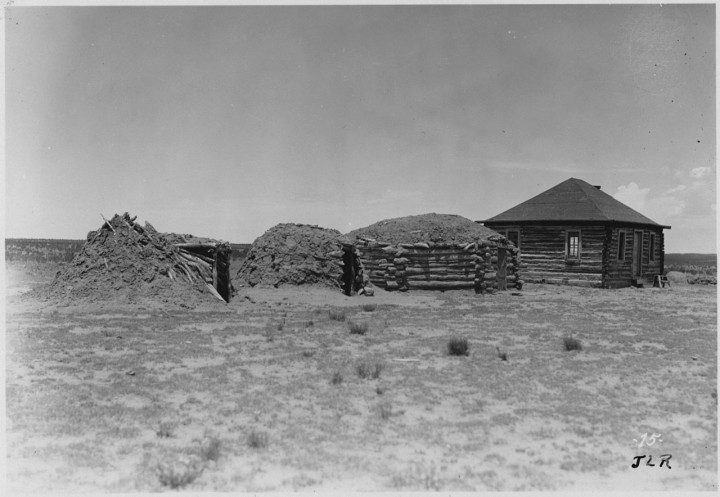
The evolution of the Navajo Hogan

The evolution of the Navajo Hogan, Left to right. The very old hogan. A later style, a few of which are still in use. The hogan of today, with log walls and dirt roof. Many Navajos live in modern log and stone houses, similar to the one pictured above. Southern Navajo Agency, 1933.  (NARA – 298586)

The different types of houses are as follows:
1, SQUARE-CORNERED HOHRAHN (Yah-dah Ahz-kah’ni Hohrahn’)

The first Hohrahn, which is mentioned in the House Songs, was first built in the Underworld. It is a square roof, covered with bark and earth and supported by four corner posts -the same shelter often seen in Arizona and New Mexico and called by the Mexicans a temporal. In its original form it is a temporary shade, but poles are often leaned against the roof, making walls, and a smoke-hole is left in the roof. The door, as in all houses, faces the east, where the gods assemble at dawn. When the hohrahn is built, a white shell is put in the bottom of the southeast post-hole, a turquoise in the southwest, an abalone shell in the northwest, and cannel-coal in the northeast hole, to bring good luck.


2. SWEAT-HOHRAHN (Tah’tsay)

The first sweat-house was built at the Place of Emergence, when the Dineh’ came up from the Underworld. It was used then, as now, not only for a sweat-bath, but to purify the body after a journey. It is made of three sticks with forked ends, which are fastened together in a tripod. Two straight sticks are leaned against the apex from the east to make the sides of the door. Then other sticks and boughs are thrown against the low framework and the whole is covered over with cedar bark and earth until it is practically airtight.

After the person has entered, heated rocks are brought in and the door is closed with several blankets. Four verses of  the Sweat-Bath Song must then be sung before he can come out, to plunge into cold water or dry himself in the sand. He goes in again and sings four more, until the entire song is sung. After an invocation to the War God and his brother, the song describes the building of the first Sweat-House which is called the Son of the She-Dark — that is, a small enclosure of semi-darkness. The song is given in part on the title-page of Part II.

Forked-Together Navajo Home - Hogan

Forked-Together Navajo Home – Hogan


3. FORKED-TOGETHER HOUSE (Ahl-chin’ ah-des-ah’ Hohrahn’)

For many years this was the characteristic Navajo hohrahn, its form and structure having been laid down by Hastseyalti, the Talking God, the greatest of the Yeibitchai. After the Slayer had destroyed all the man-eating monsters, there were only a few people left on earth, and in a great ceremonial, which is described in Chapter XVIII, thirty mortals and two gods were created.

This ceremony was performed in a Square-Cornered Hohrahn, but when the time came for the Hozonji Ceremony the Talking God called all the people together and had them build a new Medicine-Hohrahn. As in the tiny SweatHouse, only on a larger scale, three logs were leaned together from the south, north, and west, and two straight poles stretched to the east to rest on the frame of the door. A smoke-hole was left between the peak and these two poles and the walls were formed by sticks leaned against the framework and covered with cedar bark and earth.

The floor of the hohrahn is dug out a foot or more, leaving a bench all around the wall to support the poles and make a place for putting things away. On the windswept plains east of the Chuska Mountains, where both fuel and building materials are scarce, these houses are often sunk deep down into the ground, and so buried in earth on the roof and sides as to make them look like mounds.

The god and goddess for whom this first Holy Hohrahn  was built were Everlasting and Peaceful, whose names are spoken last in nearly all the great ceremonial songs. They are considered by some to be the greatest of the gods, speaking a spiritual language of their own, and dwell in the west with Estsan’ Ad’le-hi, the Woman-Who-Changes.

The Holy Hohrahn was built for the Good Luck or Hozonji Songs, which were sung over them for the first time. There are 373 of these songs, all of which were sung in one night, but now perhaps four are taken from each group and the singing always ends with the dawn. In order to bring good luck to the house, the feathers of bluebirds and yellow warblers are put in the fork of the three poles, for that was the wish of the Talking God when the first Holy Hohrahn was built.
4. Two-LEGGED HOHRAHN (Bee-jahd’ nah-kith’ Hohrahn’)

This is a Summer House, or lean-to, built of two forked posts with a pole along the top and sticks leaned against it from the west in order to have the front face east. Other sticks are often leaned against the sides, making a partly closed shelter, and such houses are commonly built in the fields. The Horned Toad built the first Two-Legged Hohrahn to sit in while he watched his corn.
5. LOGS-STACKED-UP HOUSE (Tzin-yah’dee klin’ Hohrahn’)

This is a new departure in the art of house-building and the first one was built somewhat over a hundred years ago by Ah-thit’ee-kish’nih — Draws-an-Arrow-All-the-Time. As his name indicates he was a warrior and kept his arms strong by drawing the bow. He lived among the rocks on the east side of Navajo Mountain, in the extreme northwest corner of the Reservation, where he was surrounded by implacable enemies.

It was to protect himself from them that he constructed this new type of house, with the logs piled up level with the ground. At that time the Navajos had no iron axes, except a few which they had got from the Mexicans. They just broke the limbs off of fallen logs and piled the logs across each other in a circle, which was drawn in to make the roof. Then they put smaller sticks in the spaces between the logs and chinked the cracks with cedar bark and mud.

Cedar bark was also laid over the cob-house roof, after which they carried up damp earth in a blanket and pounded the surface down hard. There was a smoke-hole in the middle and the door faced the east. It was built for warmth as well as protection and had a door-blanket made of strips of stiff yucca-stalks, woven closely in and out. In the daytime the door-blanket hung free, but at night they tied the four corners to the frame so that their enemies could not push in or jerk it open. In those days they always kept a lookout on some hilltop, and at sight of enemies coming they would all run and hide in the rocks.

Shortly after Draws-an-Arrow had built his new fort, which had loopholes along the walls, two Navajos came over to look at it and they said:

‘We will make one like that.’

This, according to Long Mustache of Klag-e-toh, is the origin of the modern hohrahn. Many others came to see it and they built more just like it. This is the kind of hohrahn that the five crippled warriors occupied, in the story of the Cub Mountain Chant, to defend themselves against the Utes. A man came clear over from the San Juan country to see what the fort was like, and, since the Navajos were at war with all their neighbors, the Logs-Stacked-up Houses filled a long-felt want.
6. YEIBITCHAI HOUSE OR MEDICINE-HOHRAHN

About forty years ago, when the Navajos got sharp axes and good saws, they began to make bigger houses, and especially for their Yeibitchai Ceremonies. Before this time the big Medicine-Hohrahns had been built with four posts for supports, a flat, square roof, and leaning-pole walls, all com pletely covered with earth. But these posts were in the way for the sand-paintings and dances and a new form of house was devised. In this, six to twelve big posts were set in a circle, with poles leaned against the connecting supports for a wall and a cob-house roof ascending to a high smoke-hole in the center. These Medicine-Hohrahns are often built fifty feet in diameter to make room for the great Yeibitchai sandpaintings, in one of which fifty-six dancing figures are represented.

But expert builders can make a Logs-Stacked-up House almost as large, and in appearance it is much more symmetrical. It is a curious fact that, though invented only a hundred years ago, this cob-house type hohrahn has exactly the same structure as the roofs of the temples in northern China. Looked at from the inside it seems nothing more than an inverted cone, made of logs laid one on the other; but though several white men have tried they have not been able to build one that would stand. These failures have demonstrated that if one timber is laid wrong, the whole structure will weaken and crawl.
7. THE MODERN HOHRAHN OR HOGANS

The final development of the Logs-Laid-Down House is a six-sided structure, made of closely fitted and joined logs with a cob-house roof covered with earth. This form is often used for the big Medicine-Hohrahns, as it gives a firm support for the roof, and the walls can be built straight up and quite high. Such houses are rapidly supplanting the older forms wherever timber is plentiful, but the roofs almost invariably leak.

Modern Navajo Hogan - Sheep Springs New Mexico

Modern Navajo Hogan – Sheep Springs New Mexico

To a white man the smoke-hole is a nuisance, allowing the rain to beat in with the shiftings of the winds until no part of the floor is dry. But with the passing of that smoke-hole the old-time religion will pass, for it is through it that the evil spirits are blown away by the medicine-man when he sings his ghost-chasing chant. That is why the older Indians still  cling to it, for they have no other religion. And the sad fate of some who have adopted the white man’s houses, keeping the doors and windows tightly closed, have convinced them that the old hohrahn is best. For there is no place for the coughs and colds to be blown out by the Hatali and tuberculosis often results.


8. MODERN HOUSES

Only the richer among the Navajos can afford to build a white man’s house. Some are made of stone by young stonemasons trained in the schools, and others of boards and timbers from the Government sawmills near Fort Defiance. But as the roads are always rough and the distances often great, the transportation of this lumber adds greatly to its cost. The doors and windows are now made at the Fort and sold on part payments to the Indians, but the prices of nails and hardware, and especially of modern plumbing, would bankrupt an ordinary Navajo. Even the model houses built at the Government schools cost two or three thousand dollars, so for many years to come the Indians are destined to live in some form of hohrahn.

Modern Navajo Home - Sheep Springs New Mexico

Modern Navajo Home – Sheep Springs New Mexico

DEDICATION

When the new house is finished, the Hosteen or male head of the family rubs a handful of white corn meal on the principal supporting timbers, beginning with the south post of the door and circling the wall to the left. He then sprinkles a circle of meal around the inside of the house and repeats the following prayer:

May my house be blessed.
From my head to my feet,
Where I lie and all above me,
All around me, may it be holy.

Then a blanket is hung over the door, the Hosteen makes a poker of green wood, and his wife builds the first fire, which she feeds with a fragment of food in order to make it happy.  A feast which has been prepared outside is then served to all who have helped. This is similar to our old-fashioned housewarming and is called a salutation to the house.

But if sickness and misfortune visit the new home, some hatali whose Lucky Songs are known to be beneficent is engaged to bless the house. The more he is paid the better their luck will be, so his fee is often munificent. He sings only his best songs, which have not been used for long and so have grown in power, and after he has started their endless repetitions the men of the assembly carry them on. None of the gods are omitted, lest they take offense, and so they sing all night. Then as the dawn appears and the Yeibitchai assemble in the east, they bow to them and sing a solemn invocation to bring good luck to all.

Source: The Navajo Indians. Contributors: Dane Coolidge – author, Mary Roberts Coolidge – author.

Navajo People Website Links:
Navajo Culture – Navajo History – Navajo Art – Navajo Clothing Navajo Pictures – Navajo Rugs – Navajo Language– Navajo Jewelry – Navajo Code Talker – Navajo Pottery – Navajo Legends – Hogan’s – Sand Painting – Navajo Food – Navajo News – Navajo Nation