Archives for February 2008

Nagaynezgani, or ” Slayer of the Alien Gods – Navajo

Two of the most important characters in Navaho mythology are twin miracle-performing sons of White-Shell Woman, Yólkai ?stsán, chief goddess. This plate pictures the leader of the two—the first conceived and the first-born, whose father is the sun. His name means “Slayer of Alien Gods,” from aná, alien; ye, gods; agán?, to kill. By him, with the assistance of Tobadz?schí?n?, his twin brother, were killed numerous bird, animal, rock, and human monsters, typifying evils, who wantonly destroyed human life.

When the Spirit People came upon this earth from below they made six sacred mountains, four on the distant horizon at the cardinal points and two in the centre, Chó?li and Tz?lhnúhod?íhl?. On the eastern slope of Chó?li, brought forth as the daughter of Earth and Sky, was born Yólkai Estsán, White-Shell Woman. First Man took her to his home near Tz?lhnúhod?hl?, where she matured in twelve days into a beautiful woman with supernatural powers. Later she lived in a home of her own at the foot of this mountain. It was while there that she gave birth to twin boys who became saviours of their people, slaying alien gods who were fast depopulating the earth.

Yólkai Estsán would often lie on the eastern slope of the mountain as the sun rose through the morning, and when the day grew warm would seek the shade of jutting rocks from which trickled shining drops of water. Quite unknown to herself she had conceived one day from the sunbeams and the dripping water. When she became aware that she was to become a mother Yólkai ?stsán was made very happy, for she did not enjoy living alone. Soon she found herself the proud possessor of twin boys. The first-born and the stronger came to be known in his youth as Nayé?n?zgan?, Slayer of Alien Gods; the other was always known as Tobadz?schí?n?, Born From Water. Their prenatal life covered a period of only twelve days, and maturity was attained in thirty-two days after passing through eight changes, one of which came every four days.

At that time the earth was infested with great giants, foreign gods, who were rapidly destroying the people. Of these, Yé?tso, Big God, as large as a mountain, was the only one in human[pg 099] form. The others were Man-eating Bird, Rolling Stone, that crushed all in its path, Tracking Bear, and Antelope, who killed without mercy. Fearing lest some of these monsters learn of the presence of her boys, Yólkai ?stsán kept them hidden away on the mountain side, but they chafed under confinement, so she made them bows and arrows and let them play about, but admonished them not to stray far from home. The boys promised to obey, but not long afterward, because in reply to their questions their mother told them she did not know who their father was, they became sulky and broke their promise, going off toward the east. They would go and search for someone who knew. When on a small knoll a long way from home they heard a whispered “Sh-h.”

“Are you afraid, my younger brother?” asked Nayé?n?zgan?.

“No!” was the quick response.

Four times they heard the whisper, and then two of the Wind People appeared. “We saw you travelling eastward,” said they, “and came to caution you. The land is cursed with alien gods who kill for pleasure; beware of them! Why do you journey thus alone without your father?”

“Our father! Alas, we know nothing of him and are now starting on a search to learn. Do you know who he is?” asked the boys.

“Yes, the Sun is your father; but if you think to find him you will have to travel far eastward and cross the wide, wide waters.”

Nayé?n?zgan? turned to his younger brother and said, “Síts?l?, let us go.”

The Sun was then overhead. Being in fact of a holy nature, the boys covered distance rapidly and by mid-afternoon had passed well beyond the limits of their homeland. There they[pg 100] came upon an old woman sitting beside a ladder projecting from a hole. She asked them who they were and whither they were going. They told her to the Sun, whose sons they were, but whom they had never seen.

Tobadzischíni – “Born From Water” – Navajo

Tobadzischíni - Born From Water - Navajo God

Tobadzischíni – Photograph 1904 by Edward S. Curtis

This is Born From Water, the second of the twin miracle-performing sons of Yólkai Estsán, the White-Shell Woman. His brother is Nayénezgani.

“I pity you, my grandchildren,” said the old woman; “come in here and rest a moment before going on.” She started down the ladder and the boys followed. Twelve ladders were descended before her home was reached. The old woman was Spider Woman, the little grandmother who belonged to the Holy Ones. Her home was well kept, clean and comfortable, and the boys were glad to rest. Said she, “My grandchildren, your journey is long and many trials will beset you before you reach the end. Take these life feathers; they will help you; if difficulties befall you, use them,” and she gave to each two feathers plucked from a living eagle.

The boys took the feathers, thanked her, and resumed their journey. After traveling a long way they came to a ridge of loose, yellow sand. It afforded poor footing for an ascent, but the boys struggled to the top, only to have the whole side of the ridge slide and carry them back. Three times the bank gave way as they were about to reach its crest; on the fourth trial they bethought themselves of the sacred feathers, and putting them on their feet marched readily over.

They traveled unimpeded then for quite a long distance, in time coming to four rows of tall, thorny reeds with spiked branches. The reeds grew far enough apart to permit travelers to pass into them, but closed whenever the unwary allowed himself to be caught, and he never escaped. The boys marched boldly up to the reeds and started in, then darted back quickly. The reeds closed instantly, but did not catch them. Then they put the life feathers on their feet again and jumped over all four rows.

The next obstacle was a deep cayon with precipitous walls. This, however, was not a serious impediment, for the life feathers, as before, helped them to cross it in one bound. By nightfall the boys had arrived at a broad, beautiful meadow where lived the Wósakidi, or Grasshopper People, who received them kindly,[pg 101] giving them food and beds for the night. On being asked whither they were bound, the boys replied that they were journeying to the home of the Sun, their father, whom they had never seen.

The Wósakidi cautioned the boys of dangers ahead, and as they were about to depart in the morning gave them little balls of yellow sputum to put in their mouths to prevent poisoning, should they find it necessary to eat or smoke among hostile people, and two sacred wands of turquoise and white shell. Two of the Wósakidi also accompanied them for a time as guides.

They had not been long on their way when they came to a place where the trail ran between two high, smooth-faced bowlders. “These,” said their Wósakidi companions, “are the Bumping Rocks. If you step into that narrow passageway between them they will crash together and kill you.” The boys started as if to enter, but fell back. The huge rocks came violently together, but did no harm. The feint was made three times, and each time the rocks crashed together and bounded back. The fourth time the boys entered they placed their sacred wands of turquoise and white shell across the gap above their heads and passed through, for these held the boulders apart. As they emerged on the opposite side they saw the Sun rising from his eastern home and he was yet far away.

Soon a wide stretch of water was encountered; so far as they could see there was nothing but water. Here again they used their life feathers and were carried safely over. Four successive stretches of water and land were crossed, and still a fifth sheet of water lay before them. Along its shores paddled many varieties of animals. The boys looked out across the deep and could discern away out in the center a house of turquoise and white shell, its roof glistening in the sunlight. Certain that it must be the home of their father, they readjusted their life feathers to start across, but found that they had lost control over them. They tried them several times in different places, but to no avail. The thought of not reaching their father’s house when so near filled their hearts with bitter disappointment. Seemingly there was naught that they could do, but they sat and pondered.

Navajo clans and marriage choices


Navajo family at fair

Navajo family at fair

Diné Traditional Marriage

(From the Navajo Common Law Project)

The traditional Diné wedding is based on the mating of the young maiden, White Shell Woman, and the Sun God in the White World. The following procedures of today’s wedding ceremony may vary depending on geographical location and customs are as follows:

  • The wedding takes place at the bride’s residence in a traditional hooghan.
  • The groom is seated on the west side in the hooghan and his relatives are seated to his left.
  • The bride’s relatives enter the hooghan and are seated to the right.
  • An uncle or a well-respected male individual is appointed as the wedding ceremony performer. He brings in a traditional pot of water and a gourd dipper.
  • The bride immediately follows carrying a wedding basket containing com mush.
  • The bride sits beside the groom with the water pot and basket placed in front of them side by side. The basket is to remain in place throughout the initial wedding ceremony.
  • The person who brings in water is seated to right-hand side of the couple.
  • The groom’s parents present the bride’s parents with gifts of values as agreed.
  • The wedding ceremony performer proceeds with pouring the water into the gourd dipper. The bride then pours water onto the groom’s hands to rinse his hands. The groom repeats this process for the bride.
  • A song or a prayer may be done before proceeding to the blessing of the com mush.
  • The blessing of the com mush is performed by sprinkling com pollen from west to east and back to west then from south to north and back to south in a straight line and crossing at the center on the com mush. Then in one circular motion, a sprinkle is made beginning from the east to south, west, north and ending to the east, but the circle is not enclosed. An opening is always left to the east representing an entrance and exit for the way of life.
  • The performer will place a dab of com pollen east on the com mush then the groom will take a small portion of the mush and com pollen to eat. The bride will then take a small portion of the mush and com pollen to eat. The same procedures are performed for the remaining cardinal directions and center of the com mush.
  • After this blessing, the groom and bride are pronounced husband and wife.
  • They are directed to continue eating more of the com mush. The com mush will also be shared with the groom’s relatives first and then with the bride’s relatives.
  • When all the mush has been eaten the basket is given to the groom’s mother to keep in her family.
  • A feast proceeds after the wedding ceremony. The wife’s relatives will provide all of the food for the feast.
  • During the feast, traditional moral practices of motivational and fundamental speeches of advises are given to the newly wed based on the holistic values and guiding principles of parenting, family well-being, and their roles and responsibilities as husband and wife. These speakers may be parents, relatives, leaders, medicine-people, and elders.


The traditional pot and the water used in the ceremony represent the Mother Earth containing grandmother and grandfather Holy Water of Life. The gourd dipper represents the roots, growth, interweaving, and reseeding of life. The water is poured on the hands for cleansing of certain wrongs that may have been committed and symbolizes the transition from individualism to a beginning of unity and sharing of the roles. and responsibilities.


The significant of the Diné traditional basket represents the creation. It is crafted from the center and proceeds in the footprints of life in the opposite path of the sun and the shadow. It is the foundation to the proceeding of growth and journey of life, Dah’adíníisá, Hajíínáí, dóó Ha’aznáagí hane’. It also reveals, from the center and outward, the comprehension of all bad and good things that happen in the process of the journey from the Dark to White World. From outside and inward in the path of the sun and the shadow, it reveals the comprehension of all the blessings and harmonies provided by the Holy Spirit and the Holy People.


The base is the foundation of life, the Mother Earth, and the outer edge is the foundation of the Father Universe. The color prints or figures are the formations of the earth surfaces, water, and the sky of days and nights throughout the four seasons. The color prints are not completely enclosed where there is an opening that represents an entrance and exit. The opening represents access to all foundations of life that the Mother Earth and the Father Universe provide. It is also the passage for communication in all prayers and songs to the Holy Spirit and the Holy People.


The black prints also represent the Holy People’s readiness to listen, assist, protect, and to guide. Like the Holy People, they also represent the Diné medicine­ people and leaders. The red stripes are the rainbow and represents the children, the Diné ­Bíla’ Ashla’ii Dine’é with the spiritual name Diyin Nohookáá Dine’é. It also represents the mind, dreams, language, learning, teaching, planning, prayers, and songs, which are the tools to every day life and accomplishments in the future.


The Diné traditional baskets have many uses. In the wedding ceremony the basket brings in com mush where com pollen is used. The com mush is the sacrament of binding power to unity of life, and the com pollen is the blessing for a new beginning of life.

The purpose of crossing a sprinkle of the com pollen is a blessing to uphold, with integrity and dignity, a pledge of unity, and roles and responsibilities.

The sprinkle of the com pollen from the west to east and back represents the commitment and expectations that the husband will go outside to succeed and bring in the teachings and nourishment to his family’s well being. He has to maintain his energy to uphold the home and improvement of the livelihood. He has to uphold his stability, mentality, and role modeling to keep the dignity, integrity, obedience, and discipline in place for his children. He has to uphold his affection and compassion for his family.


The sprinkle of the com pollen from the south to north and back represents the expectation of the mother to uphold her roles and responsibilities like the father, but from and within the household for her family’s well-being. The circular com pollen sprinkle represents the new family’s journey on the footprints of life.

The traditional Diné kinship and clan systems (K’é dóó Dóóne’é) need to be seriously considered before a couple plans to wed. This is a Diné verbal law brought down from our ancestors to keep the bloodline healthy.

This Diné traditional wedding serves as an example of using the guiding principles of life, Iiná Bitsé Siléí dóó Báá Siléí as the Navajo Customary Law.Virtually the sole surviving function of the clan is in the limitation of marriage choices; clan exogamy at Shonto remains universal. On the positive side, however, no pattern of clan preference in marriage is discernible. The frequency of marriage between different pairs of clans is proportional throughout to the numerical strength of the clans themselves. Beyond limiting marriage choice, clan affiliation serves only to establish certain special etiquette patterns as between members, especially if they happen to be strangers. The relations and reciprocal behavior established are essentially similar to those which ensue when two Anglo-American namesakes meet by chance, and probably have no more functional significance. Economic and social responsibility for clan brothers and sisters are definitely things of the past at Shonto (cf. Kluckhohn and Leighton, 1946, p. 65). It is readily observable that interaction between households and residence groups is determined by blood relationship without reference to clan.
More than any other factor, it is probably the lack of a clearcut residence tradition (see below) which has in the long run robbed Shonto’s clans of most of their functional significance. The result of this situation is that clans cut completely across territorial lines, and cannot be correlated with any of the regular functional units of Shonto society.

Only the first six clans in the list, plus kinlichi’ini, were present in the Shonto area two generations ago. The clan inventory is extremely limited as compared with other Navaho communities (cf. Carr, Spencer , and Woolley, 1939; Kluckhohn and Leighton, 1946, p. 64). In addition to those represented in the community, only 14 additional clans are recognized by some Shonto informants. Many of the clans given separate designation by Reichard ( 1928, pp. 11-13) are believed to be not merely linked but identical. In particular, all of the clans.
Navajo People Website Links:
Navajo CultureNavajo HistoryNavajo ArtNavajo Clothing Navajo PicturesNavajo RugsNavajo LanguageNavajo JewelryNavajo Code TalkerNavajo PotteryNavajo LegendsHogan’sSand PaintingNavajo Food Navajo NewsNavajo Nation

Navajo Religious And Social Views

The Navajos call themselves Dine’ — “the People” — which implies that other humans are “not-people” or are enemy people (anaii dine’e). Dine’ has a broad meaning; it means not just earth people, but holy people — diyin dine’e — with whom the Navajos are closely associated, thus giving them a sense of their divinity, or contentedness to the gods.

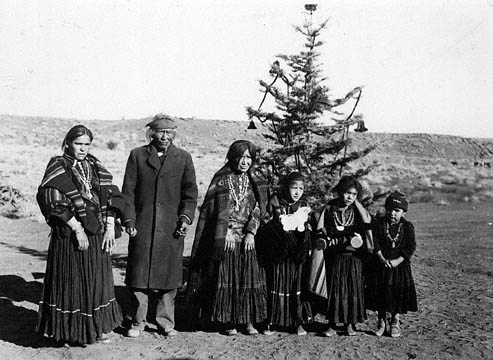
Peshlakai Etsetti Navajo Family with Christmas Tree

Peshlakai Etsetti Navajo Family with Christmas Tree – 1935 Christmas at Wupatki 

Photo courtesy NAU Cline Library Special Collections

In this, of course, they are not unique. All ethnic groups imagine themselves as chosen. James Axtell has written that the Indians of Canada and New England believed that they were superior to the French and English.

They thought their way of life the best, and when runaway Indian schoolboys returned to their tenacious cultures, they quickly relapsed into the old way. The prideful eastern Natives, whose conceit the Christian divines condemned as sinful, simply did not believe in the superiority of “civilization.”

The same may be said for the Navajo. The proscriptions laid on the true people by the Holy Beings did not apply to the non-Navajo. For instance, at one time (and still perhaps today), Navajos relied on Anglos to bury corpses as a way to avoid contamination by the dead.

Flora Bailey was asked to examine a corral of dead, blackened sheep that had been struck by lightning. If Navajos observed the lightning-struck sheep, they would become ill; if Bailey looked at them, she would not get sick because she was a white person, a non-Navajo.

In the early part of this century, Little Gambler asked William T. Williams to bury his brother, who was killed by lightning. Williams also shot a horse over his grave as Little Gambler requested. Little Gambler, however, would not attend the burial, and Williams did not tell him that before he got the corpse in the ground a coyote had fed on his brother’s body.

The proscriptions of the Holy Beings did not apply to the whites, so that Williams would not contaminate himself as the Navajo ran the risk of doing.

Navajo religion — its beauties, its curing, and indeed its taboos — extended its advantages and restrictions only to the Navajos.

Source: William H. Lyon, “Americans and Other Aliens in the Navajo Historical Imagination in the Nineteenth Century,” American Indian Quarterly24.1 (2000): 143, Questia, 20 Oct. 2007 

Navajo People Website Links:
Navajo CultureNavajo HistoryNavajo ArtNavajo Clothing Navajo PicturesNavajo RugsNavajo LanguageNavajo JewelryNavajo Code TalkerNavajo PotteryNavajo LegendsHogan’sSand PaintingNavajo Food Navajo NewsNavajo Nation

Navajo Medicine-Men

IT IS commonly agreed by Indians and traders alike that, among the Navajos, one man out of eight is a medicine-man. That is about the same as saying that, among the white people, one man out of every eight belongs to some lodge or secret society or is a communicant of some church. And, with them as with us, these men who belong are the leaders.

Navajo Medicine Man

Navajo Medicine Man

Much has been said by uninformed people about the charlatanism of Indian medicine-men. But among the Dineh all the important men belong to different lodges. They also know many lucky songs and prayers to protect them and theirs from bad luck, and as a sign to the gods they wear on their hair-braid a turquoise bead and shell for every lodge. With a Shooting Arrow bead in his hair a Navajo will laugh when the lightning strikes close. But without it he will shrink in fear — he has no medicine to ward off the bolt.

A good Navajo medicine-man is a superior being, at once a doctor, a religious leader, and a historian. In the chants which he sings and the myths which he relates there is preserved the story of his people. A Five-Rattle Hatali — one who has the five different kinds of rattles which are used in the fourteen big ceremonies — is a Ph.D., LL.D. He is an intellectual leader, respected for his learning and the power which that learning gives him.

The Navajos are ruled by medicine-men.
The fear of devils, or chindis as the Navajo call them, is the basis of the medicine-man’s power. Whether these devils are virulent germs and microbes, as many of them are, or merely bad dreams or bad luck, it is his business to drive them out.

His treatment is eclectic and inclusive. He gives the patient emetics and purges, he sweats him over aromatic herbs. He kneads his relaxed muscles like a well-trained osteopath until every bone is in place. Then he sings over him and prays, paints his body from the feet up to drive the devils out at his mouth; loads cigarettes and lights them as an offering to the gods and makes a series of sand-paintings. Then they dance and sing holy songs all night and the patient generally gets well.
No matter what was the matter with him, or if he only thought he was sick, the medicine-man has effected a cure. But there is one little formality which must be observed in advance or the medicine will not work. The doctor must be paid. And the more you pay him, the better results you will get. It is a grand system, but the charges are not high. For an ordinary all-night sing or devil-chasing ceremony, six dollars is the usual fee.
This devil-chasing is the real old Stone Age religion and is undoubtedly of Asiatic origin. From Asia, too, comes that unreasoning fear of the dead which haunts the Navajos at every turn. Even to dream of the dead calls for a purification ceremony, and the Reservation is dotted with chindi hohrahns, deserted houses in which some one has died. Whether the body is buried in the hut or not, no Navajo will ever enter its door again or use any of the property left inside. A log is torn out from the north or west wall, for the removal of the body, and it is abandoned to the ghosts of the dead.
This  superstition, however, is not without its good points, for when an epidemic of smallpox or influenza sweeps the land, the Navajos flee and escape. They are afraid of death, and the devils which bring death, and that is why they survive. But the Hopis in their old, infected pueblos are decimated by every epidemic.

The smallpox killed thousands of them before the soldiers came in and cremated the dead and cleaned up. Yet a well-intentioned official in charge of a Navajo school takes pride in the effort he is making to overcome their heathen fears. On every Memorial Day he marches the children through the cemetery to salute the graves of the dead.

Navajo People Website Links:
Navajo CultureNavajo HistoryNavajo ArtNavajo Clothing Navajo PicturesNavajo RugsNavajo LanguageNavajo JewelryNavajo Code TalkerNavajo PotteryNavajo LegendsHogan’sSand PaintingNavajo Food Navajo NewsNavajo Nation