Conversational Navajo Lesson Video by DaybreakWarrior

Conversational Navajo Lesson: Emotion Vocabulary


This video is essentially a continuation of the previous video called, “How to Start Conversations in the Navajo Language.” Essentially, I introduced the phrase, “Haa ánít’é?” which means, “How are you doing?”

Of course it isn’t quite useful if you don’t know how to respond to this question. So in this video, I provided the different ways in which you can respond to this question along with providing some vocabulary words for various emotions in Navajo.

In addition to this, I’ve also included the basic ways you can respond to, “Haa lá ánít’é?” by responding with:

Bil nisin (sleepy)
Dichin nisin (hungry)
Dibáá’ nisin (thirsty)

Though, I’m grateful that someone took the time to translate the emotions on that “How Are You Doing Today?” chart in Navajo, it is more useful to have it in 1st person as opposed to 3rd person so you can learn the emotions. I hope you like this video… enjoy!

Click Here to Subscribe to daybreakwarrior

Jack Jackson – Navajo Oral History

Jack Jackson – Navajo-Retired State Legislator


Jack Jackson - Navajo-Retired State Legislator

Photo by Tom Grier/Navajo Oral History Project.

Jack Jackson Sr. lives in Navajo, New Mexico. After several years as an educator, Jack served nearly two decades in the Arizona State Legislature as a representative and senator.

Jack and his twin brother organized the All Indian Rodeo Cowboys Association. In recent years, Jack has served as a leader in the Cultural Affairs department at Diné College, and on the Board of Directors of the Diné Development Corporation.

Jack Jackson Interview

Jack Jackson, Sr., is of the Kinyaa’áanii (Towering House) clan.

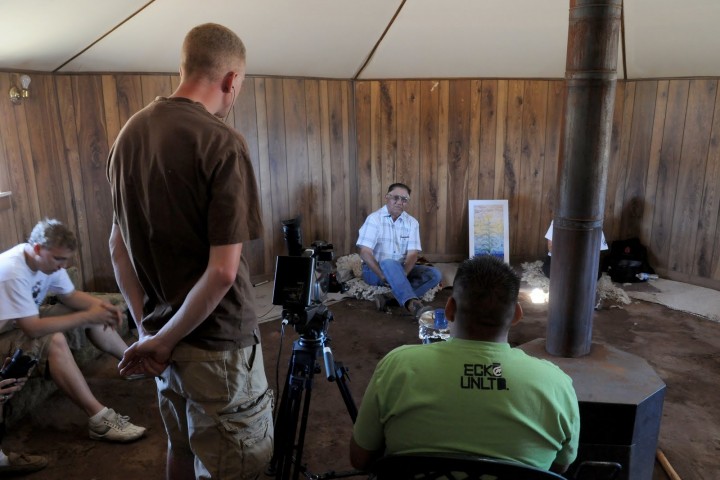
During the interview, Jack explained some details about the Navajo creation story and the importance of the cornstalk in Navajo culture. He shared a wealth of knowledge about the founding of Diné College and the vision for the institution as a way to serve the Navajo people, while helping maintain traditional Navajo ways.

Project completed by:
Josh Averbeck – WSU
Alexandria Fisher – WSU
Trevor Foster – DC

This documentary film was researched, photographed, edited and produced by students of Winona State University (Winona, Minnesota) and Diné College (Tsaile, Arizona, Navajo Nation) during summer 2011.

It contains stories Jack Jackson Sr. of Navajo, New Mexico, told the students during several hours of interviews about his life

This documentary film is archived at the Navajo Nation MuseumNavajo Nation LibraryWinona State University Library, and Diné College Library, and will be archived at the Smithsonian Institution’s National Museum of the American Indian.

The film is part of the Navajo Oral History project, a multi-year collaboration between the Winona State UniversityMass Communication Department and Diné College– The official Tribal College of the Navajo Nation


How To Make Blue Corn Pancakes (Navajo Food)

 Navajo Food & Language Video


This video is meant to show how to make blue corn pancakes, called abe neezmásí or abe’ bee neezmásí. The instructions used were thse provided in this week’s Navajo Times, under “Tí’ Diné Bizaad Bee Yádeilti’ Dooleel! (Let’s Go Speak Navajo)”.

Basically, in this video I guide you through how to make pancakes & even tell what the Navajo words are to the ingredients. The instructions are written in the Navajo Language in February 26th’s issue of Navajo Times.

by: Daybreak Warrior

The Puppy – Navajo Language Lesson


The Puppy - Navajo Language Lesson

THE PUPPY

Far from the hogan in a dry sand wash I found the gray dog
and a new baby puppy gray with black spots.

Poor little puppy, it crawled to me crying.  

Thin little baby, its pink cold nose found my hand.

You gray pup with black spots.
I will teach you to watch the sheep so that always there will be a place for you in our hogan.


 Source : “Little Herder in the Spring” by Ann Clark 1940

Illustrated by:
Hoke Denetsosie
Linguistics by:
John P. Harrington
Robert W. Young

More Navajo Language Lessons

Tsidil – Navajo Stick Game

The Stick Game is a traditional activity given to the First Dine Clans by Changing Woman. Since it is not seasonally-specific, it can be played and enjoyed anytime of the year.


Navajo Stick Game-1

This game kit includes 40 polished stones (stars), three black & white dice, 25 colored playing sticks (markers), instructions, a 16-page, fullcolor, spiral-bound book, and 10-minute DVD.

Tsidil - Navajo Stick Game

DVD was filmed at the Aneth Community School Hogan and features Jim Dandy, Sr. and 6th grade children from Montezuma Creek Elementary. Game can be played by up to 25 students.

Navajo Stick Game-2

Book is illustrated by Navajo artist, Curtis Yanito.

Price $25.00

To Purchase:
Heritage Language Resource Center
Navajo and Ute Language Resources
28 West 200 North
Blanding, Utah 8451
435 -678 -1230
Website: media.sjsd.org

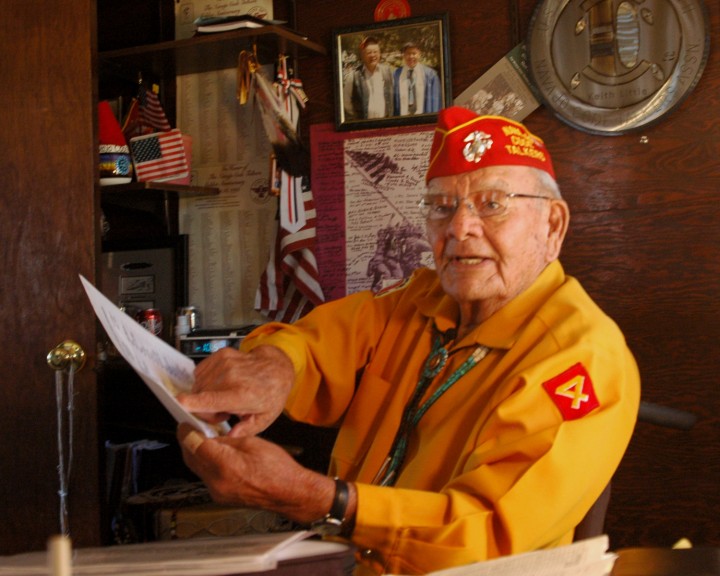
Keith Little, Navajo Code Talker,1925- 2012

Keith Little – Navajo Oral History Project

“My weapon was my language, and that language probably saved countless lives.”

Keith Little, Navajo Code Talker,1925- 2012

 Photo by Tom Grier/Navajo Oral History Project.

Keith Little
War: World War II, 1939-1945

Branch: Marine Corps
Unit: 4th Marine Division; 6th Marine Division
Service Location: Saipan (Northern Mariana Islands); Iwo Jima; Marshall Islands; Pacific Theater
Rank: Private
Place of Birth: Tonalea, AZ

After a hardscrabble upbringing, Keith Little was determined to contribute to the war effort when he learned about the attack on Pearl Harbor. The problem was, he was only 15 years old at the time and had to wait two years to enlist.

A stranger signed for him to become a Marine, and Little signed up for the code talker program. Little witnessed some of the fiercest fighting in the Pacific Theater, while helping to maintain communications with a code that the Japanese couldn’t crack.

Keith Little was Tódách’ái’nii (Bitter Water Clan), born for Tl’ázá Láná (Many Goats Clan). His chei was Tábaahá (Water’s Edge Clan) and his nálá was Kiyaa’áanii (Towering House Clan).

Keith Little Explains the CodeKeith Little Explains the Code  –  Photo by Tom Grier/Navajo Oral History Project.

Interviewer Ann Ramsey:
So what was it like when you were a child? What did you do? Did you go to school?

Keith Little:
Well they didn’t let me go to school because at that time back in the 1930s the government and the Navajo tribal police were forcing kids to go to school. And any time one of those people came around I was hidden someplace, either put over the hill or herd sheep so that they won’t see me, and I wanted to go to school. So one day I ran away and went to — caught a ride to Tuba City and went to the boarding school and tell them I wanted to go to school.

Interviewer Ann Ramsey:
Did you like going to school? What did you learn?

Keith Little:
Well I was just like any-other kid without — they were very strict about talking in your own language, Navajo, and I could not talk Navajo at school. So that kind of makes you — forces you to learn English, you know, at whatever levels you can, the fastest way you can; and I did that. I learned a few words like, “going to the wash room,” “washing up,” saying “hello” and saying “good morning” and things like that. And then writing. I learned to write. You know I wanted to write very bad so it was interesting. But for many years, well it was kind of hard for me to hold that pencil [laughs] or do any reading. I had a hard time learning to read. But the school is what I wanted, and I think the reason is that he said, “Go to school, learn to be like a white man, do things like the white man.” And I see white people wearing clean clothes, have a nice haircut and they always wear a white shirt or something like that and they were always in authority too. So I figured well, the essence of the thing was that the older peoples say that when you learn to talk and listen, work like a bilagaana, someday you going to be like that. So that’s the way I wanted to be.

Interviewer Ann Ramsey:
I think I remember you saying something about you felt as though Pearl Harbor was a sneak attack?
Keith Little:
Well the Pearl Harbor attack on Sunday, December the 7th — I was in school at Ganado Mission School in Ganado, Arizona. And we had gone to church that day and then had our noon meal, and then Sunday evenings they don’t serve meals. They usually serve real dried up peanut butter sandwich and a fruit and maybe a boiled egg with it, and it was never enough for us. So a bunch of us would go down and cook some rabbits down in the hole, down in the watch. So we had all the meal cooking, got our sandwiches and took it down there to have a feast, then we forgot that there was no salt. So one guy had to run back to the dormitory and get some salt. A time later he came back, running real hard. He was panting and couldn’t get a word out and we all looked at him, stared at him. What was the matter with the guy? And pretty soon he finally spilled out the words. He says, “You guys, the United States has been bombed,” he said. And we all looked at him, “What?” The United States had been bombed. “Where?” “Pearl Harbor

Keith Little-Jessica 0026 Photo by Tom Grier/Navajo Oral History Project.


Keith helps tell the important story of the Code Talkers through his role as president of the Navajo Code Talkers Foundation.

Little was among the most vocal of the remaining Code Talkers, always preaching about the preservation of the Navajo traditions, culture and the language that the federal government tried to eradicate before he and others were called on to use it during the war. Little traveled the country advocating for a museum near Window Rock that would house World War II memorabilia, tell the stories of his colleagues, and serve as a haven for vets.

Sources:
The Veterans History Project, Winona State University, Dine College, and the Navajo Times

Keith Little Interviewing

 Photo by Tom Grier/Navajo Oral History Project.

Keith Little – Navajo Code Talker – Living History Video

After hearing about the Japanese attack on Pearl Harbor while in boarding school, Keith Little chose to enlist in the U.S. Marines. He went to Communications School and became one of the legendary Navajo Code Talkers, seeing action on Iwo Jima, Roi Namur, Saipan and other Pacific locations. Keith helps tell the important story of the Code Talkers through his role as president of the Navajo Code Talkers Foundation.

Project completed by:
Robbie Christiano – WSU
Jessica King – DC
Shawn Tsosie – DC

This documentary film was researched, photographed, edited and produced by students of Winona State University (Winona, Minnesota) and Diné College (Tsaile, Arizona, Navajo Nation) during summer 2009.

This documentary film is archived at the Navajo Nation MuseumNavajo Nation LibraryWinona State University Library, and Diné College Library, and will be archived at the Smithsonian Institution’s National Museum of the American Indian.

The film is part of the Navajo Oral History project, a multi-year collaboration between the Winona State UniversityMass Communication Department and Diné College– The official Tribal College of the Navajo Nation


Navajo Monster Slayer Project

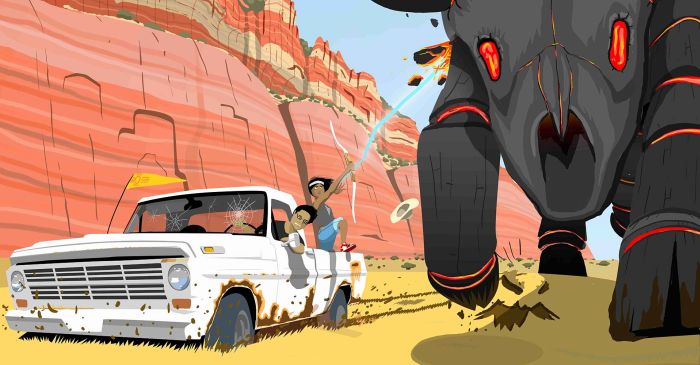
Monster Slayer Project Begins Production


Monster_Slayer_Truck_Scene
By Denny J Spencer

Local production company Astronaught in a joint effort with Indiegenous
Productions announced today the start of production for the Monster Slayer Project. A
short film that is a contemporary retelling of the Navajo Hero Twins story.

Cast_of_Monster_SlayerCast of the Monster Slayer Project


The projects main goal is to reach Navajo youths of this current generation through film, in
an effort to inspire them to want to learn about their heritage. The Project recently
auditioned and cast all Dineh (Navajo) actors and will begin shooting in the summer of
2013.

Contact:
To learn more about this project, please contact
Kjell Boersma
http://www.monsterslayerproject.com
http://www.facebook.com/monsterslayerproject
info@monsterslayerproject.com

Sheep Corral – Navajo Language Lesson

Sheep Corral - Navajo Language Lesson


SHEEP CORRAL
Near my mother’s hogan is the sheep corral, a hard packed place fenced with poles.
There is a tree for shade.
There is a shelter for lambs in the sheep corral.

 Source : “Little Herder in the Spring” by Ann Clark 1940

Illustrated by:
Hoke Denetsosie
Linguistics by:
John P. Harrington
Robert W. Young

More Navajo Language Lessons

Mitzie Begay, Navajo Oral History

Mitzie Begay, was Navajo-Cultural Liaison Ft. Defiance Hospital

Mitzie Begay, Navajo Oral History

 Photo by Tom Grier/Navajo Oral History Project.


Mitzie Begay – Navajo-Cultural Liaison Ft. Defiance Hospital – Living History Video

Mitzie Begay lives in Fort Defiance, Arizona.
Her title is cross-cultural coordinator for the home-based care program at Tséhootsooí Medical Center, formerly known as Ft. Defiance Indian Hospital, for over 30 years.

Project completed by:
David Dvorak – WSU
Molly Golden – WSU
Tashina Johnson – DC

Michael Ruka – WSU

This documentary film was researched, photographed, edited and produced by students of Winona State University (Winona, Minnesota) and Diné College (Tsaile, Arizona, Navajo Nation) during summer 2009.

This documentary film is archived at the Navajo Nation MuseumNavajo Nation LibraryWinona State University Library, and Diné College Library, and will be archived at the Smithsonian Institution’s National Museum of the American Indian.

The film is part of the Navajo Oral History project, a multi-year collaboration between the Winona State UniversityMass Communication Department and Diné College– The official Tribal College of the Navajo Nation


Mitzie Begay - Navajo-Cultural Liaison
Photo by Tom Grier/Navajo Oral History Project.

In her work, Mitzie helps bridge gaps between traditional ways of healing with modern medicine.

She meets with Navajo patients and caregivers and helps build understanding and comfort with difficult medical decisions while ultimately respecting each patient’s cultural values.

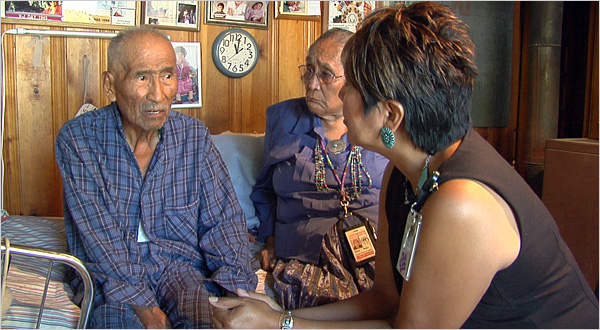
Mitzie Begay-NYT-article

OUTREACH Gina Nez, right, and Mitzie Begay visited Jimmy Begay (no relation), 87, a “code talker” in World War II, who signed an advance directive on end-of-life care.
Photo courtesy of The New York Times

Mr. Begay has signed the poem and the advance directives, and so has Mitzie Begay.

“Traditionally, it’s our belief to always have a positive attitude,” even when someone is dying, she said. “The family has a five-day sing” — a Navajo ceremony — “drink herbs and paint their bodies. All these things are done for the patient, and then we know we did all we could.

“After a patient dies, you don’t hang on, because the deceased is no longer on Mother Earth. You wash up, take your corn pollen and go on with life.”

Courtesy of The New York Times
By BEN DAITZ, M.D.
Published: January 24, 2011


Changing Woman Protects Her Sons

One day, when the monster Yé’iitsoh came to visit her, changing woman quickly hid the boys.
Yé’iitsoh had seen little footprints around changing women’s hogan, he and he was very curious.
He asked, “Where are the little children who made these tracks?”

Changing Woman Protects Her SonsOh it was I who made these little footprints, “lied changing woman.”  “I was lonely and long for some children, so I made footprints with my fists like this.” She pressed her fist into the sand to demonstrate. “Then I added the total imprints with my fingers like this.”

Charles Yanito artist and illustrator

 Illustrated  artwork by Charles Yanito.

From the book:  The Legend of the Navajo Hero Twins

Ordering Information

San Juan School District
Heritage Language Resource Center
28 West 200 North
Phone: 435-678-1230
FAX: 435-678-1283
Store Hours: 9:00 – 4:30
Monday through Thursday
Email: rstoneman@sjsd.org

Online order at this Website: media.sjsd.org

We accept purchase orders, credit cards, and checks.
We bill only for items shipped and actual cost of shipping.
Personal orders ship after payment is received.
Please estimate 10% of purchase total for shipping cost.

Other Books and Posters

The Legend of the Navajo Hero Twins Book Review
Changing Woman Protects Her Sons
The Holy Beings Teach the Navajo Twins Poster
Navajo Winter Storytelling Poster
The Navajo Hero Twins Receive Their Weapons – Poster
Tsidil – Navajo Stick Game
Book Review of  ”The Legend of the Horse”
Legend of the Horse Poster
K’é – Diné (Navajo) Kinship System