Navajo Squaw Dance 1873

View of a Native American (Navajo) Circle Dance (Squaw Dance) at Fort Defiance (McKinley County), New Mexico.

Navajo Squaw Dance 1873

The men wear woven shirts and pants, hats and necklaces. Some men are on horseback and three men sit on the ground nearby. The adobe buildings and a log wall at Fort Defiance are in the distance.
Creator(s) – O’Sullivan, Timothy H., 1840-1882.

Date 1873

Notes: “Expedition of 1872, 1st Lieut. Geo. M. Wheeler. Corps of Engineers, Commanding.” printed on stereo card.; Descriptive information printed on label on verso reads: “Navajoe Indian Dance, at old Fort Defiance, N.M.”; Formerly F22756;

Number “80” etched in original negative reproduced in photographic print.; Stamp on verso shows eagle logo and reads: “War Department, Corps on Engineers, U.S. Army. Geographical and Geological Explorations and Surveys West of the 100th Meridian.

Navajo Women and Men at Fort Defiance 1873

View of Native American (Navajo) women and men at Fort Defiance, Arizona.

Navajo Women and Men at Fort Defiance 1873


People sit on the ground or on horseback, or stand beside an adobe wall and a timber wall. People are beneath a shaded stone shelter with vigas. Woven blankets and burlap sacks are on the ground. Rocky hills are in the distance.

Creator(s) O’Sullivan, Timothy H., 1840-1882.

Date: 1873

Geographical Surveys West of the 100th Meridian (U.S.)

2 Navajo Girls holding Hands

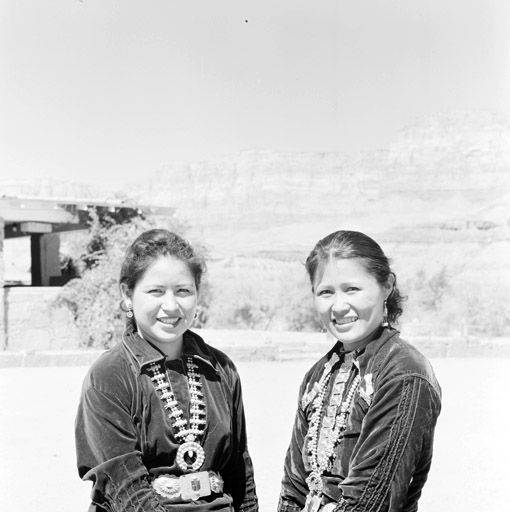
2 Navajo girls - Mabell and Nora at Marble Canyon, holding hands

Navajo Girls Mabell and Nora at Marble Canyon, AZ

Date: 1940s
Photo by: Muench, Josef
Repository Northern Arizona University. Cline Library.

Navajo Woman Weaver Making Yarn

Navajo Woman Weaver with Child Spinning  Wool Description:

Navajo woman weaver making yarn out of raw wool, sitting next to child with baby on board behind.


Subject Navajo Indians; Weaving
Publisher: Center for Southwest Research, University Libraries, University of New Mexico
Date Original: ca. 1920-1940

Navajo Family in Canyon de Chelly, AZ 1920-1940

Navajo family in Canyon De Chelly, AZ. Date  1920-1940

Title: Navajo family in Canyon de Chelly, AZ
Subject: Navajo Indians; Chelly, Canyon de (Ariz.)
Description: Navajo family in Canyon de Chelly, AZ.
Publisher: Center for Southwest Research, University Libraries, University of New Mexico
Date Original: ca. 1920-1940

Inter-Tribal Night Performance- Navajo Fair Photos


Inter Tribal Night Performance Navajo Fair 1

Miss San Carlos Apache, Miss Northern Navajo Miss Apache Indian, and Jr Miss Mt. Turnbull

Laute  Mountain Apache Girl

Inter Tribal Night Performance Navajo Fair 2

Apache Dancers

Inter Tribal Night Performance Navajo Fair 3

Yei Bi Chei (Yebichai) Night Chant-Third Day

It is understood that the patient has been sweated in the morning, as on the second day.

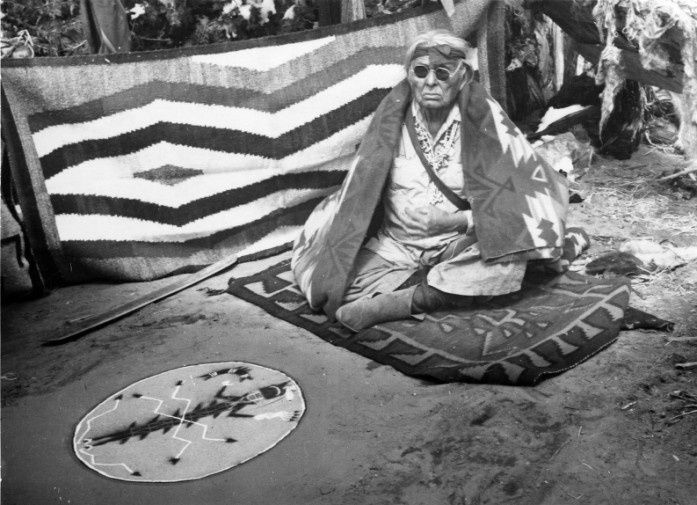
Navajo Medicine Man

Photo of Navajo Medicine Man

Sources of Information for the Article:

The Night Chant, A Navaho Ceremony. By Washington Matthews – May, 1902.
Legend Of The Night Chant- The North American Indian By Edward S. Curtis 1907
The Nightway:A History and a History of Documentation of a Navajo Ceremonial by: James C. Faris – 1990.
Earth is My Mother, Sky is my Father, by Trudy Griffin-Pierce, 1992

On this night he is dressed in spruce boughs by the assisting medicine-man, bound around the wrists, arms, ankles, legs, and body, and fastened on the head in the form of a turban.

After several songs, Nayenezgani and Tobadzischini cut the boughs from the body, using a stone arrow-point as a knife. Then the boughs are cut into fragments over the patient’s head, after which the singer takes a feather wand, points it toward the four cardinal points above the fire, and brushes the patient, chanting meanwhile.

At the end of the brushing he points the wand out of the smoke-hole, at the same time blowing the dust from it out into the open air.

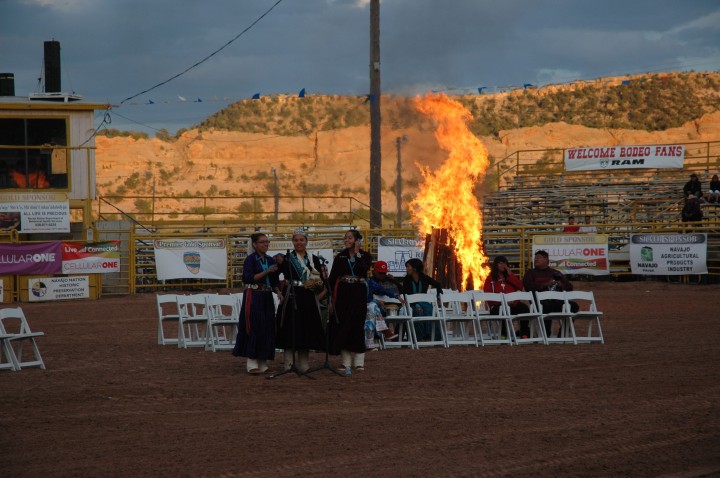
See the Yei Bi Chei Ceremony now going on in Shiprock at  the Northern Navajo Nation Fair


Tobadzischini – Born From Water – Navajo Mask

This is Born From Water, the second of the twin miracle-performing sons of Yolkai Estsan, the White-Shell Woman. His brother is Nayenezgani.

Tobadzischini - Born From Water - Mask
Mask representing the younger twin, known both as Na?ídígishí, He Who Cuts Life Out of the Enemy, and Tóbájíshchíní, Born of Water. Mask used in Night Chant Ceremony, recorded by Matthews in 1902

The mask is the usual inverted bag made of set sacred buckskin. It is the painted with red ocher all except a space over the face, triangular informed with round corners.

This space is black bordered with white and large enough to include eye-holes and a mouthful. On the ground of the red ocher, both the front in the back of the mask are painted a number of few symbols in white. These vary in number, position, and arrangement on different mask in at each new painting of the mask but the number is always a multiple of four.

To an angle of each mouthful and I whole is all diamond shaped is attached a white shell. A fringe of red or yellow here are wool, either staff or flowing is attached to the seam across the crown from side to side.. A turkey feather and a eagle feather are fixed to the top of the mass, to one side of the center. It collar is a fox skin.

Nayenezgani – Slayer of Alien Gods

Two of the most important characters in Navaho mythology are twin miracle-performing sons of White-Shell Woman, Yolkai Estsan, chief goddess. This photo pictures the leader of the two the first conceived and the first-born, whose father is the sun.

Nayenezgani - Slayer of Alien Gods

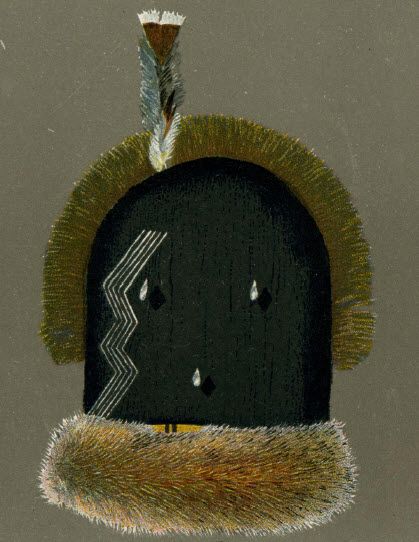
Mask representing Naayéé’ Neizghání, Monster Slayer, used in Night Chant Ceremony.
Source: The Night Chant, A Navajo Ceremony by Washington Matthews – Date = 1902

His name means “Slayer of Alien Gods,” . By him, with the assistance of Tobadzischini, his twin brother, were killed numerous bird, animal, rock, and human monsters, typifying evils, who wantonly destroyed human life.

The masks the usual inverted buckskin bag of the male character. It is
painted black with sacred charcoal and has a lightning symbol on one cheek, either right or left, consisting of five white, narrow, zigzag parallel lines -which present,each, four obtuse angles.

To each of the holes for eyes and mouth is affixed a brilliant white sea-shell.
A fringe of hair is secured to the seam of the mask, from side to side; this is usually red or yellow and may be either flowing or stiff. A turkey-plume and a downy eagle-feather are attached at the top of the
mask, at one side of the center.

gend of the Navajo Hero Twins cover

The Legend of the Navajo Hero Twins Book 

Navajo creation story

Books and Posters

The Legend of the Navajo Hero Twins Book Review
Changing Woman Protects Her Sons
The Holy Beings Teach the Navajo Twins Poster
Navajo Winter Storytelling Poster
The Navajo Hero Twins Receive Their Weapons – Poster
Tsidil – Navajo Stick Game
Book Review of  ”The Legend of the Horse”
Legend of the Horse Poster
K’é – Diné (Navajo) Kinship System

Haschebaad – Female Deity, or Goddess

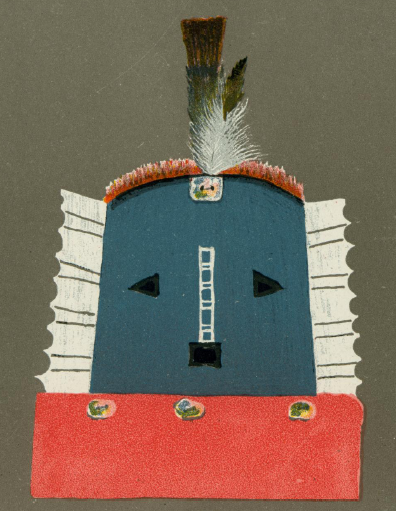
In Navajo mythology there are numerous references to benevolent female deities, who are personated in medicine rites by men wearing masks, as shown here. Haschebaad may be translated “female deity,” or “goddess.” The Mask is Used in Yebichai Night Chant Ceremony

Haschebaad -  female deity, or goddess

Source: The Night Chant, A Navajo Ceremony by Washington Matthews – Date = 1902


The mask differs much from the male mask. While the latter, like a bag inverted, covers the entire head and neck, and completely conceals the hair of the wearer, the former conceals only the face and throat and allows the hair to flow out freely over the shoulders.

The Yebichai actor never wears the hair bound up in a queue. While the male mask is soft and pliable, the female mask is stiff and hard, being made of untanned skin.

It is nearly square in shape; the top is always slightly rounded and ‘in some cases the base is a little broader than the top.

There is a flap or wing, called the -ear, on each side about two inches broad, as long as the margin of the mask proper, and indented or created on the outer margin. The margins are all alike in each. set of. masks but not in any two sets.

The hole for the mouth is square’ The holes for the eyes are triangular,-the apices pointing outwards. The mask is painted blue, the ears white, a square field around the mouth-hole and a triangular field around each eye-hole are black.

The kethawns and the dry-paintings represent the female mask as having a yellow horizontal stripe-.at the bottom, like the male masks ; but this has not been observed on any mask ; ‘instead there is sometime’s a horizontal line of bead-work, about two inches broad, not uniform in design on all masks.

From the bottom of the mask proper, i. e., the piece of raw-hide, a curtain of red flannel or red baize, or other material, usually hangs.

Sometimes this curtain ‘is covered with beads, or adorned with fragments of shell. No definite rules seem to prevail with regard to this curtain. There is always a piece of abalone (haliotis) shell secured with thongs in the center at the top, behind which feathers of turkey and eagle, or of red-shaved woodpecker, are stuck.

The mask is tied to the head by means of long buckskin strings. Sometimes there is a fringe of short hair at the upper margin.