Yei Bi Chei (Yebichai) Night Chant-Second Day

The Navajo conduct this Ceremony under the name of Kléj? Hatál, Night Chant, or Yéb?chai Hatál, The Chant of Paternal Gods.

Second Day Night Chant Sandpainting Photo

Just at sunrise the patient is given the first ceremonial sweat. This is probably given more as a spiritual purification than in anticipation of any physical benefit. To the east of the hogán a shallow hole is dug in the earth, in which are placed hot embers and ashes, covered with brush and weeds, and sprinkled with water, upon which the patient takes his place.

He is then well covered with blankets. The medicine-man, assisted by Hasché?lt? and Hasch?baád, places about the patient a row of feathered k?dán, and then commences to sing while the patient squirms on the hot, steaming bed. After singing certain songs the medicine-man lifts the blanket a little and gives the patient a drink of medicine from a ceremonial basket. He is again covered, and the singing goes on for a like time.

FIRST SONG OF THE PAINTING.

A little one now is prepared. A little one now is prepared.
For Hastsehogan, it now is prepared.
A little message now is prepared,
Toward the trail of the he-rain, now is prepared,
As the rain will hang downward, now is prepared.
A little one now is prepared. A little one now is prepared.
For Hastsealti, it now is prepared.
A little kethawn now is prepared,
Toward the trail of the she-rain, now is prepared,
As the rain will hang downward, now is prepared.

Kethawn arranged in ceremonial basket

Kethawn arranged in ceremonial basket

Later the blankets are removed and Hasché?lt? and Hasch?baád perform over the patient, after which he goes to the hogán. The brush and weeds used for the bed are taken away and earth is scattered over the coals.

This sweating, begun on the second day, is repeated each morning for four days: the first, as above noted, taking place east of the hogán, and the others respectively to the south, west, and north. The ceremonies of the second night are practically a repetition of those held the first night.

During the third song Hasché?lt? enters with the Hasché?lt? balíl, placing it four times in the prescribed order and giving his call; then he goes out, re-enters, and takes from the medicine basket four sacred reed k?dán.

These he carries in ceremonial order to the four cardinal points: first east, then south, next west, lastly north.

Next stick k?dán are taken out of the basket, which holds twelve each of the four sacred colors. These also are carried to the four cardinal points—white, east; blue, south; yellow, west; black, north. After all the k?dán are taken out, Hasché?lt? again enters with the Hasché?lt? balíl, using it in directional order and giving medicine as on the night before.


Haschélti – Talking God Mask – Yebichai Ceremony


The mask of Haschélti is the only white one seen in the ceremony. It is the caplike or baglike mask common to all male characters.


The circular holes for mouth and eyes are each surrounded with a peculiar symbol.

Haschelti - Talking God - MaskMask representing Haashch?éé?ti?í, Talking God, used in Night Chant Ceremony, recorded by Matthews in 1902

This is said to represent a mist arising from the ground and a rain-cloud hanging above. Ascending from the mouth toward the top of the mask is the symbol of a corn-stalk with two ears on it.

At the bottom of the mask is a transverse band of yellow, to represent the yellow evening light, crossed by eight vertical black strokes to represent rain.

When worn in the dance, it has a fringe of hair from side to side over the top; two tails of the black-tailed deer hanging over the forehead; at the back a fanlike ornament of many (6 to 12) eagle-plumes, and, at the base of this, a bunch of owl feathers. A large collar of spruce conceals the yellow band under the chin.

Yei Bi Chei (Yébîchai) Night Chant-First Day

A description of the ritual and form of the Yébîchai ceremony,—Kléjê Hatál, or Night Chant,—covering its nine days of performance, will give a comprehensive idea of all Navaho nine-day ceremonies, which combine both religious and medical observances. The myth characters personified in this rite are termed Yébîchai, Grandfather or Paternal Gods. Similar personifications appear in other ceremonies, but they figure less prominently

Note: The use of the word “Navaho”, and , “Navajo” are used in the writings about the Diné,  their history, and culture. See  this article: Use and spelling Navaho or Navajo

Each morning during the first four days of the Navaho Yébîchai healing ceremony, or Night Chant, the patient is sweated—sometimes inside a small sweat-lodge, oftener by being placed upon a spot previously heated by a fire and covered with heavy blankets.

Yei Bi Chei Sweat Lodge- Navaho

The three figures are medicine-men, or singers, chanting. The patient lies under the blankets surrounded by a line of sacred meal in which turkey-feather prayer-sticks, kadán, are implanted.

First Day:

The ceremonial, or medicine, hogán is built some days in advance of the rite. The first day’s ceremony is brief, with few participants. Well after dark the singer, assisted by two men, makes nine little splint hoops entwined with slip-cords, and places them on the sacred meal in the meal basket.

CIRCLE KETHAWNS.

These objects, called by the various but nearly synonymous names of Ye’b’tsai-tsa’pas, ye’ts-ida-V’lpas, ye’bapas and tsapasiazi-olia’l, are twelve in number. Each circle is made of a twig of ts’i’lts’ln or aromatic sumac two spans long.Navajo Kethawn

The ends are tied together by means of a yucca fiber exactly two spans long. The butt end of the fiber is applied to the. butt end of the twig, underneath it, and at first parallel to it, the fiber is’ then wound around the spliced extremities of the twig, so that its tip end shall approximate the tip end of the’ twig

Following this, three men remove their everyday clothing, take Yébîchai masks, and leave the hogán. These three masked figures are to represent the gods Haschéltî, Talking God, Haschbaád, Goddess, and Haschélapai, Gray God.

When they have gone and passed to the rear of the hogán, the patient comes in, disrobes at the left of the center, passes around the small fire burning near the entrance of the hogán, and takes his seat in the center, immediately after which the singing begins.

During the third song Hasché?lt? enters with his cross-sticks—Hasché?lt? balíl—and opens and places them over the patient’s body, forcing them down as far toward the ground as possible. The second time he places them not so far over the body; the third, not lower than the shoulders; the fourth time, over the head only, each time giving his peculiar call, Wu-hu-hu-hu-u!

Then Hasché?lt? takes up a shell with medicine and with it touches the patient’s feet, hands, chest, back, right shoulder, left shoulder, and top of head, this being the prescribed ceremonial order, uttering his cry at each placing of the medicine.

He next places the shell of medicine to the patient’s lips four times and goes out, after which Hasch?baád comes in, takes one of the circle k?dán, touches the patient’s body in the same ceremonial order, and finally the lips, at the same time giving the slip-cord a quick pull.

Next comes Hasché?lapai, who performs the same incantations with the k?dán. Again Hasché?lt? enters with the cross-sticks, repeating the former order, after which he gives the patient four swallows of medicine,—a potion different from that first given, the medicine-man himself drinking what remains in the shell. This closes the ceremony of the first day.

There will, perhaps, be considerable dancing outside the hogán, but that is merely practice for the public dance to be given on the ninth night. The singer and the patient sleep in the hogán each night until the nine days are passed, keeping the masks and medicine paraphernalia between them when they sleep.

SONGS OF THE EVENING

The songs sung on this evening, called Aga’hoa’gis-in or Summit Songs, are 26 in number; but not all are sung on this occasion; more of them are heard later during the nine-days’ ceremony. The whole set is sung on the third night. When there is no dance of the naakhai’ to be held on the last night, only three songs of the set -are repeated.

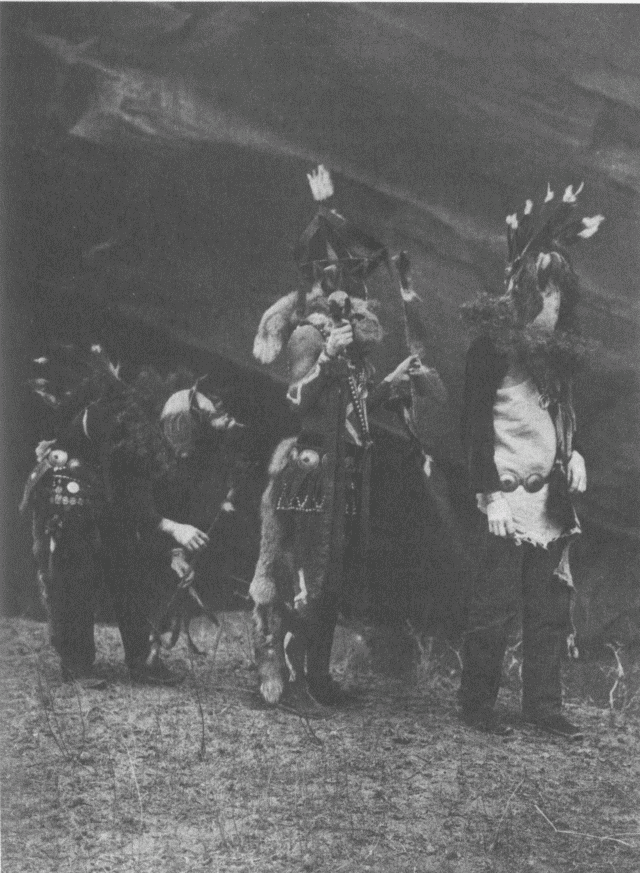
God of Harvest, Fringe Mouth, and Talking God

The personated deities pictured in this plate appear together in acts of succor in the Night Chant in the order seen, the Talking God in the lead. From left to right they are, respectively, the God of Harvest, Fringe Mouth, and Talking God.

Sources of Information for the Article:

The Night Chant, A Navaho Ceremony. By Washington Matthews – May, 1902.
Legend Of The Night Chant- The North American Indian By Edward S. Curtis 1907
The Nightway:A History and a History of Documentation of a Navajo Ceremonial by: James C. Faris – 1990.
Earth is My Mother, Sky is my Father, by Trudy Griffin-Pierce, 1992


Frank Begay Navajo Hoop Dancer

Frank Begay Navajo Hoop DancerFrank Begay a Navajo Hoop Dancer,  toured Yugoslavia and Italy during 1962 with the Duqesne University of Pittsburgh.
Source: Denver Public Library Digital Collections.


The Navajo Nation Zoo

The Navajo Nation Zoo and Botanical Park is the only Native American owned-and-operated Zoo in the Country.

Navajo Nation Zoo 1

Zoo Hours: 10 am – 4:30pm, Monday – Saturday, and most major holidays.

Admission is Free for everyone!

Navajo Nation Zoo

The Navajo Nation Zoo and Botanical Park offers a number of services to the Navajo People and visitors from all over the world. Nearly all of our products and services are free of charge too!

Free guided tours to school groups
Picnic areas for rental for your next event
Event Rental Of The Navajo Nation Zoo

The Animals at the Zoo
The Navajo Zoo has over 100 animals representing just over 50 species. All of these animals are on permanent display for our visitors’ enjoyment. As you notice from the links above, we have a great collection of common animals that are native to the Navajo Nation and Southwest U.S.


Coyotes Of The Navajo Nation ZooThe Navajo Zoo has two Coyotes, named Codee and Lucky Sophia. The Zoo acquired young Codee in May 2011 from Sanders, AZ, and Lucky Sophia came all the way from Mojave Valley, AZ in February 2012 to live at the Navajo Zoo.

Cougars Of The Navajo Nation Zoo
The Navajo Zoo has three Cougars on exhibit. The eldest is named Sophie and came to the Navajo Zoo in 1997 from Yuma, AZ. She is rather shy. Previously she shared her enclosure with a very friendly male named Napoleon, who died in 2008 after living at the Zoo for 18 years. In September 2011 we introduced two new older cubs to Sophie. One is a male that already weighs 90-100 pounds before his first birthday; the other is a female (photo above) that is half the size of Sophie. The new male was named Hunter and the female was named Kay-bah through the Zoo’s Adopt-an-Animal Program.

Use and spelling Navaho or Navajo

This is a response to many inquiries I have been receiving about word “Navaho” as used in articles on this website.

I have just came back from my trip to the Navajo Nation Museum and library doing research for my articles on this website.

I also visited Saint Michael’s Historical Museum near Window Rock, AZ where the Franciscan Fathers wrote ” An ethnologic dictionary of the Navaho language (1910).

Navajo Museum 1

Navajo Nation Museum – Photo by Harold Carey Jr.

Saint Michael’s Historical Museum

Saint Michael’s Historical Museum – Photo by Harold Carey Jr.

From Research on literature of the Southwest I have come up with the following:

Its origin is described in the “Ethnologic Dictionary of the Navaho Language”.

“The word Navaho, or originally, Navajo, is first mentioned and applied to this tribe of Indians by Fray Alonzo Benavides O. F. M., in his “Memorial to the King of Spain” written in 1630. After describing the Gila Apaches, Benavides says that more than fifty leagues north of these “one encounters the Province of the Apaches of Navajo.

Although they are the same Apache nation as the foregoing, they are subject and subordinate to another Chief Captain, and have a distinct mode of living. For those of back yonder did not use to plant, but sustained themselves by the chase; today we have broken land for them and taught them to plant.

But these of Navajo are very great farmers, for that is what Navajo signifies—great planted fields.”
1. Franciscan Fathers. Ethnologic Dictionary of the Navaho Language.

The Navahos call themselves: “Dine” which means men or people and in conversing with them they will tell you that “Dine” simply means “The People”.

The list below is from a search of works published by various authors interested in Southwestern archaeology and ethnology by writers using “ho” or “jo”.

NAVAHO
Hosteen Klah: Navaho Medicine Man and Sand Painter by Franc Johnson Newcomb (May 28, 2012)
The Enduring Navaho [Paperback]Laura Gilpin (Author) Publication Date: 1987
The Navaho by Clyde & lLighton, Dorothea Kluckhohn (1974)
Navaho Witchcraft by Clyde Kluckhohn (1995)
Navaho Indian Myths (Native American) by Aileen O’Bryan (Jun 14, 1993)
The Dine: Origin Myths of the Navaho Indians (Forgotten Books) by Aileen Warner O’Bryan (May 7, 2008)
Origin Myths of the Navaho Indians by Aileen O’Bryan; BAEB 163 [1956]
Navaho Myths, Prayers, and Songs by Washington Matthews; UCPAAE 5:2 [1906]

NAVAJO
Navajo Texts. by Pliny Earle Goddard (Jan 1, 1933)
Navajo Indians by Dane Coolidge and R. Mary (Jun 1930)
Navajo gambling songs – Matthews, Washington, 1843-1905
A study of Navajo symbolism (Volume v. 32 no. 3) – Newcomb, Franc Johnson
The Navajo and his blanket – Hollister, Uriah S., 1838-1929
The Navajo Indians; a statement of facts – Weber, Anselm, Father, 1862-1921
The making of a Navajo blanket – Pepper, George H. (George Hubbard), 1873-1924
The gentile system of the Navajo Indians – Matthews, Washington, 1843-1905

George Wharton James has an explanation for the use of NAVAHO and we quote the paragraph. “It will be observed that I follow the Americanized and rational form of spelling the name NAVAHO. Why people should consent to use the misleading and unnecessary form of the name NAVAJO, is beyond me.

Every stranger to the Spanish tongue—and there are millions who are thus strange—naturally pronounce this Na-va-joe, and cannot be blamed. Yet it does give the One-who-knows the opportunity to laugh at him, and perhaps this is the reason the Spanish form is retained.

Were the name one of Spanish origin we might be reconciled to that form of spelling, but as it is a name belonging to a tribe of Amerinds who were here and had been here for centuries when the Spaniards came, there is no reason why they should have fixed upon them forever a European method of spelling their name”.

2. James, George Wharton. “Indian Blankets and their Makers.” A. O. McClurg and Co., Chicago. 1920.

For justifying the use of Navaho in the Dictionary of the English Language and find in Funk and Wagnalls: “Navaho, an important and rapidly increasing branch of Athapascan Indians dwelling in New Mexico and Arizona; employed in herding blanket making, silver smithing, and as laborers in railroad and ether public works.
“Navajo” is the preference shown in Websters New International Dictionary.

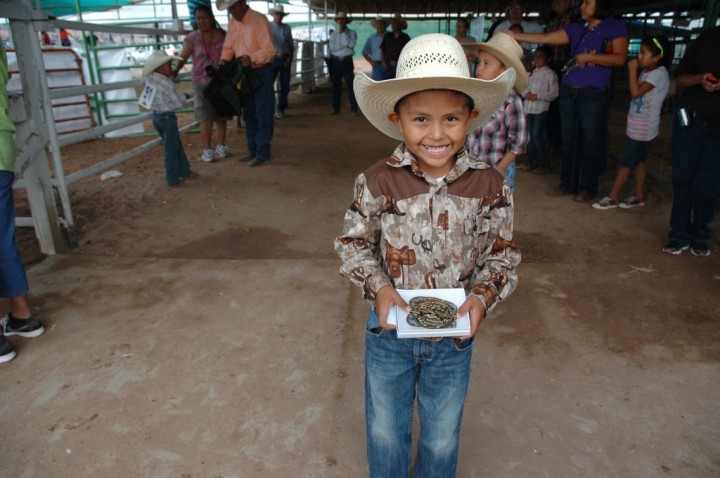
Wooly Riding Championship – Navajo Nation Fair

Navajo Wooly Riding Championship

66th Annual Navajo Nation Fair

Navajo-Wooly-Riding-006

5 year and-under category

Navajo Wooly Riding Kash Long of Indian Wells

Navajo Wooly Riding Kash Long of Indian Wells

Kash Long of Indian Wells, Ariz., placed first with a 45-point ride.

Rhyas Vicenti of Ganado, Ariz., placed second with a 44
Cauy Silver of Window Rock and Trey Nez of Chinle tied for third with 39 sc

6- to 7-year-old category

Navajo-Wooly-Riding Jareth Hale, 7, of Beshbitoh, Ariz

Jareth Hale, 7, of Beshbitoh, Ariz., was named the wooly riding champion for her 64-point ride

Jerome Begay Jr., of Smith Lake, N.M., who placed second with a 62-point ride.
Cody Rustin, of White River, Ariz., was third with a 60 and
Davien Begay, of Naschitti, N.M., in fourth with a 58.

Navajo-Wooly-Riding-002

Navajo-Wooly-Riding 003

Navajo-Wooly-Riding 004

ores.

A Navajo tour of Monument Valley (Video)

by TheGuardian
“Monument Valley in Utah is one of the most iconic natural wonders of the world, its vast sandstone buttes familiar from countless Westerns, but few visitors explore its cultural life. Here Navajo guide Larry Holiday talks about life on the reservation and the challenges families face, as well as the beauty of the landscape”

Navajoland Inn & Suites Hotel Saint Michaels & Window Rock AZ


Sponsoring the Navajo Shoe Game Tournament.

Book now
Powered by Booking.com


Two double beds.. Cable TV with HBO. Phone , Bathroom with shower/tub combination. Iron/ironing board.

Navajoland Inn & Suites Hotel Saint Michaels & Window Rock AZ

Navajoland Inn & Suites Arizona welcomes you in our most popular, comfortable, luxurious and lively hotel in Navajo nation. It is located just 3 miles from Window Rock the capital of Navajo Nation. The city extends into the states of Utah Arizona and New Mexico. It covers 27,000 square miles of unmatched beauty. Navajo Hotel Arizona offers you to enjoy your stay at Navajo nation where you can see more than a dozen of national monuments, tribal parks and many more historic places. At Navajo Nation Inn Arizona you can enjoy a quiet night in one of our rooms or make the night special in one of our suites. Each and every room offer a perfect view of the Window Rock Cliffs and Forest

Hotels near Navajo nation

If you are searching for a hotel near Navajo Nation then Navajo land Inn and Suites is the best destination to stay with your family and friends. Your whole family, friends and kids will love to visit all the places in and near Navajo nation like NAVAJO NATION MUSEUM AND ZOO, WINDOW ROCK AIRPORT, GOLF COURSE, NATIONAL PARKS etc. At navajoland Inn and S suites you can conducts parties, events and business meetings. We provide you an area of 1,200 sq ft of meeting space, seating in a room for 80 people, Theatre seating for about 50 people and U-shape seating for 50 people for your business meetings. Here we provide you Flip charts, w/markers, TV and VCR Screen in our conference rooms at rental. After a long exhausting day with lots of travel and meetings you can relax in our indoor heated swimming pool which will defiantly take away all your fatigue. You can also relax in the Jacuzzi. For people who are fitness conscious we also have a fitness center, euro spa and sauna to keep them fit and healthy.

Book now
Powered by Booking.com


A full floor of unique lifestyle amenities
AM/FM Alarm Clock
Hairdryers Available
Coffee Maker in Room
In-door heated swimming pool
24 Hour Front Desk
Meeting/Banquet Facilities
Handicapped Rooms/Facilities
No Smoking Rooms/Facilities
Refrigerator/Microwave only in suites
25 inch TV
Free Parking
Restaurant
Free Local Telephone Calls
Television with Cable
Fitness Center or Spa
Ice Machine
Conference Facilities
Laundry Service
Iron/Ironing Board
Pets Allowed (but for a fee)
Jacuzzi
Wheel Chair Access
Truck Parking
Security
Two-room suites for honey mooners, business people,
or large families.

Meeting Facility :

Team Meetings, religious retreats, family gatherings or game night for your group are all welcome. We offer 1,200 sq ft of meeting space Classroom seating for 80 people Theatre seating for 50 people U-shape seating for 50 people For your meeting we offer the following supplies available with the conference room rental: Flip charts w/markers TV and VCR Screen Please ask about meeting space rental and equipment fees.

Navajo Nation Fair Frybread Contest Results

66th Annual Navajo Nation Fair Frybread Contest Results

Event Presented by Navajo Agricultural Products Industry.

Navajo Nation Fair Frybread Contest

Contestants: Winners/Cash Prize:

1. Gladys Jones 1st Place – $500.00

2. Eric Manuelito 2nd Place – $300.00
Tohatchi, N.M.

3. Lucy Mannie 3rd Place – $200.00
Window Rock

4. Michael Eriacho 4th Place – $100.00
Ramah, N.M.