Archives for January 2013

San Francisco Peaks – Navajo Sacred Mountain

Humphrey Peak (Doko’o’osliid)

Part of the San Francisco Peaks
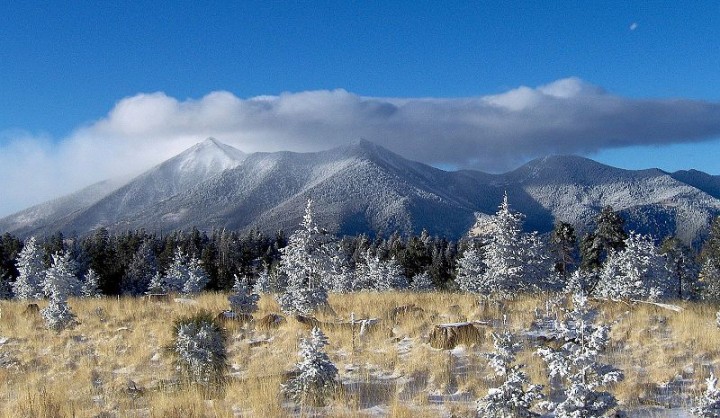
San Francisco Peaks - Navajo Sacred Mountain

Abalone Shell Mountain

Direction: West ( E’e’aah)
Color: Yellow (Litzo)
Protector: Wolf (Ma’íí Tsoh)

In the west, Doko’oosliid San Francisco Peaks was made on a abalone blanket, soil from Doko’oosliid and pieces of abalone brought from the Third World .

They dressed and decorated this mountain with abalone shell to create understanding of our social unity and life (Iina).

San Francisco peaks was anchored with sunbeams and the mountain was covered with a blanket of yellow cloud.

It also was decorated with black clouds and male rain.

Abalone shell boy made his home on the mountain of the West

These are the Holy People that were told to live in this mountain:
1. Yellow Evening Boy and Girl
2. Abalone Shell Boy and Girl
3. Yellow Corn Boy and Girl
4. All kinds of yellow birds
5. Mixture of water and plants
6. Yellow wind was made to give life to this mountain

The San Francisco Peaks, is where the sun sets.

When you watch the sun set behind the San Francisco Peaks from a certain location, the setting sun creates this bright hue into the sky making a certain kind of light reflect down to earth.

This reflected light is what gives the San Francisco Peaks its literally translated name,

The Mountain that Reflects. As the sun sets, you have carried out your plans.

From day to day, these carried out plans eventually equates to your life.

The western mountain, the San Francisco Peaks, represents life.

The Navajo Sacred Mountains Poster

The Navajo Sacred Mountains Poster

Available in three sizes:
23” x 35” – $10.00
18” x 24” – $6.00
11” x 14” – $2.00
Illustrates the Six Scared Mountains,
their characteristics, and contributions in
Navajo culture and history.

Online order at this Website: media.sjsd.org

San Juan School District
Heritage Language Resource Center
Phone: 435-678-1230
Email: rstoneman@sjsd.org

The Four Navajo Sacred Mountains

Mount Blanca (Tsisnaasjini’ – Dawn or White Shell Mountain – East
Mount Taylor (Tsoodzil – Blue Bead or Turquoise Mountain) – South
San Francisco Peaks (Doko’oosliid – Abalone Shell Mountain) – West
Mount Hesperus Dibé Nitsaa (Big Mountain Sheep) – Obsidian Mountain – North

Navajo People Website Links:
Navajo Culture – Navajo History – Navajo Art – Navajo Clothing Navajo Pictures – Navajo Rugs – Navajo Language– Navajo Jewelry – Navajo Code Talker – Navajo Pottery – Navajo Legends – Hogan’s – Sand Painting – Navajo Food – Navajo News – Navajo Nation


Mount Taylor (Tsoozil) Navajo Sacred Mountain

Mount Taylor (Tsoodzil) – Blue Bead or Turquoise Mountain)

Mount Taylor (Tsoozil) Navajo Sacred Mountain

Direction: South ( Sháddi’ááh)
Color: Turquoise (Dootlizh)
Protector: Cougar (Náshdóítsoh)

In the Fourth World to the south Mount Taylor (Tsoodzil – Blue Bead or Turquoise Mountain) was planted by First Man.

It was made with a turquoise blanket, soil of Tsoozil and pieces of turquoise,that first man had gathered from the mountains in the Third World

Turquoise Girl was told to live in the mountain of the South.

A stone knife was thrust through the sacred mountain from top to bottom to fasten it to the earth.

The mountain was covered with a blanket of blue cloud.

It was decorated with dark mists and female rain.

Cougar was sent to guard Turquoise Girl.

These are the Holy People that were told to live in this mountain:
1. Blue Twilight Boy and Girl
2. Turquoise Boy and Girl
3. Blue Corn, the spirit of a boy and girl who carries a corn kernel
4. Blue birds and blue swallows
5. Spotted Blue Corn for plant symbols
6. Blue Wind was made to give life to the mountain
It is called by the Mexicans San Mateo, and was on September 18, 1849, named Mt. Taylor, “in honor of the President of the United States,” by Lieut. J. H. Simpson, U. S. Army.

This is one of the sacred mountains of the Navahoes, and is regarded by them as bounding their country on the south, although at the present day some of the tribe live south of the mountain.

They say that San Mateo is the mountain of the south and San Francisco is the mountain of the west, yet the two peaks are nearly in the same latitude.

One version of the Origin Legend (Version B) makes San Mateo the mountain of the east, but all other versions differ from this. Blue being the color of the south, turquoise and other blue things, as named in the myth, belong to this mountain.

As blue also symbolizes the female, she-rain belongs to San Mateo.

Mount Taylor marks the southern boundary of the Navajo homeland , and is associated with the direction south and the color blue;

It is also important in the Blessing Side ceremonies and the Enemy Side Ceremony.
Mount Taylor was once the home of Yé’iitsoh (Chief of the Enemy Gods).
Once the sun is up, sunrays are all around and Mount Taylor is adorned with sunlight.

After thinking about what you want to do for the day, you start to plan your activities. It is also named Turquoise Mountain.

Thoughts such as, “We want to progress,” grow from small plans to large plans and Mount Taylor has the power to satisfy that wish.

These powers come from the different types of characteristics Mount Taylor was given.

It was given Blessing Way, Chanting Way and Warrior Way characteristics.

The Four Navajo Sacred Mountains

Mount Blanca (Tsisnaasjini’ – Dawn or White Shell Mountain – East
Mount Taylor (Tsoodzil – Blue Bead or Turquoise Mountain) – South
San Francisco Peaks (Doko’oosliid – Abalone Shell Mountain) – West
Mount Hesperus Dibé Nitsaa (Big Mountain Sheep) – Obsidian Mountain – North


Navajo People Website Links:
Navajo CultureNavajo HistoryNavajo ArtNavajo Clothing Navajo PicturesNavajo RugsNavajo LanguageNavajo JewelryNavajo Code TalkerNavajo PotteryNavajo LegendsHogan’sSand PaintingNavajo Food Navajo NewsNavajo Nation


Learn How To Make A Snowman – Navajo Language

This tutorial shows how to build a snow man (yas hastiin).

by: Daybreak Warrior

Though it is a simple thing to build a snowman, the purpose of this video is to explain how to build one in the Navajo language. Hearing instructions is another way to learn a language.

The footage was shot in northeastern Arizona, on the Navajo reservation. Yes, parts of Arizona do get snow! Enjoy! 🙂


Navajo People Website Links:
Navajo Culture – Navajo History – Navajo Art – Navajo Clothing Navajo Pictures – Navajo Rugs – Navajo Language– Navajo Jewelry – Navajo Code Talker – Navajo Pottery – Navajo Legends – Hogan’s – Sand Painting – Navajo Food – Navajo News – Navajo Nation


Mount Blanca (Sisnaajini) Navajo Sacred Mountain

Mount Blanca (Sisnaajini) – Dawn or White Shell Mountain

Direction: East ( Ha’a’aah)
Color: White (Ligia)
Protector: Bear (Shash)

Mount Blanca (Sisnaajini) - Dawn or White Shell Mountain


Mount Blanca (Sisnaajini) Navajo Sacred Mountain

The mountain is considered to be the eastern boundary of the Dinetah, the traditional Navajo homeland.

When the Holy People had assembled the things with which to dress the East mountain, they traveled by way of a sunbeam and rainbow beam to decorate Sisnaajiní.

The Holy People dressed Sisnaajiní with a perfect white shell for positive thoughts and thinking.

Then the Holy People ran a bolt of lighting through a sacred mountain to fasten the East mountain to our Mother Earth.

These are the Holy People that were told to live in this sacred mountain:
1. Dawn Boy and Girl
2. White Bead Boy and Girl
3. White Corn and Male Rain
4. Rock Crystal Boy and Girl and Birds
5. Spotted White Corn for vegetation symbols
6. White Wind, Spotted Wind gave life to this mountain

As Navajo people, we were given Blanca Peak as a starting point. Blanca Peak was put in the eastern direction because the sun rises from there at the start of each day.

Blanca Peak should be thought of as the ‘north arrow’ on a map, which determines the orientation of a person’s mind and physical presence on earth. The eastern direction is easily determined each morning as it is dawning. The sun then rises.

During this process, you are waking up and thinking what it is that you will be doing for the day.

As you go outside of your Hogan, you’re already facing east toward the Holy People. So, being that Blanca Peak is in the eastern direction, Blanca Peak represents ‘thought’.

Thought comes first in everything that you do. Blanca Peak was carefully formed.

Its spirit is that of the Holy People and its appearance is that of varying plants such as trees and flowers.

In that respect, your first thoughts have those same characters.

The literal translation of Blanca Peak (from Navajo) is Black Belted Mountain. There are many stories in why it is called that.

Each of the sacred mountains is a holy person dressed in various outfits. Blanca Peak has a belt. A layer of trees around it that is caused by the ‘tree line’ forms the belt. Just like any of the sacred mountains, Blanca Peak stands on its feet and extends out its arms.
Sources:
Navaho Legends -Matthews, Washington,-.
The Dîné: origin myths of the Navaho Indians – O’Bryan, Aileen.
An ethnologic dictionary of the Navaho language – Franciscans, Saint Michaels, Ariz.
Foundation of Navajo Culture, by Wilson Aronilth, Jr.,

The Four Navajo Sacred Mountains

Mount Blanca (Tsisnaasjini’ – Dawn or White Shell Mountain – East
Mount Taylor (Tsoodzil – Blue Bead or Turquoise Mountain) – South
Mount Humphrey (Doko’oosliid – Abalone Shell Mountain) – West
Mount Hesperus Dibé Nitsaa (Big Mountain Sheep) – Obsidian Mountain – North

Other Sacred Mountains

Huerfano Mesa – Navajo Sacred Mountain
Gobernador Knob – Navajo Sacred Mountain

The Navajo Sacred Mountains Poster

The Navajo Sacred Mountains Poster


Navajo People Website Links:
Navajo Culture – Navajo History – Navajo Art – Navajo Clothing Navajo Pictures – Navajo Rugs – Navajo Language– Navajo Jewelry – Navajo Code Talker – Navajo Pottery – Navajo Legends – Hogan’s – Sand Painting – Navajo Food – Navajo News – Navajo Nation

There Is No Food – Navajo Story


There is no food  - Navajo Story

 There is no flour nor cornmeal to make into bread,
‘There is no coffee that my mother could boil for us to drink.

There is no food.
The corn my father planted in his field is gone.

We ate it.
There was so little.
The corn pile in the storehouse was not high enough to last for long.
It is gone.
Now all of it is gone.
There is no food.
There is food at the Trading Post in sacks and in boxes, in bins and in cans on the shelf.

There is food at the Trading Post, but the Trading Post is far away and snowdrifts and snow clouds are heavy between

There is food at the Trading Post but my father has nothing leftof the hard, round money that he must give to the Trader for the food:
There is no food here in my mother’s hogan.

Then it is time to eat, we talk of other things, . but not of hunger.
This thing called hunger is a pain that sits inside me.
At first it was little, but now it grows bigger and bigger.’
It hurts me to be hungry.

Source : “Little Herder in the Winter” by Ann Clark 1940

Illustrated by:
Hoke Denetsosie

Linguistics by:
John P. Harrington
Robert W. Young

Navajo People Website Links:
Navajo Culture – Navajo History – Navajo Art – Navajo Clothing Navajo Pictures – Navajo Rugs – Navajo Language– Navajo Jewelry – Navajo Code Talker – Navajo Pottery – Navajo Legends – Hogan’s – Sand Painting – Navajo Food – Navajo News – Navajo Nation