Archives for January 2013

Rainbow Bridge, Utah – Tsé’naa Na’ní’áhí

Rainbow Bridge’s Navajo name is Tsé’naa Na’ní’áhí – (Rock Span)
or Na’nízhoozhí – (Span or Bridge)


Rainbow Bridge, Utah - Tsé'naa Na’ní’áhí

Rainbow Bridge is the world’s largest known natural bridge.

From its base to the top of the arch, it is 290 feet-nearly the height of the Statue of Liberty-and spans 275 feet across the river. .The top is 42 feet (13 meters) thick and 33 feet (10 meters) wide.

The dark, vertical streaks onthe sandstone, called “desert varnish,” are composed of iron oxide or manganese. Many believe these particles leach from the rocks; others believe that minerals are blown as dust particles and settle on wetter areas of rock. Afternoon sunlight makes the colors especially brilliant.

The existence of this famed rock span was known to the Paiutes and Navajos long before its discovery by Anglo-Americans.

That discovery was shared by two veteran Southwestern scholars–Dr. Byron Cummings and William B. Douglass–who were united, albeit briefly, by John Wetherill, a famous Southwestern trader and explorer in his own right.

On August 11, 1909, the group began their trek to the bridge.

They were guided by Ute Mountain Ute Jim Mike, a member of the Douglass party who had supposedly heard about the bridge from the Navajos, and by John Wetherill, trader and self-taught archeologist.

Along the way they were to meet up with Paiute Nasja Begay, and Navajo Dogeye Begay.

Finally, late in the afternoon of August 14, the weary riders reached their goal.

William B. Douglas party, including Navajo Ute, and Paiute Indians

William B. Douglas party, including Navajo Ute, and Paiute Indians, celebrate their discovery of Rainbow Bridge, Utah, as they eat watermelon in Paiute Canyon, 1909. – Photo by By N. Judd

To the Navajo people of the Southwest, Rainbow Bridge is not just a unique geological feature.

Navajo stories tell of a male and a female rainbow person coming together in perfect union, and being frozen in time.

This rock rainbow is particularly special because it is the only rainbow that can be viewed from both sides (Luckert 22-3). It is the site of ritual offerings, sacred ceremonies, and other religious practices.

Glen Canyon is home to several other sites of religious significance for the Navajo people, including a sacred spring, several rock beings, and the union of the feminine Colorado River and the masculine San Juan River.

However, these sites have all been covered by the waters of the manmade Lake Powell, disrupting Navajo spiritual practice (Luckert 24). One major concern of the Navajo is that the rock people are being drowned by Lake Powell.

Additionally, sacred offerings cannot be placed at the union of the Colorado and San Juan Rivers, as it is covered by water, which prevents the Navajo from properly conducting ceremonies that protect them from harsh weather and disease (Luckert 25).

Perhaps of more pressing concern than any of these other issues is the increasingly large presence of tourism in the Glen Canyon area. Because of the tourists, the Navajo people are not able to communicate with the spirits around Rainbow Bridge during the day, but the ceremonies cannot be conducted at night after the tourists have left because of the decrees of the spirits (Luckert 92-3).

Tourists are also often quite disrespectful of Navajo beliefs. Despite the posting of various signs asking them to avoid doing so, many tourists approach and walk under Rainbow Bridge, things that are expressly forbidden in the Navajo tradition.

A Navaho Creation Myth about Rainbow Bridge told by Frank Goldtooth

One day the Twins were playing and they came to a canyon facing the north which is now Paiute Canyon. They could not get across when a worm came along and stretched his body across the canyon.

It was a shooting worm, wó nal?’ilí, and it later became Rainbow Bridge. According to this bridge, all bridges have been made in the same way. The worm did this himself for he had power.

After they were almost grown, both Twins lived at Navaho Mountain. They ran around Navaho Mountain four times from the east to the west and from the south to the north. When they had finished, they were full grown.

Works Cited:
Luckert, Karl W. Navajo Mountain and Rainbow Bridge Religion. Flagstaff: Museum of Northern Arizona
Navaho Legends by Matthews, Washington,- Navaho Legends.
Harrison Lapahie Jr. – lapahie.com
Sacred Land, Sacred View – Robert S. McPherson

The Four Navajo Sacred Mountains

Mount Blanca (Tsisnaasjini’ – Dawn or White Shell Mountain – East
Mount Taylor (Tsoodzil – Blue Bead or Turquoise Mountain) – South
San Francisco Peaks (Doko’oosliid – Abalone Shell Mountain) – West
Mount Hesperus Dibé Nitsaa (Big Mountain Sheep) – Obsidian Mountain – North

Navajo People Website Links:

Navajo Culture – Navajo History – Navajo Art – Navajo Clothing Navajo Pictures – Navajo Rugs – Navajo Language– Navajo Jewelry – Navajo Code Talker – Navajo Pottery – Navajo Legends – Hogan’s – Sand Painting – Navajo Food – Navajo News – Navajo Nation

Navajo Nation Hosts Successful Balloon Event

A rendition of beautiful aerial poetry in motion.

Those are words that depict the Third Annual Monument Valley Hot Air Balloon Event at Monument Valley Navajo Tribal Park on January 11-13, 2013, which was sponsored by the Navajo Nation Parks and Recreation Department. The increasing-popular event was definitely a novelty and catered to every desire.

Balloon Event at Monument Valley
First-time participants and visitors describe the annual dovetailing event as “absolutely amazing to mystic,” which is the credo of Navajo. And there’s something that makes worldwide visitors embrace the elegance and timeless Navajo cultural treasures to the showcase of architectural ambience.
Hot air balloon pilot enthusiast Graham Bell from Malvern, England has an insatiable love for the Navajo Nation. Case in point, he made a triumphant return to the Navajo Nation – this marks his seventh visit to marvel the beauty of Navajo. However, it was only his second time to participate in the annual premier event at Monument Valley Navajo Tribal Park. Graham was one of 20 pilots from throughout the world who soared through the crisp blue skies in a towering grand assembly fashion.
“Monument Valley is a mystic place in the nicest possible way. There’s just something that I just love here,” Bell explained. “When I received an invitation to participate in the Monument Valley Hot Air Balloon Event, it didn’t take me more than three seconds to say yes. I always dreamed of flying here.”

Fashion Show

Monument Valley Balloon Event – Fashion Show by Shayne Watson, 1/12/13

Graham has been coasting his balloons through the skies for 22 years and has participated in many hot air balloon events throughout the world. Although the signature event at Monument Valley has fewer balloons in the air, Graham said he especially enjoyed his rides on the Navajo Nation.
“It was very peaceful and serene,” he noted. “There’s no pressure here, just pure enjoyment to see a panoramic view of the area. I also met a lot of amazing people.”
Bell said he vacationed with his son and daughter and visited several parks in the Four Corners region including Grand Canyon in the past. However, Bell said their favorite place was Monument Valley Navajo Tribal Park.
Chris Bell from Aberdeenshire, Scotland who is Bell’s brother came along for the ride so to speak, but he didn’t know he was going to also get a birds-eye-view of the iconic red rock formations.
Bell said “It was absolutely amazing and it exceeded my expectation. It was just wonderful and I feel privileged that I had an opportunity to be a rider. I can see why people see it as special place – it’s mystic. To see Monument Valley from the sky is just magical.”
Cathy Stringfellow of Albuquerque said although she is from Albuquerque, she would rather fly at Monument Valley, adding, “There is no comparison to the balloon event in Albuquerque. This place is absolutely beautiful.”
Bryan Hill of Page, Arizona echoed similar comments. “Monument Valley’s most unique rock formations, mesas, buttes and iconic scenery provides a jaw dropping backdrop creating one of the most breathtaking places on earth to enjoy hot air ballooning.”
Hill said the idea of hosting a hot air balloon event on the Navajo Nation was discussed in 2007 and finally brought to fruition after many months of planning by Hill and Navajo Nation Parks and Recreation Department staff. Since then, Hill has been working quietly behind the scenes with Navajo Nation Parks and Recreation Staff to launch three successful hot air balloon events at Monument Valley Navajo Tribal Park.
He was quick to point out his gratitude to the Navajo Nation, noting, “The balloon pilots and crews are all grateful to the Navajo Nation Parks and Recreation staff for putting this event together. We hope this event will continue for years to come and be a boost to the local economy. All the pilots feel privileged to both fly Monument Valley and spend time with the locals. Flying hot air balloons in Monument Valley is exciting then when you add the welcome we received from the people of Monument Valley and the Navajo Nation, the event elevates to ‘outstanding!’ We are all already looking forward to next year.”
No expenses were spared at the third annual event, which featured a variety of activities, games, speakers, entertainers and musical genres that was suited for the entire family. Distinguished Navajo leaders also attended and participated in the eye-catching celebration.

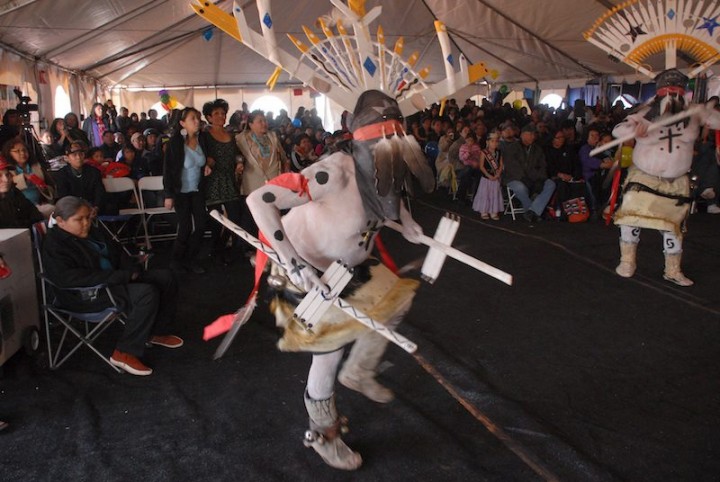
Joe Tohonnie Jr & Apache Crowndancers

Joe Tohonnie Jr & Apache Crowndancers at Monument Valley Hot Air Balloon Event

Event Coordinator Geraldine Camarillo, said “I met with the community six months before the event to gather input on who would be performing at this event. We try very hard to accommodate the community’s input and this year we had a great line-up for both Youth Day and Family Day.”
Navajo Nation President Ben Shelly said “Thank you for coming out and thank you Navajo Nation Parks and Recreation for bringing this event to the Navajo Nation. Thank you to all the visitors for coming. You can get to know who we are. We have a lot of great food and places to shop. Look at our beautiful sites here on the Navajo Nation. I am very proud of the Navajo people.”
Navajo Nation Vice President Rex Lee Jim has become a mainstay and especially enjoys the annual Monument Valley Hot Air Balloon Event. In fact, this is Jim’s third time he has journeyed through the skies as a rider.
“Thank you for allowing us to be here today,” said Jim. “I’d like to welcome all the non-Navajos here. Be sure and buy from our Navajo people and help them. Let’s also take care of our land and keep it beautiful.”

Bill Lee takes Vice President Rex Lee Jim

Bill Lee takes Vice President Rex Lee Jim and Council Delegate Jonathan Nez for a morning flight.

Navajo Nation Council Delegate Jonathan Nez who was also a rider stated, “It gives you a better appreciation of our land from the air. We have one of the most beautiful places in the world. I want to challenge the Navajo people to be good stewards of our land and keep it beautiful and pristine.”
Larry Holiday, a community liaison who works with the schools in Monument Valley assisted with the Navajo shoe game, which was a first-ever featured event.
Holiday said the Navajo shoe game was a match-up between elders who have years of knowledge and wisdom versus the younger generation. Holiday said that it is imperative that communities host Navajo shoe games and other winter events because that is when oral stories and activities can be shared about early Navajo history.
Navajo Nation Parks and Recreation Department Director Martin L. Begaye, said “I am very proud of my staff who worked tirelessly to plan and host this wonderful community event. I would also like to thank the many partners and sponsors who assisted to make it successful. We are doing our best to promote the local businesses and help boost the Navajo Nation economy while simultaneously accommodating our visitors. This is one way that we are saying ‘thank you’ to the Navajo people for their support and our way of giving back to the community. The Navajo Nation is a haven of unparalleled scenic beauty, however, it is the Navajo people who are truly unique and beautiful.”

Source:

Roberta John – Senior Economic Development Specialist
Email: bobbie@navajonationparks.org


Navajo People Website Links:

Navajo Culture – Navajo History – Navajo Art – Navajo Clothing Navajo Pictures – Navajo Rugs – Navajo Language– Navajo Jewelry – Navajo Code Talker – Navajo Pottery – Navajo Legends – Hogan’s – Sand Painting – Navajo Food – Navajo News – Navajo Nation

Rainbow Lodge and Navajo Trading Post

The Rainbow Lodge and Navajo Trading Post were built in 1924 by S.I. Richardson and his son Cecil.

Rainbow Lodge and Navajo Trading Post

Photo of Rainbow Lodge and Navajo Trading Post 1950

A second post, a tent operation located near War God Springs, was operated on the other side of the mountain by Ben and Myri Wetherill.

The Richardson brothers came to the Southwest to escape the harsh life imposed on them by their fundamentalist father.

After working with relatives in the trading post business, the brothers took a pack trip from Kaibito to the bridge. It was this trip that inspired them to start a guide and trading post business on the southern slope of Navajo Mountain.

Their plan included construction of a road from Tonalea, Arizona to their new Rainbow Lodge and Trading Post at Willow Springs.

Hubert Richardson sold his interest in the lodge to Barry Goldwater, future Arizona Senator and presidential candidate.

World War II handicapped business at the lodge. Very little recreational travel took place during the war, and remote locations like Rainbow Lodge were hit the hardest. But Goldwater loved the country around Rainbow Bridge.

He had bought into the Richardson operation in the 1930s as a partner and in 1946, after the conclusion of the war, decided he wanted to have a go at running a successful tourist operation.

The lodge did little business during the war, with the Wilsons leaving Navajo Mountain for a brief time to secure employment elsewhere. The lodge was virtually unused for nearly five years.

With wartime fuel restrictions lifted by 1946, people began touring the Southwest again. Goldwater had guessed well regarding post-war tourism. In 1923, annual visitation to the bridge was only 142 people.

After 1945, visitation went up every year, reaching a high of 1,081 in 1955. Goldwater secured the promise of the Park Service to distribute Rainbow Lodge pamphlets to all persons inquiring about services at Rainbow Bridge.

In high hopes of success, Goldwater sent 1,500 pamphlets to the Park Service’s information office. Unfortunately the lodge burned to the ground in August 1951, leaving nothing but high hopes.

Navajo Mountain – Head of the Earth

Navajo Mountain (Naatsis’áán – Head of the Earth)


Navajo Mountain - Head of the Earth

According to Navajo oral traditions, Navajo Mountain and Rainbow Bridge are integral parts of the creation story cycle.

After forming the six most sacred mountains–Mount Taylor, Blanca Peak, San Francisco Peaks, Hesperus Peak, Gobernador Knob and Huerfano Mountain–the First People created several more important peaks.

Although Navajo Mountain isn’t one of the six most sacred mountains, the peak does carry such significance that traditional Navajos still refuse to climb the mountain above the lower elevations.

Traditional Navajos believe these mountains and their spirits can help cure the sick, protect the people and bring rain.

In one creation myth, the Navajos traveled far in their quest for their homeland and carried with them five animals–a bear, a snake, a deer, a porcupine and a puma. After many days of travel, the people abandoned the snake and the porcupine near Navajo Mountain.
“The snake and porcupine were of no use, but were a trouble instead, since they had to be carried along.” They turned the snake and porcupine loose at Navajo Mountain, which is why they exist in great numbers in this region today.

Navajo Mountain, a large laccolithic dome, straddles the Utah-Arizona border of the Navajo Indian Reservation. The Navajo call this sacred mountain Naatsis’aan, “Head of the Earth Woman.”

Navajo Mountain has a rich and varied historical past. The earliest maps identify it as Sierra Panoche. The ruined dwellings and irrigation ditches of Desha and Anasazi people, evidence of years of human occupation, still stand on nearby mesa tops, canyon walls, and desert floors.

Official documentation of the occupation of Navajo Mountain began with Spanish explorers and Catholic fathers Anastasio Dominguez and Silvestre Velez de Escalante, who “met only Paiutes” when they forded the Colorado River near Navajo Mountain in 1776. The San Juan Paiutes and Navajos occupied the surrounding mesas and rugged canyons in the early 1800s.

The Paiutes had friendly relations with both Navajos and Utes (traditional enemies of the Navajos), and frequently served as a bridge between the two. They began losing their traditional lands between Navajo Mountain and Kayenta in 1884. Over the years, the Navajo succeeded in getting Paiute holdings added to their reservation. In the 1980s, the Paiutes asked to be recognized as a distinct Indian tribe.

According to Navajo oral traditions, Navajo Mountain and Rainbow Bridge are integral parts of the creation story cycle. These two landforms are key fixtures in the story of Monster Slayer and are important ceremonial sites for the Protectionway and the Blessingway.

Rainbow Bridge

The discovery of nearby Rainbow Bridge by white men created controversy over whether John Wetherill, Byron Cummings, or W.B. Douglass saw or reached the bridge first. A number of amateur and professional archaeologists surveyed Navajo Mountain; they included John Wetherill, Earl Morris, Ralph Beals, Neil Judd, J. Walter Fewkes, Harold S. Gladwin, A.B. Kidder, Byron Cummings, and Charles L. Bernheimer. In 1960 and in 1981 Alexander J. Lindsay and Richard Ambler excavated sites near Glen Canyon and the northeast portion of Rainbow Plateau for Northern Arizona University.

The Rainbow Lodge and Trading Post were built in 1924 by S.I. Richardson and his son Cecil. A second post, a tent operation located near War God Springs, was operated on the other side of the mountain by Ben and Myri Wetherill. In 1932 the Dunn family from Chilchinbito established the Navajo Mountain Trading Post near Cottonwood Wash; it was sold by Dunn’s daughter Madelaine Cameron in 1978.

Trader S.I. Richardson claimed the road he built in 1924 from Red Lake to Navajo Mountain followed an ancient “Ute War Trail.”

Sources:
Navaho Legends by Matthews, Washington,- Navaho Legends.
Sacred Land, Sacred View – Robert S. McPherson
Utah History Encyclopedia

The Four Navajo Sacred Mountains

Mount Blanca (Tsisnaasjini’ – Dawn or White Shell Mountain – East
Mount Taylor (Tsoodzil – Blue Bead or Turquoise Mountain) – South
San Francisco Peaks (Doko’oosliid – Abalone Shell Mountain) – West
Mount Hesperus Dibé Nitsaa (Big Mountain Sheep) – Obsidian Mountain – North

Navajo People Website Links:

Navajo Culture – Navajo History – Navajo Art – Navajo Clothing Navajo Pictures – Navajo Rugs – Navajo Language– Navajo Jewelry – Navajo Code Talker – Navajo Pottery – Navajo Legends – Hogan’s – Sand Painting – Navajo Food – Navajo News – Navajo Nation
Huerfano Mesa – Navajo Sacred Mountain

Huerfano Mesa (Dzil Na’oodilii – Encircling Mountain)

Home of First Man (‘Altsè Hastiin) and First Woman (’Altsè Asdzáá)

Huerfano Mesa -Navajo Sacred Mountain

Photo by Brad Fregger

Huerfano Mountain is a mountain summit in San Juan County in the state of New Mexico (NM). Huerfano Mountain climbs to 7,441 feet (2,268.02 meters) above sea level. Huerfano Mountain is located at latitude – longitude coordinates (also called lat – long coordinates or GPS coordinates) of N 36.425843 and W -107.845061

Dzil Na’oodilii is one of the sacred mountains of the Navajos, and is said to be suspended from the sky with sunbeams.

Dzil Na’oodilii is considered to be the “lungs” of Navajo country.

It is also the home of Yódí’ashkii (Goods of Value Boy), and Yódí’at’ééd (Goods of Value Girl), and one of the homes of ‘Altsé Hastiin (First Man), and ‘Altsé ‘Asdzáá (First Woman).

In the beginning DzilNa’oodilii was decorated with pollen, rugs, hides, cloth, and Male Rain for the coming of a special child (Changing Woman)

The Four Navajo Sacred Mountains

Mount Blanca (Tsisnaasjini’ – Dawn or White Shell Mountain – East
Mount Taylor (Tsoodzil – Blue Bead or Turquoise Mountain) – South
San Francisco Peaks (Doko’oosliid – Abalone Shell Mountain) – West
Mount Hesperus Dibé Nitsaa (Big Mountain Sheep) – Obsidian Mountain – North

Navajo People Website Links:

Navajo Culture – Navajo History – Navajo Art – Navajo Clothing Navajo Pictures – Navajo Rugs – Navajo Language– Navajo Jewelry – Navajo Code Talker – Navajo Pottery – Navajo Legends – Hogan’s – Sand Painting – Navajo Food – Navajo News – Navajo Nation

Gobernador Knob – Navajo Sacred Mountain

Gobernador Knob (Ch’óol’í’í – Fir Mountain)


Gobernador Knob the site where the Navajo’s Divine Goddess, Changing Woman (‘Asdzáá Nadleehe), was found by Talking God (Haashch’eelti’i) .

The Navajo have many traditions relating to Gobernador Knob. Navajo beliefs say that it represents the “Heart” of Navajo Country

Gobernador Knob also represents the outward look of the Male Hogan.

The traditional Navajo ancestral home is the area encompassed by the four sacred mountains but it’s “heart” is at Gobernador Knob, located near the north-east corner of the enlarged area of the map, where
Gobernador Knob - Navajo Sacred Mountain

Gobernador Knob is a small hump on Spruce Mountain (or Fir Mountain), that rises about 90 to 100 feet from Spruce Hill, having an overall elevation of 8,000 feet. Gobernardor Knob rises above the high broken mesa countryside sloping west from the Continental Divide to the Largo Canyon,

There are a number of identified Navajo remains in the vicinity of the Knob itself and the region is a part of the Dinétah (The original or old Navajo Country). At about 1921, Dr. Alfred V. Kidder of the Phillips-Andover Academy investigated what he believed to have been refugee sites of Puebloans fleeing Spanish vengeance during the troubled years during and following the Pueblo Rebellion of 1680.


The Four Navajo Sacred Mountains

Mount Blanca (Tsisnaasjini’ – Dawn or White Shell Mountain – East
Mount Taylor (Tsoodzil – Blue Bead or Turquoise Mountain) – South
San Francisco Peaks (Doko’oosliid – Abalone Shell Mountain) – West
Mount Hesperus Dibé Nitsaa (Big Mountain Sheep) – Obsidian Mountain – North

Navajo People Website Links:

Navajo Culture – Navajo History – Navajo Art – Navajo Clothing Navajo Pictures – Navajo Rugs – Navajo Language– Navajo Jewelry – Navajo Code Talker – Navajo Pottery – Navajo Legends – Hogan’s – Sand Painting – Navajo Food – Navajo News – Navajo Nation

Porcupine (Dahsáni) Navajo Protector

Changing Woman gave the Hashtl’ishnii – Mud People Clan Porcupine (Dahsáni) as their symbol of protection.

Porcupine (Dahsáni) Navajo Protector

Porcupine is thought to have mystical healing powers, and used during winter ceremonies by Navajo Medicine Men. They are also an important animal for the Navajo Shoe Game.

He is also the protector of Mount Hesperus (Dibé Nitsaa) the Navajo Sacred Mountain of the north and
the Holy People that were told to live in this mountain:

Folding Darkness Boy and Girl
Black Jet Boy and Girl
Black Corn Boy and Girl and cold seasons


The Navajo Zoo has two resident Porcupines. One is a male, appropriately named Spike, while the other is a female named Barb. Spike was found locally as a tiny orphan in 2001 when he was small enough to fit in the palm of your hand. Barb came to the Zoo in September 2008 and was also orphaned soon after birth. Both porcupines are full-grown and weigh between 25 and 30 pounds. They really enjoy apples given as treats during tours with school children.

Navajo Taboo: Do not kill porcupines or you will get nosebleeds.

The Four Navajo Sacred Mountains

Mount Blanca (Tsisnaasjini’ – Dawn or White Shell Mountain – East
Mount Taylor (Tsoodzil – Blue Bead or Turquoise Mountain) – South
San Francisco Peaks (Doko’oosliid – Abalone Shell Mountain) – West
Mount Hesperus Dibé Nitsaa (Big Mountain Sheep) – Obsidian Mountain – North

Navajo People Website Links:

Navajo Culture – Navajo History – Navajo Art – Navajo Clothing Navajo Pictures – Navajo Rugs – Navajo Language– Navajo Jewelry – Navajo Code Talker – Navajo Pottery – Navajo Legends – Hogan’s – Sand Painting – Navajo Food – Navajo News – Navajo Nation

Gray Wolf Navajo Protector

Gray Wolf  (Ma’ iitsoh)

Protector protector of Bitter Water Clan.


Gray Wolf Navajo Protector

Gray Wolf was given by Changing Woman as a protector to the Tó dích’íinii – Bitter Water Clan. He also was protector to Abalone shell boy and Navajo Sacred Mountain Doko’o’osliid (San Francisco Peaks).
The howl of a wolf is a signal to turn back from a battle, raid, or hunting trip.

Gray Wolf Chief Ruler

Now after all the people had emerged from the lower worlds First Man and First Woman dressed the Mountain Lion with yellow, black, white, and grayish corn and placed him on one side.

They dressed the Gray Wolf with white tail feathers and placed him on the other side. They divided the people into two groups.

The first group was told to choose whichever chief they wished.
They made their choice, and, although they thought they had chosen the Mountain Lion, they found that they had taken the Wolf for their chief.

The Mountain Lion was the chief for the other side. And these people who had the Mountain Lion for their chief turned out to be the people of the Earth. They were to plant seeds and harvest corn.

The followers of the Wolf chief became the animals and birds; they turned into all the creatures that fly and crawl and run and swim.

They smoked and felt good and began to teach the people to be farmers, to plant corn, wheat, melons, pumpkins, beans, chile, etc. and how to irrigate and take care of their crops. All four (animals) taught the people to use all kinds of grasses, timber, etc.

Blue and Yellow Foxes went together to the pueblos and belong to them. Coyote and Badger belong to the Navajos, but Great Wolf was the chief (ruler) of the whole.

He gets up at daybreak, stands in the midst of the people’s dwellings and calls to the people to go to work in the fields

He advises them to get early to work planting corn, gardening and irrigating.

He had a very smart woman for a wife and they had two children. After a time this woman made herself three small sticks for gambling and would go off all day long and leave the children helpless.

Late in the afternoon Wolf chief, the man, came home and saw the state of the hogan, untidy, and one of the children lying in the ashes of the fireplace.

He did not try to clean up for he was very tired and lay down. At sunset his wife came back with her sticks but she had gambled away everything she had. Then the husband expostulated with her on her conduct. She replied tartly that he could stay and take care of the hogan and children as he had nothing to do. He said he provided food, etc. but she was quarrelsome and continued scolding (like the Navaho women today!).

She told her husband she could take care of herself and so continued scolding, etc. until time for the Corn dance. She carried off the corn to grind and make mush for the dance although her own children were crying with hunger.

Finally she told her husband to go off and she could easily find another. She said she could do without assistance. The husband avoided replying to her and said nothing. He lay still all night feeling bad about her. In the morning he did not know what to do. He took his bow and arrow and walked off.

Shortly he found some meat in the woods on a tree and he took some and ate it raw.

That That is why Wolf eats raw meat. 


The Four Navajo Sacred Mountains

Mount Blanca (Tsisnaasjini’ – Dawn or White Shell Mountain – East
Mount Taylor (Tsoodzil – Blue Bead or Turquoise Mountain) – South
San Francisco Peaks (Doko’oosliid – Abalone Shell Mountain) – West
Mount Hesperus Dibé Nitsaa (Big Mountain Sheep) – Obsidian Mountain – North

Navajo People Website Links:

Navajo Culture – Navajo History – Navajo Art – Navajo Clothing Navajo Pictures – Navajo Rugs – Navajo Language– Navajo Jewelry – Navajo Code Talker – Navajo Pottery – Navajo Legends – Hogan’s – Sand Painting – Navajo Food – Navajo News – Navajo Nation

Mount Hesperus – Navajo Sacred Mountain

Mount Hesperus Dibé Nitsaa

Big Mountain Sheep or Obsidian Mountain

Mount Hesperus - Navajo Sacred Mountain
Direction: North (Náhookos)
Color: Black (Lizhin)
Protector: Porcupine (Dahsáni)

The Holy People traveled by way of a sunbeam and a rainbow beam.

They assembled the North mountain with beautiful black jet for positive self awareness to protect us from danger and evil.
Then the Holy People fastened down the sacred mountain with a rainbow beam for peace and harmony.
These are the Holy People that were told to live in this mountain:
1. Folding Darkness Boy and Girl
2. Black Jet Boy and Girl
3. Black Jet Boy and Girl
4. Black Corn Boy and Girl and cold seasons
5. Bird symbol is black birds and corn beetle birds
6. Sacred Black Wind gave life to this mountain and Monster Slayer is the protector of this mountain
After the sun sets, darkness settles in. Mount Hesperus represents darkness. During its formation, it was adorned with the Black Jet stones and other elements.

The literal translation of Mount Hesperus from Navajo is Big Sheep.
Mount Hesperus was named after having many big horned sheep on its surface.

Mountain Song:
My child, I will feed you, give you good health, and I will give you strength and courage.
My child, I will give you clean air and clean water to drink. I am your life.
My child, get ready now and educate yourself. Improve yourself and don’t ever forget who you are.
My child, what I am dressed with, is what you are dressed with. I am your home and you mother and father.

The Four Navajo Sacred Mountains

Mount Blanca (Tsisnaasjini’ – Dawn or White Shell Mountain – East
Mount Taylor (Tsoodzil – Blue Bead or Turquoise Mountain) – South
San Francisco Peaks (Doko’oosliid – Abalone Shell Mountain) – West
Mount Hesperus Dibé Nitsaa (Big Mountain Sheep) – Obsidian Mountain – North

Navajo People Website Links:

Navajo Culture – Navajo History – Navajo Art – Navajo Clothing Navajo Pictures – Navajo Rugs – Navajo Language– Navajo Jewelry – Navajo Code Talker – Navajo Pottery – Navajo Legends – Hogan’s – Sand Painting – Navajo Food – Navajo News – Navajo Nation

Cougar – Náshdóítsoh Navajo Protector

Changing woman gave Honághááhnii – One Walks Around You Clan, Cougar or Mountain Lion, (Náshdóítsoh) as their symbol of protection & healing. Ceremonies & songs tell of the mountain lion’s medicinal powers.

Cougar was sent to guard Turquoise Girl on Mount Taylor (Tsoozil) Navajo Sacred Mountain of the South

Cougar - Náshdóítsoh Navajo Protector

 Photo by Harold Carey Jr. at Navajo Nation Zoo

Its eyes are able to see evil in the darkness. The Honághááhnii name may have been given to them by the Apache, meaning “One Walks Around You Clan.” Or it may have originated from the custom of leaving a warrior to walk around while others slept at night.

Navajo People Website Links:
Navajo Culture – Navajo History – Navajo Art – Navajo Clothing Navajo Pictures – Navajo Rugs – Navajo Language– Navajo Jewelry – Navajo Code Talker – Navajo Pottery – Navajo Legends – Hogan’s – Sand Painting – Navajo Food – Navajo News – Navajo Nation