Narbona Primero – Navajo Chief

Narbona Primero - Navajo Chief

Narbona Primero - Navajo Chief

Born abound 1766 and was killed in a confrontation with U.S. soldiers on August 31, 1849.

Narbona was one of the wealthiest Navajo of his time due to the amount of sheep and horses his outfit, or extended family group, owned. He was not a “chief” of all of the Navajo, the independent minded Navajo having no central authority, but he was very influential due to his status in the tribe, gained from both his wealth, high personal reputation and age at the time he negotiated with the Americans.

Narbona had become one of the most prominent leaders in the aftermath of the massacre of 24 Navajo leaders in March 1822 at Jemez Pueblo who had been travelling under flag of truce to a peace conference with the New Mexican government. In February 1829 he lead the Navajo in battle against a Mexican expedition into the Chuska Mountains led by Captain Blas de Hinojos and defeated it utterly. The site of the battle, Copper Pass (Beesh Lichii’I Bigiizh), is now known as Narbona Pass.

In 1849, Narbona had ridden with several hundred of his warriors to meet with a delegation of led by Col. John M. Washington to discuss terms for peace between the Navajo and the “New Men”, Americans who had driven the Mexicans from what is now the Southwestern United States. The US party was composed of both U. S. Regulars and local New Mexican auxiliaries.

Mariano -Navajo Chief

Mariano he was a Navajo Leader and was born in San Juan River in New Mexico and was a war leader around Mount Taylor.

Mariano Navajo Chief - New Mexico

Mariano Navajo Chief – New Mexico

Mariano was a member of a delegation of Navajo representatives who traveled to Washington, D.C., in 1874 to discuss the provisions of the 1868 “Treaty Between the United States of America and the Navajo Tribe of Indians”

Navajo Delegation to Washington, D. C.  in 1874

Navajo Delegation to Washington, D. C. in 1874

Standing L-R: Wild Hank Sharp, Ganado Mucho, Barbas Hueros, Agent Arny, Kentucky Mountain Bill, Cabra Negra, Cayatanita, Narbona Primero, Jesus Arviso (Interpreter)
Sitting L-R: Carnero Mucho, Mariano, Juanita Pal ti-to (Manuelito’s wife), Manuelito, Manuelito Segundo, Tiene-su-se – 1874
Navajo People Website Links:
Navajo CultureNavajo HistoryNavajo ArtNavajo Clothing Navajo PicturesNavajo RugsNavajo LanguageNavajo JewelryNavajo Code TalkerNavajo PotteryNavajo LegendsHogan’sSand PaintingNavajo Food Navajo NewsNavajo Nation

Elle Ganado wife of Tom Ganado

Tom’s Ganado mother and some of his white friends succeeded in persuading him that eight wives were seven too many. Out of the eight Tom chose Elle, who, strange to say, is the only wife who has borne him no children.

Elle Ganado

Elle Ganado

Tom and  are wealthy, as Navajos count wealth, owning several flocks of sheep and goats (which are cared for by Tom’s army of grandchildren) much turquoise, wampum and an abundance of the typical Navajo hand-wrought silver jewelry.
Tourists who have come to know the old couple wonder if they do not long for the life and people of their home country. They do, occasionally, and visit the reservation, but always return before they had intended. Thoroughly Americanized in their mode of living and sanitary habits, Tom and Elle soon tire of the filth and superstition of their tribe.
To their white friends Tom and Elle exemplify everything Navajo, but to their relatives at home they are sorely contaminated by American cleanliness and are earnestly besought by the medicine men to give up their dangerous habits of bathing and changing clothes occasionally.

Most photographers posed Elle with Navajo children. usually girls. Although usually identified as her children, she had none, and these were likely those of other craft demonstrators or Tom’s grandchildren from an earlier marriage.

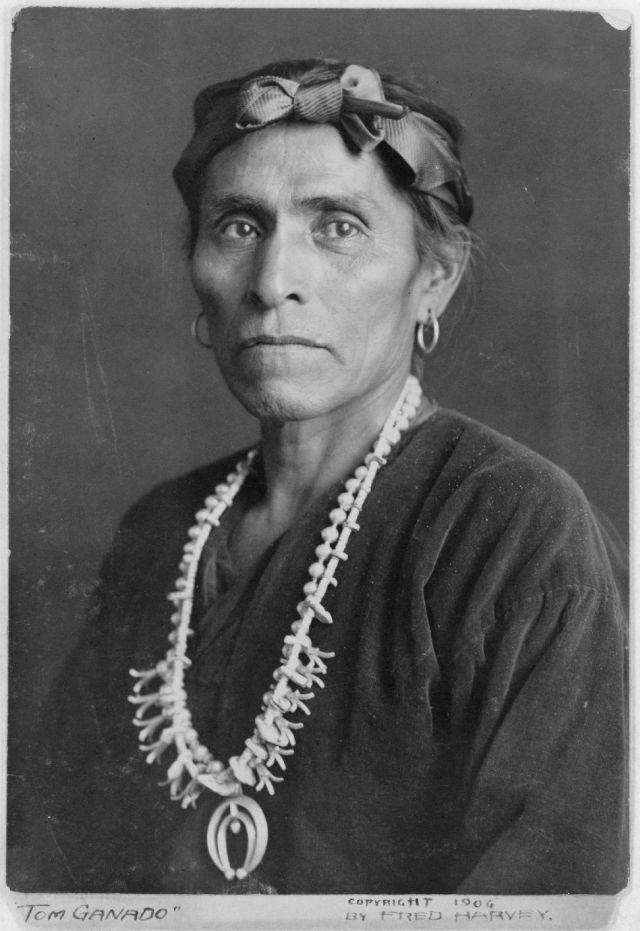
Tom Ganado or, “Mail Carrier” – Navajo Man

Tom Ganado  apparently interacted with tourists. Tom Ganado was fluent in Navajo, Hopi, Spanish, and English, which greatly enhanced his value as a freighter for Hubbell (who spoke the same four languages) and the Harvey Company.

Tom Ganado - Navajo Man

Tom Ganado – Navajo Man

Tom Ganado home is in the southern part of the reservation and he can generally be found near the settlement known as Ganado, Arizona. During the past two years Tom and his family have spent the greater part of the time in Albuquerque, where they have been engaged in one of the large stores. These and other Indians who work at this place are well cared for; they live in hogans built by themselves and have frame buildings with stoves that can be used when desired.
Extreme cold has no terrors for the Navaho Indian, as it is an old enemy; they are however, unaccustomed to steam heat. The sudden changes from superheated rooms to the outer cold and dampness are the cause of much sickness, and Tom, though strong and wiry, became a victim of new conditions. He caught a heavy cold and, soon after, pneumonia developed. A consultation was held and he was finally removed to the hospital. The doctors soon had the disease under control, but, owing to his weak condition, he was obliged to remain in the hospital several weeks.

In 1904 the Albuquerque Morning Journal describes Tom and his work:
Tom has been with the Harvey system here for nearly two years, and in that time has become one of the most useful men about the big establishment. He is not merely a picturesque ornament. He works, knows the details of the business thoroughly and but for his frankness in dealing with customers, would make an excellent salesman. Tom, however, sticks rigidly to the truth and has no hesitancy in speaking his convictions accordingly when a prospective customer comes to the curio department. Tom’s opinion of the individual is quietly formed and as quickly announced.
Tom’s interactions with tourists, if accurate, did not reflect the Harvey Company’s view of the ideal American Indian demonstrator, though his industriousness and hard work were valued and remembered in his home community of Ganado.
Navajo People Website Links:
Navajo CultureNavajo HistoryNavajo ArtNavajo Clothing Navajo PicturesNavajo RugsNavajo LanguageNavajo JewelryNavajo Code TalkerNavajo PotteryNavajo LegendsHogan’sSand PaintingNavajo Food Navajo NewsNavajo Nation

Barboncito, Navajo political and spiritual leader

Barboncito,  (1821-1871) was a famous Navajo political and spiritual leader who lived in Canyon de Chelly, had long been known as a peace leader, but he reluctantly turned warrior in 1860. With Carson’s invasion, he was among the first to surrender, but he rapidly experienced a change of heart. Finding his confinement unbearable, he escaped with five hundred others on the night of June 14, 1865. He was hunted by New Mexican militia units, but he avoided capture.
He also was known as Hastiin Hastiin Daagi (“Full-bearded Man”), Bislahalani (“the Orator”), and  (“Beautyway Chanter”). Barboncito was born into the Coyote Pass clan about 1820 and was a brother to Delgato.

Barboncito Navajo political and spiritual leader

Barboncito Navajo political and spiritual leader

American officials awarded authority to Navajos already in possession of some power. Determining leadership at the Bosque Redondo nonetheless proved difficult prior to the summer of 1866. Federal policy was based upon the idea that the government dealt with only a few Indian leaders who would bargain for the tribe.
But at the beginning of the experiment, there were few leaders with enough stature to command respect. Barboncito, known for his tough diplomacy, might have been an early spokesman for the Diné. Shortly after his somewhat early surrender, however, he became disillusioned with Carleton’s utopia and fled eastern New Mexico. Herrero had only a limited following.
As a result, the responsibility of government recognition fell upon Delgadito, who had originally been identified as an “Enemy Navajo,” one of a band of people long noted for their cooperation with Spanish, Mexican, and American representatives. Although he had briefly helped in the fight against the Americans, some doubt remained about his limited resistance during the Kit Carson campaign. He had been instrumental in arranging for the early surrender of himself and several other ricos, a surrender that was suspected of aiding in Carson’s victory.
By the time Barboncito, Manuelito, and Ganado Mucho had reached the reservation, the Bosque Redondo had become an administrative nightmare. Because of its expense, Carleton’s experiment had already come under considerable scrutiny. Investigations by various federal officials had become commonplace, especially after the Sand Creek Massacre of Cheyennes in 1864. One of the most famous of these investigations was a special joint congressional committee headed by Senator James R. Doolittle of Wisconsin. It was not, however, solely concerned with Navajos.
It was thus that Barboncito, Manuelito, and Ganado Mucho were propelled into leadership. These men found themselves  faced with a difficult situation. The Navajos could not afford to be malleable wards. This fact was dramatically illustrated just weeks after Ganado Mucho’s surrender.

 
Navajo People Website Links:
Navajo CultureNavajo HistoryNavajo ArtNavajo Clothing Navajo PicturesNavajo RugsNavajo LanguageNavajo JewelryNavajo Code TalkerNavajo PotteryNavajo LegendsHogan’sSand PaintingNavajo Food Navajo NewsNavajo Nation

Navajo leader Ganado Mucho (Many cattle)

Ganado Mucho, which means many cattle, was born into the Tatsohnii (Big Water) Clan of the Navajo, or Diné (Of the people), and was a Navajo leader during the tribe’s difficult transition to reservation life
Ganado Mucho, like Manuelito, had also retreated to the Grand Canyon and lived among the Coyoteros, but he was a different kind of leader.

Of both Hopi and Navajo ancestry, Ganado Mucho was a cautious man who was inclined toward diplomacy. He was, after all, a wealthy man with large herds of cattle and sheep. His tranquility was, nonetheless, severely disturbed by the unwise actions of the American military in the late 1850s.

Ganado Mucho Navajo Leader

Ganado Mucho Navajo Leader

It would have been unremarkable had Ganado Mucho gone to war, but he did not, even when his fellow leaders did. During the 1859-61 war, he remained at home in his territory west of the Defiance Mountains and maintained neutrality. His policy proved to be successful.

When private New Mexican expeditions marched into Navajo territory in 1862, in search of livestock  and slaves, he still managed to avoid conflict. Kit Carson’s invasion the following year was a different matter, however. Carson’s orders called for the capture of all Navajos.

Already filled with distrust of Anglo-Americans, Ganado Mucho rejected the capitulation of his fellow ricos and retreated. But by the spring of 1866, harassed by Pueblo, New Mexican, and Ute raiders, he had had enough. Ganado Mucho surrendered and was escorted to the Bosque Redondo. Although his arrival at the reservation with his large herds had some of the trappings of a majestic spectacle, it was marked with tragedy, for two of his daughters had been taken as slaves en route.
By the time Barboncito, Manuelito, and Ganado Mucho had reached the reservation, the Bosque Redondo had become an administrative nightmare. Because of its expense, Carleton’s experiment had already come under considerable scrutiny. Investigations by various federal officials had become commonplace, especially after the Sand Creek Massacre of Cheyennes in 1864.

One of the most famous of these investigations was a special joint congressional committee headed by Senator James R. Doolittle of Wisconsin. It was not, however, solely concerned with Navajos. was thus that Barboncito, Manuelito, and Ganado Mucho were propelled into leadership. These men found themselves  faced with a difficult situation. The Navajos could not afford to be malleable wards. This fact was dramatically illustrated just weeks after Ganado Mucho’s surrender.
More than one hundred Comanches attacked the Navajo horse herds. They killed the herders, one of whom was Ganado Mucho’s son, and stole two hundred head. Soldiers managed to locate their trail, pursued them, and eventually engaged them in combat on July 14. The battle, however, was indecisive.

The Comanches fled east, and the soldiers could not keep up. The commander of Fort Sumner, Captain William McCleave, placed picket posts to the east to protect Navajo property and lives, but even McCleave doubted the effectiveness of this defense.
A year later, this spectacle would move Ganado Mucho to rare eloquence. Stricken by personal tragedy, he addressed New Mexican Superintendent of Indian Affairs A. Baldwin Norton in bitter irony. He pointed out that the Navajos had come to the Bosque because they had been promised safety. But what had they gained when their enemies were better armed than they and the army could not protect them?

Ganado Mucho’s immediate instincts remained in character despite his caustic remarks, made after twelve months of rumination. He apparently did not organize resistance or plan an escape; instead, he reluctantly cooperated.

Source: Chiefs, Agents & Soldiers: Conflict on the Navajo Frontier
 

Navajo People Website Links:
Navajo CultureNavajo HistoryNavajo ArtNavajo Clothing Navajo PicturesNavajo RugsNavajo LanguageNavajo JewelryNavajo Code TalkerNavajo PotteryNavajo LegendsHogan’sSand PaintingNavajo Food Navajo NewsNavajo Nation

Navajo Mythology Twins – Monster Slayer

Two of the most important characters in Navajo mythology are twin miracle-performing sons of White-Shell Woman, Ylkaists¡n, chief goddess. This plate pictures the leader of the two the first conceived and the first-born, whose father is the sun. His name means “Slayer of Alien Gods,” from an, alien; ye, gods; to kill. By him, with the assistance of Tobadz­schin, his twin brother, were killed numerous bird, animal, rock, and human monsters, typifying evils, who wantonly destroyed human life.

Navajo Hero Twins Poster

Naayéé’neizghání (Slayer of Monsters) and Tóbájíshchíní (Born for Water) are the Navajo Hero Twins.

Navajo Hero Twins Poster

When the Spirit People came upon this earth from below they made six sacred mountains, four on the distant horizon at the cardinal points and two in the centre, Chaa­li and Tza­lhnahodaa­hla­. On the eastern slope of Chin­li, brought forth as the daughter of Earth and Sky, was born Ylkaiestsan, White-Shell Woman. First Man took her to his home near Tza­lhnahoda­hla, where she matured in twelve days into a beautiful woman with supernatural powers. Later she lived in a home of her own at the foot of this mountain. It was while there that she gave birth to twin boys who became saviours of their people, slaying alien gods who were fast depopulating the earth.

Monster Slayer - Tóbájíshchíní ­ - Navajo

Monster Slayer – Tóbájíshchíní – Navajo

Yalkai Estsa¡n would often lie on the eastern slope of the mountain as the sun rose through the morning, and when the day grew warm would seek the shade of jutting rocks from which trickled shining drops of water. Quite unknown to herself she had conceived one day from the sunbeams and the dripping water. When she became aware that she was to become a mother Yalkaiastsa¡n was made very happy, for she did not enjoy living alone. Soon she found herself the proud possessor of twin boys. The first-born and the stronger came to be known in his youth as Nayainazgana­, Slayer of Alien Gods; the other was always known as Tobadza­scha­ina­, Born From Water. Their prenatal life covered a period of only twelve days, and maturity was attained in thirty-two days after passing through eight changes, one of which came every four days.

At that time the earth was infested with great giants, foreign gods, who were rapidly destroying the people. Of these, Ya­tso, Big God, as large as a mountain, was the only one in human form. The others were Man-eating Bird, Rolling Stone, that crushed all in its path, Tracking Bear, and Antelope, who killed without mercy. Fearing lest some of these monsters learn of the presence of her boys, Yólkai Ä”stsán kept them hidden away on the mountain side, but they chafed under confinement, so she made them bows and arrows and let them play about, but admonished them not to stray far from home. The boys promised to obey, but not long afterward, because in reply to their questions their mother told them she did not know who their father was, they became sulky and broke their promise, going off toward the east. They would go and search for someone who knew. When on a small knoll a long way from home they heard a whispered “Sh-h.”

“Are you afraid, my younger brother?” asked Nayaitnazgana­.

“No!” was the quick response.

Four times they heard the whisper, and then two of the Wind People appeared. “We saw you travelling eastward,” said they, “and came to caution you. The land is cursed with alien gods who kill for pleasure; beware of them! Why do you journey thus alone without your father?”

“Our father! Alas, we know nothing of him and are now starting on a search to learn. Do you know who he is?” asked the boys.

“Yes, the Sun is your father; but if you think to find him you will have to travel far eastward and cross the wide, wide waters.”

Nayaitnazgana­ turned to his younger brother and said, “Sa­tsa­la­, let us go.”

The Sun was then overhead. Being in fact of a holy nature, the boys covered distance rapidly and by mid-afternoon had passed well beyond the limits of their homeland. There they came upon an old woman sitting beside a ladder projecting from a hole. She asked them who they were and whither they were going. They told her to the Sun, whose sons they were, but whom they had never seen.

gend of the Navajo Hero Twins cover

The Legend of the Navajo Hero Twins Book 

Navajo creation story

Books and Posters

The Legend of the Navajo Hero Twins Book Review
Changing Woman Protects Her Sons
The Holy Beings Teach the Navajo Twins Poster
Navajo Winter Storytelling Poster
The Navajo Hero Twins Receive Their Weapons – Poster
Tsidil – Navajo Stick Game
Book Review of  ”The Legend of the Horse”
Legend of the Horse Poster
K’é – Diné (Navajo) Kinship System

Navajo Mythology Twins – Born From Water

This is Born From Water, the second of the twin miracle-performing sons of Yólkaistsán, the White-Shell Woman. His brother is Nayénzgan.

“I pity you, my grandchildren,” said the old woman; “come in here and rest a moment before going on.” She started down the ladder and the boys followed. Twelve ladders were descended before her home was reached. The old woman was Spider Woman, the little grandmother who belonged to the Holy Ones. Her home was well kept, clean and comfortable, and the boys were glad to rest. Said she, “My grandchildren, your journey is long and many trials will beset you before you reach the end. Take these life feathers; they will help you; if difficulties befall you, use them,” and she gave to each two feathers plucked from a living eagle.

Born From Water - Tobadzîschíni­ - Navajo

Born From Water – Tobadzîschíni­ – Navajo

The boys took the feathers, thanked her, and resumed their journey. After travelling a long way they came to a ridge of loose, yellow sand. It afforded poor footing for an ascent, but the boys struggled to the top, only to have the whole side of the ridge slide and carry them back. Three times the bank gave way as they were about to reach its crest; on the fourth trial they bethought themselves of the sacred feathers, and putting them on their feet marched readily over.

They travelled unimpeded then for quite a long distance, in time coming to four rows of tall, thorny reeds with spiked branches. The reeds grew far enough apart to permit travellers to pass into them, but closed whenever the unwary allowed himself to be caught, and he never escaped. The boys marched boldly up to the reeds and started in, then darted back quickly. The reeds closed instantly, but did not catch them. Then they put the life feathers on their feet again and jumped over all four rows.

The next obstacle was a deep canyon with precipitous walls. This, however, was not a serious impediment, for the life feathers, as before, helped them to cross it in one bound. By nightfall the boys had arrived at a broad, beautiful meadow where lived the Wasaka­da, or Grasshopper People, who received them kindly,giving them food and beds for the night. On being asked whither they were bound, the boys replied that they were journeying to the home of the Sun, their father, whom they had never seen.

The Wasaka­da­ cautioned the boys of dangers ahead, and as they were about to depart in the morning gave them little balls of yellow sputum to put in their mouths to prevent poisoning, should they find it necessary to eat or smoke among hostile people, and two sacred wands of turquoise and white shell. Two of the Wasaka­da­ also accompanied them for a time as guides.

They had not been long on their way when they came to a place where the trail ran between two high, smooth-faced bowlders. “These,” said their Wasaka­da­ companions, “are the Bumping Rocks. If you step into that narrow passageway between them they will crash together and kill you.” The boys started as if to enter, but fell back. The huge rocks came violently together, but did no harm. The feint was made three times, and each time the rocks crashed together and bounded back. The fourth time the boys entered they placed their sacred wands of turquoise and white shell across the gap above their heads and passed through, for these held the bowlders apart. As they emerged on the opposite side they saw the Sun rising from his eastern home and he was yet far away.

Soon a wide stretch of water was encountered; so far as they could see there was nothing but water. Here again they used their life feathers and were carried safely over. Four successive stretches of water and land were crossed, and still a fifth sheet of water lay before them. Along its shores paddled many varieties of animals. The boys looked out across the deep and could discern away out in the centre a house of turquoise and white shell, its roof glistening in the sunlight. Certain that it must be the home of their father, they readjusted their life feathers to start across, but found that they had lost control over them. They tried them several times in different places, but to no avail.The thought of not reaching their father’s house when so near filled their hearts with bitter disappointment. Seemingly there was naught that they could do, but they sat and pondered.

Navajo creation story

Books and Posters

The Legend of the Navajo Hero Twins Book Review
Changing Woman Protects Her Sons
The Holy Beings Teach the Navajo Twins Poster
Navajo Winter Storytelling Poster
The Navajo Hero Twins Receive Their Weapons – Poster
Tsidil – Navajo Stick Game
Book Review of  ”The Legend of the Horse”
Legend of the Horse Poster
K’é – Diné (Navajo) Kinship System

Navajo Jewelry and Silversmiths

Among the Navajo Indians there are many smiths, who sometimes forge iron and brass, but who work chiefly in silver. When and how the art of working metals was introduced among them I have not been able to determine; but there are many reasons for supposing that they have long possessed it; many believe that they are not indebted to the Europeans for it. Doubtless the tools obtained from American and Mexican traders have influenced their art.

Portrait of Navajo Silversmith Bai-De-Schluch-A-Ichin (Slender Silversmith) in Native Dress with Silver Necklaces, Concho Belts, Tools and Army Saddle Bag 1883 - Creator: Wittick, George BenPortrait of Navajo Silversmith Bai-De-Schluch-A-Ichin (Slender Silversmith)
in Native Dress with Silver Necklaces, Concho Belts, Tools and Army Saddle Bag
1883 – Creator: Wittick, George Ben

Old white residents of the Navajo country tell me that the art has improved greatly within their recollection; that the ornaments made fifteen years ago do not compare favorably with those made at the present time; and they attribute this change largely to the recent introduction of fine files and emery-paper. At the time of the Conquest the so-called civilized tribes of Mexico had attained considerable skill in the working of metal, and it has been inferred that in the same period the sedentary tribes of New Mexico also wrought at the forge. From either of these sources the first smiths among the Navajos may have learned their trade; but those who have seen the beautiful gold ornaments made by the rude Indians of British Columbia and Alaska, many of whom are allied in language to the Navajos, may doubt that the latter derived their art from a people higher in culture than themselves.

The appliances and processes of the smith are much the same among the Navajos as among the Pueblo Indians. But the Pueblo artisan, living in a spacious house, builds a permanent forge on a frame at such a height that he can work standing, while his less fortunate Navajo confrere  dwelling in a low hut or shelter, which he may abandon any day, constructs a temporary forge on the ground in the manner hereafter described. Notwithstanding the greater disadvantages under which the latter labors, the ornaments made by his hand are generally conceded to be equal or even superior to those made by the Pueblo Indian.

A large majority of these savage smiths make only such simple articles as buttons, rosettes, and bracelets; those who make the more elaborate articles, such as powder-chargers, round beads , tobacco cases, belts, and bridle ornaments are few. Tobacco cases, made in the shape of an army canteen, such as that represented in , are made by only three or four men in the tribe, and the design is of very recent origin.

Navajo People Website Links:
Navajo CultureNavajo HistoryNavajo ArtNavajo Clothing Navajo PicturesNavajo RugsNavajo LanguageNavajo JewelryNavajo Code TalkerNavajo PotteryNavajo LegendsHogan’sSand PaintingNavajo Food Navajo NewsNavajo Nation

Navajo medicine-men (singers,hatáli­)

The medicine-men, who are termed singers,  hatáli­, are a dominant factor in the Navaho life. Like all primitive people, the Navaho are intensely religious, and the medicine-men, whose function it is to become versed in the mysteries of religion, are ever prone to cultivate in the minds of the people the belief that they are powerful not only in curing disease of mind and body but of preventing it by their incantations. Anyone who possesses the requisite ability may become a medicine-man, but owing to the elaborate ceremonies connected with their practices it requires long years of application ere one can attain sufficient knowledge to give him standing among his tribesmen.

To completely master the intricacies of any one of the many nine days’ ceremonies requires close application during the major portion of a man’s lifetime. The only way a novice has of learning is by assisting the elders in the performance of the rites, and as there is little probability that opportunity will be afforded him to participate in more than two or three ceremonies in a year, his instruction is necessarily slow.

The medicine-men recognize the fact that their ritual has been decadent for some time, and they regard it as foreordained that when all the ceremonies are forgotten the world will cease to exist.

Hástin Yázhe (Navaho)

Hástin Yázhe (Navaho)

Hástin Yázhe- Navaho

Photograph 1904 by E.S. Curtis

The most pronounced dread manifested by the Navaho is that derived from their belief respecting the spirits of the dead. It is thought that the spirit leaves the body at death and travels to a place toward the north where there is a pit whence the gods and the animals emerged from an underworld before the first Navajo were created, and which the dead now enter.

Their myths tell of the disappearance of a beautiful daughter of one of the animal chiefs on the fourth day after the gods and the animals came up into this world; diligent search was unrewarded until two of the searchers looked down through the hole and espied her sitting beside a stream in the lower world combing her hair. Four days later death came to these searchers, so that now the Navaho will go to any extreme to avoid coming into contact with spirits of the dead, chinde, which they believe travel anywhere and everywhere at will, often doing evil, but never good. The body is prepared for burial previous to death, and is never touched afterward if it can be avoided.

To the end that the spirit may begin aright its journey to the afterworld, the body is taken out of the hogan through an opening specially made in the wall on the northern side, for the doorway always faces the east. The immediate relatives of the deceased avoid looking at the corpse if possible. Friends of the family or distant relations usually take charge of the burial. A couple of men dig a grave on a hillside and carry the body there wrapped in blankets. No monument is erected to mark the spot.

Before the body is taken out, the hogan is vacated and all necessary utensils are carried away. The two men who bury the remains of the former occupant carefully obliterate with a cedar bough all footprints that the relations of the deceased may havemade in the hogan, in order to conceal from the departed spirit the direction in which they went should it return to do them harm.

The premises are completely abandoned and the house often burned. Never will a Navaho occupy a hogan, and when travelling at night he will take a roundabout trail in order to avoid one. Formerly horses were killed at the grave. So recently as 1906 a horse was sacrificed within sight of a Catholic mission on the reservation, that its spirit might accompany that of a dead woman to the afterworld. This horse was the property of the woman, and her husband, fearing to retain it, yet not daring to kill it himself, called upon another to do so.