Story Telling – Navajo Language Lesson


Story Telling - Navajo Language Lesson

1-NAHANI'

STORY TELLING
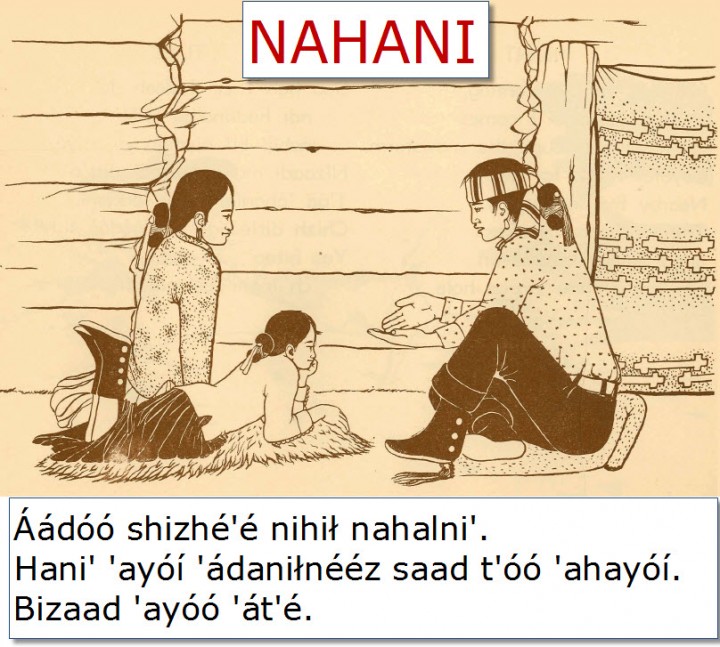
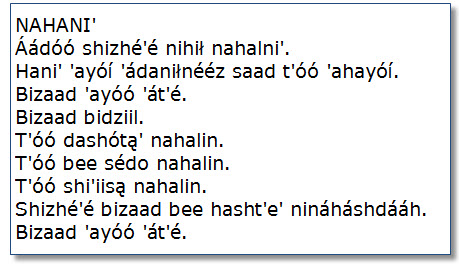
Then my father tell us stories.
Long stories made up of many words.
His words have power.
They have strength.
They seem to hold me.
They seem to warm me.
They seem to feed me.
My father’s words, they comfort me.
His words have power.


More Navajo Language Lessons


Navajo People Website Links:
Navajo Culture – Navajo History – Navajo Art – Navajo Clothing Navajo Pictures – Navajo Rugs – Navajo Language– Navajo Jewelry – Navajo Code Talker – Navajo Pottery – Navajo Legends – Hogan’s – Sand Painting – Navajo Food – Navajo News – Navajo Nation


Build a Fire – Navajo Language Lesson

They will build a fire to melt snow into water to give to the sheep
My father blows on his hands to warm them

Build a Fire - Navajo Language Lesson

They will build a fire to melt snow into water to give to the sheep.
It takes much wood to make a fire to melt snow into water,
but if the sheep have water to drink they do not hunger so much.

My father blows on his hands to warm them.
His breath looks like smoke.
My father shreds juniper bark to start the outdoor fire.
He takes a lighted stick from our fire. ‘
He takes it outside..
He puts it under the bark and the dry wood, and kneeling down he blows on it.
Soon a small flame comes

Source : “Little Herder in the Winter” by Ann Clark 1940
Illustrated by:

Hoke Denetsosie
Linguistics by:
John P. Harrington
Robert W. Young


Navajo People Website Links:
Navajo Culture – Navajo History – Navajo Art – Navajo Clothing Navajo Pictures – Navajo Rugs – Navajo Language– Navajo Jewelry – Navajo Code Talker – Navajo Pottery – Navajo Legends – Hogan’s – Sand Painting – Navajo Food – Navajo News – Navajo Nation
The Dogs are Hungry – Navajo Language Lesson

The Dogs are Hungry - Navajo Language Lesson

THE DOGS ARE HUNGRY
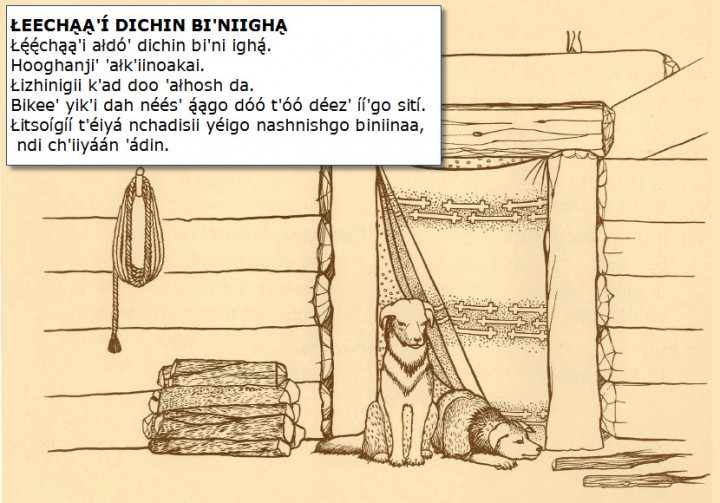
The dogs are hungry, too.
They crowd in the hogan.
The black one is not sleeping now.
He lies with his head t on his paws and looks at nothing.
The yellow one whimpers.
He has worked hard, but there is no food.

Source : “Little Herder in the Winter” by Ann Clark 1940

Illustrated by:
Hoke Denetsosie

Linguistics by:
John P. Harrington
Robert W. Young

The Four Navajo Sacred Mountains

Mount Blanca (Tsisnaasjini’ – Dawn or White Shell Mountain – East
Mount Taylor (Tsoodzil – Blue Bead or Turquoise Mountain) – South
San Francisco Peaks (Doko’oosliid – Abalone Shell Mountain) – West
Mount Hesperus Dibé Nitsaa (Big Mountain Sheep) – Obsidian Mountain – North

Navajo People Website Links:

Navajo Culture – Navajo History – Navajo Art – Navajo Clothing Navajo Pictures – Navajo Rugs – Navajo Language– Navajo Jewelry – Navajo Code Talker – Navajo Pottery – Navajo Legends – Hogan’s – Sand Painting – Navajo Food – Navajo News – Navajo Nation

There Is No Food – Navajo Story


There is no food  - Navajo Story

 There is no flour nor cornmeal to make into bread,
‘There is no coffee that my mother could boil for us to drink.

There is no food.
The corn my father planted in his field is gone.

We ate it.
There was so little.
The corn pile in the storehouse was not high enough to last for long.
It is gone.
Now all of it is gone.
There is no food.
There is food at the Trading Post in sacks and in boxes, in bins and in cans on the shelf.

There is food at the Trading Post, but the Trading Post is far away and snowdrifts and snow clouds are heavy between

There is food at the Trading Post but my father has nothing leftof the hard, round money that he must give to the Trader for the food:
There is no food here in my mother’s hogan.

Then it is time to eat, we talk of other things, . but not of hunger.
This thing called hunger is a pain that sits inside me.
At first it was little, but now it grows bigger and bigger.’
It hurts me to be hungry.

Source : “Little Herder in the Winter” by Ann Clark 1940

Illustrated by:
Hoke Denetsosie

Linguistics by:
John P. Harrington
Robert W. Young

Navajo People Website Links:
Navajo Culture – Navajo History – Navajo Art – Navajo Clothing Navajo Pictures – Navajo Rugs – Navajo Language– Navajo Jewelry – Navajo Code Talker – Navajo Pottery – Navajo Legends – Hogan’s – Sand Painting – Navajo Food – Navajo News – Navajo Nation

Olympics – Navajo Language Word of the Day Video

Source: Terry Teller (daybreakwarrior)
http://www.youtube.com/user/daybreakwarrior/featured

The Navajo Word of the Day is “Olympics”.
The word in Navajo for olympics is “Ahaa Honinééh.” To use this word in Navajo, you would say, “Ahaa Honinééhígíí éí London hoolyéedi baa na’aldeeh.” This means, “The Olympics are being held in London.” Breakdown:

Ahaa Honinééhígíí: The Olympics
Éí: it
London hoolyéedi: at the place called London
Baa na’aldeeh: it is being held

Since I hadn’t been updating my Navajo Words of the Day like I should, I added a new word today, “Alha’dikááh,” which means, “a lot of people racing side by side.” This is more of a term for a foot or running race, but it can also be used for other events. For example:

Dzi’izí (bike) Bee (by means of it) Alha’dikááh: Competitive Cycling
Na’alkóó?’ (swimming) Yee (by means of it) Alha’dikááh: Competitive Swimming

Here are different ways you can use these words in sentences:

Ryan Lochte éí Na’alkóó’ Yee Alha’dikááh yee atah.
Ryan Lochte is competing in the swimming event.

Taylor Phinney éí Dzi’izí Bee Alha’dikááh yee atah.
Taylor Phinney is competing in the cycling event.

Again, just a few words to share since the Summer Olympics are currently being held! Enjoy!

Navajo Word of the Day: Fireworks (Video)


Since today is July the 4th, I figured a good word to use would be “fireworks.” To say fireworks in Navajo, you can say it one of two ways, “naaltsoos dildoní” or “naaltsoos dilchxoshí.” Naaltsoos means “paper” and dildoní means “the one that explodes.” In the same way, dilchxoshí means “the one that pops,” just like our past word of the day for popcorn, “naadáá’ dilchxoshí ,” for “corn that pops,” or “tó dilchxoshí” for soda pop (popping water).

To use it in a sentence, you can say “Ya’iishjáástsoh yizilígíí’ biyi’ díí’góó yoolkáálgóó naaltsoos dildoní da’dildon leh,” which means, “On the 4th of July, people usually pop fireworks.”

The breakdown:
Ya’iishjáástsoh: July
Yizilígíí’: that month
Biyi’: in it
Díí’góó: the 4th
Yoolkáálgóó: on that day
Naaltsoos dildoní: fireworks
Da’dildon: they pop/explode them
Leh: usually

Enjoy this word of the day & Happy 4th of July! 🙂

Rodeo Terminology in the Navajo Language – Video

Rodeo, or known as Ahóóhai in the Navajo language, is a very popular sport on the Navajo reservation. Since many Navajos have cattle, it’s not suprising that Navajos undertaken this competitive sports event. This video basically covers the names of the events in Navajo, both timed and rough stock events. This video also covers the names of key individuals involved in a rodeo, for example:

Akalii: Cowboy:
Dóola Bil Naalgeedígíí: Bull Rider
Hastiin Lá At’ínígíí: Rodeo Clown
Bil Nída’algeedgo Nídayiiláhígíí: Pick-Up Man


The term “rodeo” in Navajo comes from the word “Naa’ahóóhai,” which means “chicken” in Navajo. Rodeos on the reservation initiated around a “chicken-pull.” Over time, this word got shortened to “ahóóhai,” and rather than being named after chicken pulls it became the term for “rodeos” as rodeos got popular on the reservation. Also, some people will use the term “Naa’ahóóhai” or “Ahóóhai” for agricultural shows; tribal, county, or state fairs.

The names of the rodeo events in Navajo:

Líí’ T’áá Dilkoohgo Naalgeedígíí: Bare Back

The breakdown:

Líí’: horse
T’áá Dilkoohgo: in a smooth manner (i.e. without a saddle)
Naalgeedígíí: the one that is bucking

Líí’ Bik’ídahaznilgo Naalgeedígíí: Saddle Bronc

The breakdown:

Líí’: horse
Bik’ídahaznilgo: things are set on it (i.e. it is saddled)
Naalgeedígíí: the one that is bucking

Béégashii Alts’áá’ Wódleehígíí: Team Roping

The breakdown:

Béégashii: cow
Alts’áá’: on each side
Wódleehígíí: the one where it is roped

Tóshjeeh BinaagoL?íí’ Náádadiilwo’ígíí: Barrel Racing

The breakdown:

Tóshjeeh: barrel/water container
Binaago: around it
Líí’: horse(s)
Náádadiilwo’ígíí: the one where they run around

Béégashii Yáázh Wódleehígíí: Calf Roping

The breakdown:

Béégashii: cow
Yáázh: the little one (i.e.calf)
Wódleehígíí: the one that is roped

Béégashii Bik’os Náágisgo Nehe’nílígíí: Steer Wrestling

The breakdown:

Béégashii: cow
Bik’os: it’s neck
Náágisgo: it is turned
Nehe’ní?ígíí: the one that is taken down

Dóola Naalgeedígíí: Bull Riding

The breakdown:

Dóola: bull
Naalgeedígíí: the one that is bucking

Béégashii Yáázh T’óó Yisdlohígíí: Ladies’ Break-Away

The breakdown:

Béégashii: cow
Yáázh: the little one (i.e. calf)
T’óó: merely
Yisdlohígíí: it is roped

Since rodeos have become a key fixture in Navajo culture, I had to include this video in my series of Navajo language terminology! Enjoy, and hopefully if you hear these terms at a rodeo on the reservation, you won’t be too confused anymore! 🙂

This video was filmed at Double “R” Ranch, in Round Rock, AZ

Source: Daybreak Warrior (Terry Teller)
http://www.youtube.com/user/daybreakwarrior/featured

Navajo “Baby Names” & Navajo Naming Concepts (Video)

Video by Terry Teller (Daybreak Warrior)

Terry says:
“I get e-mails and YouTube messages saying, “I am having a baby and want to give my child a Navajo name. Can I name them such & such?” Or, “How do you translate this into Navajo for a Navajo name?” It’s kind of hard because although you’ll have a name written all cool, you may not be pronouncing it correctly or it may not flow with the general concepts that go behind the “typical” traditional Navajo names.”


See more Daybreak Warrior Videos here:
http://www.youtube.com/user/daybreakwarrior